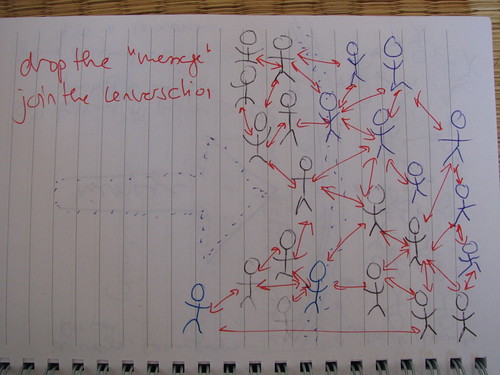
How Blogging Brings Dialogue to Corporate Communications [en]

[fr] Notes d'une conférence que je viens de donner à Zurich sur les blogs en entreprise.

As promised to the participants of this (Monday) evening’s event, here is my slideshow of the talk, notes, and links. note: notes written up on the train on the way home, I hope the links aren’t too broken and that it makes sense; let me know in the comments if there is anything weird.

Thanks to everyone for participating so well 🙂 Please feel free to add notes, comments, further questions, things you took away from the talk in the comments to this post.

note: the beginning of the notes are roughly what I said; questions and answers are not included — there were lots; I gave an accelerated version of the second part of the presentation, as we had talked a lot, and actually, covered much of what was important anyway.

For links related to corporate blogging, see those tagged corporateblogging and 20070924 for those linked to today’s talk. Click on the “related tags” on the right to explore further.

I’ve added slide numbers in brackets roughly when they appear. Not that the slides are that interesting, of course…

[1] [2] Blogging is a tool that brings dialogue, and the point of this talk is to see how that happens in a corporate context.

[3] Two main aims:

  • understanding the “bigger picture” blogging is part of
  • practical advice on introducing blogs into a business setting.

[4] As you’ve probably noticed, I’m not a Powerpoint wizard, so won’t be dazzling you with fancy slides and lots of buzzwords. I’d like to have something approaching a conversation with you. I’m obviously expected to do quite a lot of the talking (that’s what I was asked to come for!) — but you know lots of things I don’t, and you’ll have comments and questions. Please ask them as we go along… I’d rather go off-track from my presentation and be sure to address the things you’re wondering about. note: and yeah, that’s exactly what happened! got so caught up in our conversation that I lost track of time! This way of doing things, you’ll notice, is related to what blogging is about.

[5] First, I need to know a bit more about you. I know you’re communication executives and I’m told you’re already familiar with blogs — that’s a start, but I need more:

  • who reads blogs?
  • who has a blog? (personal, corporate, work-related?)
  • who is blogging this talk? (nobody — hopefully in 2 years from now, half the room)
  • who uses a feed-reader (NetNewsWire, BlogLines, Google Reader)
  • who is in a company that uses corporate blogs?
  • who has employees/clients who blog?
  • who has read The Cluetrain Manifesto? Naked Conversations? (required reading!)
  • who is in a company that is blogged about? do you know?

[6] Before we get to the meat (practical stuff), let’s clarify

  • what is blogging?
  • where does it fit in?

There’s a lot of confusion there.

Blogging is:

  • a tool/technology
  • a culture
  • from a business point of view, a strategy

Different layers.

Blogs@Intel · Intel Corporation

[7] Using just the “tool” layer often fails, because it’s just publishing “official communications” in a different wrapping. And official communications are boring — I hope I’m not breaking the news to anyone. Example of this: blogs.intel.com. Not very exciting.

I think a lot of corporate blogging failures can be attributed to stopping at the “tool” aspect of blogging, and underestimating the cultural aspects.

Listening and Learning Through Blogging

[8] Example that gets the “culture” layer: Listening and Learning Through Blogging on McDonalds’ CSR blog.

I’ve just finished my second posting, and I’ve realized how much there is to learn about the blogosphere. I’ve spent a lot of time looking at other blogs, listening to what others are saying about what we’re doing, and picking up some suggestions along the way. (McDonalds’ CSR blog)

From a business point of view, adopting blogging is a strategic decision, because it impacts the culture. It’s not just a shiny tool we can use to do the stuff we do usually, it’s linked to deeper changes.

[9] So we’re going to concentrate on the “culture, strategy” side of blogging, which is the first part of this presentation. So we’re going to have to backpedal, zoom out, and look at the big picture: [10] The Internet, The Cluetrain Manifesto.

So, what’s the Cluetrain about? It started as an online rant, and grew into a book in 2000. It’s still valid today.

Basically, the Cluetrain says that conversations are happening, inside and outside your organization, and they can’t be stopped.

[11] People are tired of being talked at. They (inside: employees; outside: customers) are too busy having [12] real conversations with their friends, people they know and trust. Offline as well as online. They won’t listen to fabricated discourse (a lot of marketing). I know that when I receive my bank statements, I’m interested in how much I’ve spent, and the flyer giving details about my bank’s latest service goes straight to the bin. What about you?

[13] These conversations are everywhere. They’re talking about you — you the companies. A lot of our day-to-day conversation is about brands, consumer products, services… These conversations [14] can’t be controlled. Control is a big issue when it comes to corporate blogging.

Is communication something you control?
Are conversations something you can control?

[15] We know how important word-of-mouth is in marketing, and in the shaping of buying decisions we make. We listen to our friends (people we trust) way more than advertising.

Do great stuff. Care. Let people know. They’ll talk about you.

[16] Blogging is about jumping in there, being part of the conversation. And this conversation is bigger than just blogging.

Not that easy, but not that hard: remember what it is to be human. To be passionate about something. To care. Bring that into the conversation.

So the important question becomes: how will this fit into my corporate culture — or not? Is it compatible?

[17] What I mean by corporate blogging: blogging that has to do with corporations, businesses. Blogging beyond the tool (culture). Everything is possible.

  • internal
  • external
  • one author
  • multiple authors (group blog)
  • very official
  • unofficial
  • employee blogs
  • news outlet (with the danger of missing the “culture” and falling back into the “just tool” use)

[18] Some quick examples of real “corporate” blogs. A lot of damage control in my examples — one thing blogs are good at.

[19] Who should blog?

Corporations do not blog. Humans do, people. You can’t remove the person from the blog. Businesses with a “do the right thing” attitude. Enthusiasm needed! [20] Bad guys shouldn’t blog. Businesses who mistreat customers and employees shouldn’t either. Not if you’re dull or cheesy or very controlling. (See Naked Conversations, pp. 134-138.)

[21] Why should one blog? Very important question.

  • to communicate differently, humanise the company
  • not just another channel to push the same tired message through.

Where does blogging fit in strategically? => who, what exactly…

See possible objectives here. Basically, anywhere there are people doing things. Except probably high-confidential security stuff.

[22] How?

You want to get blogs going for all the good reasons, but how does one

  • start blogging [23]
  • blog well? (ongoing work!)

No real “one size fits all”. Many answers to this, depends on the situation/culture of the company in question.

Some general answers, however.

[24] Check out the corporate blogging 101, very precious stuff there.

enable blogging. Encourage employees to blog. Blogging is a grassroots phenomenon, but it needs support form the top. There are maybe people already blogging — find them, and use them to encourage more blogging.

[25] have a purpose (that important Why? question). Don’t blog to blog. Figure out what current needs can be adressed by blogging. You can start small:

  • event?
  • product?
  • “news”?
  • project?
  • office life?
  • expertise on one topic?

This is very context-dependant. Need to understand the context well to be able to choose/advise wisely.

Careful! If you’re using a blog to post the usual “official communications”, you’re missing something.

[26] learn the culture: this is the big bit. Listen to bloggers (online and offline, in-house and out). Get training (this is where it’s worthwhile to put your money, as you’ve saved on expensive software).

Before going to India, I studied the culture, but it couldn’t prepare me totally for what I found when I went to live there. You need to go to a foreign culture to really “get” it. Blogging is a foreign culture.

Learning to blog well can take time. Not everyone is a natural. Ongoing effort!

[27][28] Remember, blogging is about Me & You, having a conversation.

  • dialogue
  • relationship
  • people

[29] Listen. Read blogs. Read comments. Be open. Get a feed-reader.

[30] Passion. Believe. Be passionate. If you’re not interested, it’ll be boring.

[31] Style. HUGE subject. How to write on a blog. It’s difficult.

  • write for the web
  • use “I”
  • use links, make your writing 2D instead of 1D
  • informal
  • short paragraphs
  • simple, direct language
  • no jargon or corpspeak
  • tell a story, as if to a friend
  • author name, but don’t sign posts like e-mail

[32] Time. Don’t kid yourself, it takes time. Commitment. Easily an hour a session, a few times a week. But it’s fun 🙂

If you try to remove any of these ingredients, I doubt your blog will be successful and survive.

Best practices?

[33] DO:

  • eat your own dog-food
  • trust your bloggers
  • read other blogs
  • be part of the community
  • use a feed-reader
  • link! even to competition, negative stuff
  • be human
  • learn the culture
  • use an existing blogging tool
  • discuss problems
  • define what is really confidential
  • give existing in-house bloggers a role (evangelists! learn from them!)
  • tag, ping, use the “kit” and other social tools

[34] DON’T:

  • try to control
  • use a ghost-writer or outsource blogging
  • “roll your own” tool
  • ignore established blogging conventions, they’re there for a reason
  • copy-paste print material in posts
  • use corpspeak
  • force people to blog
  • write happy-clappy stuff
  • write blog posts or comments as if they were e-mails (starting with Hi… and ending with a signature)
  • be faceless (signing with the name of the company instead of the person)

[35] FUD: fear, uncertainty, doubt. Cf. Naked Conversations pp. 140-145 for discussion, really, it’s all there:

  • negative comments
  • confidential leaks
  • loss of message control
  • competitive disadvantage
  • time-consuming
  • employee misbehaviour
  • ROI absent…

[36] ROI of blogging (google for “ROI blogging” — without quotes). Comes up often (need for quantitative measurement), but still very debated topic. Respected experts all over the map, from “it doesn’t/can’t apply” to “here is a way to calculate it”.

Distinguish:

  • hard returns
  • soft returns

There is a return, it’s a worthwhile investment, say those who do it. How to measure it is another story. Sorry 🙁

[37] A closer look at some examples… coComment [disclosure: ex-client]:

coComment blog -- Corporate Blogging Example

[38] Read the first sentence… what is wrong here? Not a human speaking. Don’t post press releases as blog posts. You might cite them, or link to them, or comment on them, but don’t stick them in there as posts. How does the reader think his “feedback” will be received when he’s being spoken at to start with?

coComment -- Corporate Blog Example 1

[39] Privacy concerns raised on other blogs. Good to address the issue and respond, instead of hiding! (it would just get worse… cf. Kryptonite). “Click here” looks bad, though, and hints that the medium (blogging) isn’t really understood.

coComment blog -- Corporate Blogging Example

[40] OMG. What is this doing here? Did somebody smoke something? First-time author on this blog — an introduction would have been more appropriate.

coComment blog -- Corporate Blogging Example

[41] Note that this is a multi-author blog, which is usually the case with an “official blog”, though often there will be one “main author” who carries it. Apology for painful upgrade, that’s good. E-mail-like signatures on each post, however, again point to incomplete understanding of the culture.

Flickr: great example (and great photosharing service too, sign up today).

Flickr Blog -- Corporate Blog Example

[43] Look at that outage notice. It’s fun! Really fun. And there are updates. Two of them. As a user/customer, I feel that they give a damn.

Flickr Blog -- Corporate Blogging Example

[44] Coverage of what’s going on in the community. Blogging is a lot about community, nurturing it.

Flickr: it's not just blogging

[45] Here, a forum post. It’s not just about blogging, remember the “bigger picture”? But same kind of attitude. How you engage with others in the community. Treat them as people and not like numbers. Look at how well this issue is documented, with links and all — and this is a “problem situation”. We’re not shoving the dirt under the carpet here.

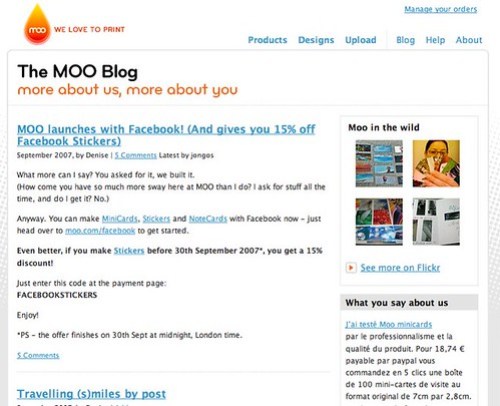
Moo note: if you got a business card from me, this is where they come from!
MOO | Blog -- Corporate Blogging Example

[46] So, this is a promotional posting (ad, marketing, oh my!) but look… it feels like she was e-mailing a friend, rings true.

Up for debate (bloggers will tell you “yes”): can you feel if somebody put his/her heart into a post?

[47] Closing notes:

Blogging is a strategy. Deep change in communications. Not pushing a message anymore, but

  • conversations
  • relationships
  • trust
  • people

The question to ask is:

Is my company/department/team ready for this?

Blogging is a grassroots phenomenon, so bottom-up (you can’t force people to be passionate about something and blog about it), but needs support from top-down. There are maybe already blogs in your company, and you might not know it!

Read The Cluetrain Manifesto and Naked Conversations to start. (I’m serious.)

Eat your dog food. If you’re going to introduce blogging in your company, you need to start blogging — before. Open a WordPress.com account and start writing about stuff you’re interested in. Use your blog as a backup brain, writing things as they occur to you. For you first, and for sharing with others in case it’s of interest to them.

Blogging is technically cheap, but culturally expensive.

[48]

Some extra stuff, off the top of my head (some from off-presentation discussion):

Blogging tools: WordPress, Movable Type and Typepad (SixApart), Drupal.

Looking up stuff in blogs: use Technorati or Google BlogSearch. Use Technorati Cosmos to see who linked to a given blog post.

The “Because Effect”: I make money because of my blog, not with my blog.

Discussion of trust and reputation in the blogosphere. Auto-regulating medium.

A few sketches I made while preparing this talk, but didn’t use:

Cluetrain 101 Sketch 1

Cluetrain 101 Sketch 2

Cluetrain 101 Sketch 3

Open-sourcing the invitation copy.

Good example of an “event blog”: LIFT conference (and go to the conference, too, it’s a great event).

promotional 😉 note: if you would like to have me come and give this talk (or another!) elsewhere, please don’t hesitate to get in touch. This is one of the things I do for a living.

Finally Getting Tumblr [en]

[fr] Un tumblelog, c'est un blog réduit à sa plus simple expression: des articles, des liens permanents, un fil RSS. Pas de commentaires, pas de gadgets, pas de tags, pas de catégories. Un bookmarklet permet de facilement choisir entre six sortes de billets prédéfinis (texte, citation, lien, photo, chat, vidéo) et devine même pour vous si vous le cliquez depuis une page web.

C'est un lieu idéal pour bloguer en passant, au fil des lectures. Noter une idée en vitesse. Mettre en valeur une photo ou une vidéo qu'on a appréciée. Prendre des notes sous forme de citation lorsque l'on lit.

I’ve had a tumblelog since February of this year, but it’s taken me a long time to figure out where it fit into my online presence.

I first tried importing everything into it, but that was a mess. Jaiku is better when it comes to lifestreaming, for the moment. (Wow, just checked, and Suprglu’s still alive — head there if you want the “fuller” version of my lifestream… with the lag, though.)

Anyway. This is what I publish on it nowadays: comments from other blogs, screenshots, quotes, and passing thoughts.

Let’s take a closer look.

What on Earth is This Tumblelog Thing?

A tumblelog is a blog stripped of all the non-essential stuff: no categories, no comments, no monthly archives, no fancy layouts, widgets. What is left? Posts, permalinks, RSS feeds… and a simple, no-nonsense layout.

Tumblr

Back in 2000 when I started blogging, the revolutionary thing about blogging tools (which at the time meant Blogger, there weren’t that many others) was that they made it dead easy to publish things online.

Tumblr has focused on that. Make it simple. Remove everything that gets in the way. Make the act of blogging so effortless that it can really become a true backup brain.

It’s a place for passing thoughts, interesting links, a video here or there. No time lost for anything else than the act of posting. Whatever you do, don’t think before posting.

A tumblelog is really a “me first!” thing. Stuff for me, first. Maybe you’ll find it interesting too — but if you don’t, no heat.

What I’m Importing

Tumblr Feed Settings

At the beginning, as I said, I imported everything into my Tumblr. But then, I wanted to import my Tumblr into my lifestream on Jaiku, and I ended up with duplicate content.

I decided to remove all my imports from Tumblr except for comments — through coComment. Comments on other people’s blogs are an important part of my online activity, and they deserve to be “kept” somewhere. CoComment does that, of course, but not in a really comfortable way for readers (the RSS feed is fine, and included on my blog, but it’s only the last comments). Reminds me that I never wrote that post about the disastrous launch of the 2.0 version, btw. Oh, well.

So, my comments go in my Tumblr.

During my stay in San Francisco this summer, I was converted (quite easily) to Skitch by Mr. Messina, and since then, my flickr photostream has seen the arrival of a great many screenshots. I feel like I finally have a camera to take photographs of my online life — as soon as I see something of note or bump into a problem, Skitch allows me [http://flickr.com/photos/bunny/tags/skitch](effortlessly upload a screenshot).

These screenshots are a narrative of my online wanderings, and as such, deserve to be displayed in a timeline separate from my thousands of photographs.

In the Tumblr they go.

What I’m Posting

So far, I’ve found two really important uses to Tumblr: quotes and thoughts. The Tumblr bookmarklet is smart enough that it recognizes that I want to post a quote if I select some text on the page before clicking it:

Posting a Quote to Tumblr

This makes posting quotes dead easy. It’s suddenly made my online reading way more valuable: I’ve always read books taking notes on what I was reading, copying quotes so I had them handy in the future — and when a lot of my reading shifted online, I lost that. With Tumblr, I’ve found it again. (Finding the quotes will be trickier, I hope Google’s indexing of the Tumblr will be sufficient.)

The Tumblr Dashboard has six pre-set types of posts: text, photo, quote, link, chat, video.

Tumblr Dashboard

These pre-set post types offer different formatting and posting forms.

I’ve started to use the text post type to jot down random thoughts that occur to me, or notes to myself. For example, I’ve spent quite a bit of today thinking about a talk I’m going to give tomorrow, and jotted down some thoughts like this one.

As you can see, Tumblr allows me to link to an individual post.

A few times, I’ve also posted snippets of chat/IM conversations.

Satisfaction Looks Neat [en]

[fr] Un outil de "customer care" qui permet d'une part aux "clients" de s'entre-aider, et au personnel de participer à la conversation. Ça semble vraiment pas mal! Quelques petits problèmes après 20 minutes d'utilisation.

I read about Satisfaction yesterday somewhere and saw it again today in Brian Oberkirch’s blog. I went to sign up and give it a quick toss around. Here are the first screenshots.

The nice thing is that as this is a support tool, I used it to record the problems I bumped in too.

Satisfaction: submitting a problem_idea_question_chat

I think it’s a pretty neat tool and I’m going to use it in future when I bump into problems, in addition to posting them to Flickr with Skitch. It’s community-based support, but with an option for company employees to participate with a “label” that identifies them as staff.

The first thing that annoyed me was that I had trouble finding where to change my profile photo. I clicked on “Account” and expected to find something there, but in fact it’s under “Dashboard”.

Satisfaction -- change image

Here is the topic I created about this problem.

Next issue, a rather important workflow/design flaw:

Recently active topics in Satisfaction Unlimited about Satisfaction Beta Release

I was a bit wordy in explaining it (early Sunday morning here), but I hope this makes sense:

Ideally, when fill in the first “chatbox”, I’m going to want to check out the links before saying “not quite right, want to add details and submit”.

Unfortunately, once I’ve done that, it seems I can’t come back to the page with the link inviting me to “add details and submit”.

That doesn’t encourage me to click the links and check out first! It encourages me to go straight to “add details and submit”.

So, if those links are really expected to be useful, encourage me to click on them by providing the “add details and submit” form on them too.

Last but not least:

Get Satisfaction: two gripes

  1. If you’re telling me that I’m set to receive e-mail updates, that’s really nice of you — but it would be even nicer to give me a link to where to change it.
  2. Please, please, please. Space-separated tags. At least support them. I’ve talked about this elsewhere (and before, too, but I can’t remember when or where). It breaks the current input model we’re used to (del.icio.us, Flickr…). It makes us type an extra character.

Go try out Satisfaction!

Tag-Related Wishlist [en]

[fr] Mes idées/prédictions/désirs pour l'évolution des tags et des technologies associées.

I told you my mind never stops spinning, didn’t I? Here are a few follow-up thoughts on my previous post on tags. View this as my brain dump of what I’d like tags to do in WordPress and around.

Bear in mind that I haven’t tried 2.3 yet, don’t know exactly what it does and doesn’t do, and haven’t done much homework. So (hopefully!) some of the stuff I’m speaking about here already exists. If it’s the case, please leave a note with a pointer in the comments.

Some of the stuff here might also be stupid. If it is, please tell me.

I don’t think all this should necessarily be in the WordPress core. Plugin makers, feel free to delve in here for inspiration. If I like your plugin, I’ll plug it.

Links Between Tagspaces

So, based on what I’ve understood, WP2.3 will provide a local tagspace. This means that if I tag a post “cat”, the link on that tag will take me to something like myblog.com/tags/cat. That’s cool.

But I want more.

I want the myblog.com/tags/cat page to contain configurable pointers to other tagspaces. For example, my Flickr photos tagged “cat”. My del.icio.us links. My videos. The Technorati tagspace.

See what I mean?

Somewhere, WordPress would ask me “What other tagspaces would you like links to?” and I’d enter “http://flickr.com/photos/bunny/tags/”, “http://del.icio.us/steph/”, “http://www.viddler.com/explore/steph/tags/”, “http://technorati.com/tag/” in some pretty form (we know how to do those now, don’t we?)

Alternate Tagspaces

Some people may not want to use the local tagspace. Hell, most people who tag their posts right now point to the Technorati tagspace. An option to do so could be nice.

Tag Combinations

I’d like my local WordPress tagspace to allow tag combinations. This is the stuff I wrote about nearly 3 years ago. Del.icio.us does it: here are my links tagged “books” AND “read”.

We need more of this, particularly if we start thinking multilingual. I want to be able to point to a page containing posts I tagged “adolescents” OR “teenagers” OR “ados” or “teens”. I use all those, but I’m sure (given the nature of tagging) some posts have slipped through the cracks and have only one or two of these tags.

Less multilingual, maybe I just want to have “cats” or “cat” (sometimes I use plural, sometimes singular, and the distinction isn’t important to me in this context).

Related Tags

Del.icio.us does this. My local tagspace pages should have this feature too.

And how about an option to be able to see (in a click) posts tagged “cat” AND all the posts tagged with one of the related tags? (This could become a bit unwieldy though.)

Tag Management

The “obvious” stuff. Rename tag “stephaniebooth” to “Stephanie Booth” everywhere it is. (Flickr does this well.) Merge tags. Add a bunch of tags to all the selected posts (result of a search or by-category selection). Remove tag X from all posts which are tagged Y.

This is the kind of stuff I wanted to make possible for categories when I wrote Batch Categories, a lifetime ago. I haven’t touched this “hack” for years now, and I’ve heard conflicting information about its compatibility with recent WordPress versions. I think somebody somewhere updated it for WP2.x — if you search you might find it.

Public Tagging

Now, this would be a source of tag spam, unless it’s for example limited to registered users of the blog, or people identified by OpenID or on a “trust list” (e.g. people who have commented on the blog before). I’ve encouraged people to open up tagging to the community on Flickr, and the feedback from those who have done it has been great. I’d like a way to do this for my blog posts, too.

I’m sure structured portable social networks have a part to play here.

More Importing/Conversion

Ages ago, I added keywords to my blog posts. (I now know it’s not very useful — maybe even, not at all.) Around the same time, I used Topic Exchange Channels for some of my posts, making the ITE channel visible on the post by adding a link to it (gosh, come to think of it — I hadn’t heard of tags yet, but what I was doing was some form of proto-tagging… quite impressed with myself!)

Anyway, leaving the self-congratulatory stuff aside, my wp_postmeta table contains old information about posts which has long since disappeared from this blog, but which is still there, ready to be recycled. I could turn those old keywords and ITE channels into tags with an importer.

So, how about a very “customizable” importer? I would give the meta field name I want to convert to tags, and indicate if the tag data is comma-separated, space-separated, or simply placed in multiple fields.

(For my old keywords, there is one meta field called “keywords” which contains a comma-separated list of words, whereas for the ITE channels there is one entry per channel called “ite_topic” (IIRC) with a unique word as a value — but there can be more than one channel per post.)

So, “manual importer”, anybody?

That’s All, Folks!

There, I think I’ve told you what was on my mind. Feedback welcome. And plugins. Code. Solutions.

WordPress Finally Has Tags! [en]

[fr] Après des années d'errance, WordPress implémente enfin un système de tags qui ne sont pas des catégories. Un billet un peu plus complet en français s'impose probablement. Qu'en pensez-vous?

I’ve known for some time that version 2.3 of WordPress would support real tagging. Today, Matt has just announced the deployment of tagging on WordPress.com.

From the start, I’ve been a very vocal supporter of the differentiation between tags and categories — and I really appreciate Matt acknowledging this in his announcement.

When I first met Matt offline for the first time nearly a year ago, at Blogtalk Reloaded in Vienna, I jumped on the occasion to pester him about tags and categories. He listened — but I don’t think he was convinced at the time.

A few months later, I was in San Francisco — and one of the first things Matt told me when we met again was “you know, I finally saw the light about tags and categories”. He told me version 2.3 would have both. I was overjoyed. I’ll never know exactly what role I played in Matt’s “seeing the light”, but I like to think I contributed 🙂

Looking back in time, Technorati started indexing tags in January 2005. They weren’t new for me then (I’d been tagging things on del.icio.us since May 2004 and on Flickr since October of the same year) but clearly, being able to tag posts was a great thing. You know me — my brain can’t sit still — two days later, I was rambling about some ways to combine tags in searches/sorting. Some of the stuff I talk about in there isn’t possible yet, but I hope it will someday.

Two days after that, I wrote my first WordPress plugin, Bunny’s Technorati Tags — which became quite popular and which I still use to this day.

I’m really glad to be able to retire this plugin, specially as Peter Westwood has written an importer for it. That means you should have no problems converting your bunny-tags into wp-tags. Thank you very much, Peter.

Bear with me while I dig though my archives: weighted tags by category is something I’d forgotten I’d wanted… does anything like that exist now?

My only gripe with the implementation of tags in WordPress, for the moment, is that they will be comma-separated. No! Please! We’ve been typing space-separated tags into Flickr and del.icio.us for three years now. Three years! When I chose space-separation for the tags in my plugin, it was because the existing interfaces for tags did it like that.

Spaces, please. Or at least an option to input them space-separated. Or a simple plugin. Tags separated by spaces, and multi-word tags between quotes.

Google Shared Stuff: First Impressions [en]

[fr] Google Shared Stuff, nouveau venu dans l'arène du social bookmarking. Pas convaincue qu'ils aient pour le moment quelque chose de plus à apporter que leurs concurrents déjà bien établis.

I’ve briefly tried Google Shared Stuff, and here are my first impressions. I’m one of those horrible people who always see what the problems are instead of what’s good, so I’ll just say as a preamble to the few gripes I’m raising here that overall, it looks neat, shiny, and it works roughly as it should.

Profile Photo

Your Shared Stuff -- Upload Picture

  • nice: I can choose photos from various sources
  • not so nice: “The photo you specify here will be used across all Google products and services which display your public photo, including Google Talk and Gmail.”

I already have a photo in my Gmail/Google Talk profile. Why can’t you use it? If I upload a photo here, is it going to overwrite it? Need more info, folks.

Private vs. Public

This is my shared stuff:

Your Shared Stuff -- As I See It

Shared stuff can be public or private. Above is the page as I, the account owner see it. Below is the page that the public sees:

Shared Stuff from Stephanie Booth -- As Everyone Sees It

See the missing link? (Not difficult, there are only two in total.) “Hah, you’ll say, you made the second link private! That’s why the public can’t see it!” Try again:

Trying - And Failing - To Share CTTS

The link was shared as “public”. This is obviously broken in some way, folks. Please fix it.

Email/Share Bookmarklet

The bookmarklet is nice, but nothing revolutionary:

Sharing Bookmarklets and Buttons

What about the sharing pane? It looks very much like the del.icio.us sharing pane, but more cluttered. The nice thing is that it lets you choose a photo to illustrate your share (like FaceBook does, for example):

Google Shared Stuff Email / Share Bookmarklet Pane

del.icio.us Sharing Pane

Besides being less cluttered, the del.icio.us pane has a huge advantage over the Google one: it’s a resizable window. Really really appreciated when a link you clicked (or a page opened by Skitch) uses that window for the new tab.

One interesting feature of this sharing pane is that it allows you to share to other social bookmarking services — not just Google’s. That’s nice. Open. No lock-in. But… isn’t it a bit pointless when I can access the del.icio.us bookmarking pane in just one click instead of three?

Google Shared Stuff Bookmarklet Pane

What I Wish For

One-Click

I’d like a one-click bookmarklet which works exactly like the “Share” button in Google Reader:

Google Reader Share Button

Clicking the “Share” button adds the post to the stream of my Shared Items page/feed. Painless. I can easily add them to my sidebar:

Google Shared Items on CTTS

However, now that I’m using the Google Reader “Next” bookmarklet more, I find that I’m in Google Reader less, so something like a “Share Bookmarklet” (Google Reader-style) would come in really handy.

The main point here is that to share something in Google Reader, I click once. With Shared Stuff or del.icio.us, I click at least twice.

Holes in Buckets!

So here we are. Again. Make all this stuff communicate, will ya? When I share stuff in Google Reader, I’d love it to be pushed to my del.icio.us account automatically, with a preset tag or tags (“shareditem” for example). It annoys me to have links I’ve saved in del.icio.us and in Shared Items (Google Reader). It’s not as bad as it was when you couldn’t search Google Reader, but still.

Am I going to add yet another list of “shared stuff” to my online ecosystem? That’s the question. Make that bookmarklet share to Google Reader Shared Items, and let me push all that to del.icio.us, and you’ll really have something that adds value for me.

Otherwise, I’m not sure where Shared Stuff will fit in my social bookmarking life.

Ethics and Privacy in the Digital Age [en]

[fr] Même si tout le contenu numérique que nous produisons court le risque de se retrouver un jour sur l'internet public, cela ne veut pas dire pour autant qu'il est acceptable de rendre public des informations qui ne le sont pas.

En l'occurrence, les réseaux sociaux comme Facebook permettent uniquement aux amis ou contacts d'un utilisateur d'avoir accès à leur profil. On n'y pense souvent pas, mais de plus en plus, ce qu'on peut voir sur le web dépend de qui nous sommes, et des relations (enregistrées) que l'on entretient avec d'autres utilisateurs.

Il convient donc d'être vigilant, sous peine de commettre des erreurs diplomatiques. Un ami à moi a ainsi rendu public aux 10'000 lecteurs d'IBcom une partie de mon profil Facebook, en illustration d'un article qu'il a écrit. Pas de gros désastre heureusement, mais s'il m'avait demandé, j'aurais tout de même fait un peu le ménage avant qu'il fasse sa saisie d'écran.

Over the last year, I’ve repeatedly asked for finer privacy control in the social tools I’m using (see here, here, here, here and here).

To summarize, tools need to let users add structure to their social networks, which in turn will allow privacy management of data made available in or through the tool: “let people I tagged X see everything, let people I tagged Y see this and that, and let people I tagged Z see everything apart from that.”

If you think of how relationships and social networks function offline, this makes perfect sense: some people are part of your friends circle, some people are close friends, some people are co-workers, some people are acquaintances, others are business contacts, judo pals, people you meet up with to play cards. And you don’t say the same things about yourself to all those people.

Your “social network” is not homogeneous. It’s a collection of little sub-communities (which can be as small as one person), with fuzzy edges, overlapping, ever-changing. Why on earth an online social network should place all the people I’m connected to on one level (or even two, or three levels) is beyond me.

Were getting there (but way too slowly). Pownce and Viddler allow you to tag your contacts and use those tags to control privacy (though with interface issues). Facebook, Flickr, and probably various others don’t allow you to tag your contacts, but do provide a few (insufficient) levels of privacy. Twitter lets you choose if you want to protect your updates.

What I’m getting to is that in today’s web of social tools, what you get to see is more and more personalized. And the information you can access about other people is often the result of your relationship to those people, and what they decided to give you access to. Just like in offline relationships. This means that you, as the person with access to the data, have an ethical responsibility towards the person who made some of his/her personal information available to you.

Because you have access to it, does that mean you have the right to publish it in a more public space? Well, I’d say the answer is most obviously “no”. By doing that, you’re betraying the trust of the person who made the data available to you.

Now, of course, I’m the first to say that you cannot control digital stuff you create and should be aware that you run the risk of seeing your private digital data ending up on the public internet at some point. “Even if it’s in a private setting, anybody can copy it and make it public.” Sure. But that doesn’t mean it’s right to do so.

So, why am I writing this? Somebody just brought to my attention that IB com published an article about Facebook in their latest issue. And to illustrate that article, a screenshot of my Facebook profile was used. The article was written by a friend of mine (“friendly-business-acquaintance” friend), who obviously had access to my “friends only” Facebook profile.

He didn’t ask me if it was OK to publish my Facebook profile in print. If he had, I might have said “no”, but I might also have simply sanitized my profile so that he could take a screenshot I would have felt comfortable showing to the public.

He didn’t realize that by publishing my Facebook profile or showing it to others outside my friends’ circle, he is making information I would like to keep somewhat private available to people I would not necessarily choose to give it to. In this case, it’s not disastrous, because I am pretty conservative about what I put online, even on my Facebook profile (and I’m more transparent then most, so there aren’t many things I keep private). But there are at times things there I would rather keep for people I know — not the 10’000 readers of IBcom.

Just like most bloggers do not consider everything said in a conversation over a glass of beer “fair game” for blogging (when in doubt, ask, unless you’re ready to jeopardize your relationships over this kind of stuff), not everything you access in social networks is fair game for publication.

As social networks get smarter about privacy, I think we’re going to bump into this kind of problem more. For the moment, it’s up to each of us to be vigilant about what we take of others’ content and make available elsewhere. And maybe we need tools that can help us keep track of privacy settings better, and warn us when we’re about to make such a “faux pas”.

Manuel de survie Twitter pour francophones [fr]

[en] A survival guide to Twitter in French. If you're an English-speaker, head over to the Twitter support site or fan wiki.

Mise à jour 03.2010: Une grande partie de ces instructions (tout ce qui touche aux SMS, en particulier) n’est plus valable aujourd’hui. Par contre, les explications sur la nature de Twitter et son caractère public restent valables.

Cela fait des mois que je veux écrire ce « manuel de survie Twitter pour francophones ». Si vous débarquez (vous êtes pardonnables, ne vous en faites pas), filez vite lire Twitter, c’est quoi ? Explications… ou écouter la Capsule de Pain consacrée à Twitter. Si votre première réaction est de l’ordre de « c’est nul, ce truc ! », vous pouvez encore lire Pas capté Twitter.


En très simple, Twitter est un service qui vous invite à envoyer la réponse à la question “que faites-vous en ce moment?” à vos amis — par internet ou par SMS.

Vous êtes encore là ? Très bien. Voici trois points importants à retenir :

  • avec Twitter, on ne choisit pas à qui on envoie ses messages ; ce sont les destinataires qui choisissent ce qu’ils veulent recevoir
  • Twitter permet de faire la jointure entre le Web et le téléphone mobile ; le service y fonctionne de façon quasi identique
  • Twitter ne devient véritablement intéressant que lorsque l’on est connecté à plusieurs personnes. N’hésitez donc pas à convaincre deux ou trois amis de s’inscrire en même temps que vous.

En pratique, comment est-ce que ça se passe ? Je vais vous présenter deux façons de vous inscrire (sur le Web et par SMS). Ensuite, je vous apprendrai les quelques commandes importantes pour pouvoir utiliser cet outil de façon agréable.

Inscription par SMS

Si vous avez reçu un SMS d’invitation de la part de Twitter, c’est sans doute que l’un de vos amis, déjà utilisateur du service, désire que vous le rejoignez.

Si vous n’avez pas reçu d’invitation, rien n’est perdu! Il vous suffit d’envoyer un SMS au +447624801423 (le numéro de Twitter) avec votre première mise à jour. Twitter vous répondra par un SMS demandant de choisir un nom.

Répondez au SMS de Twitter par un message contenant le nom d’utilisateur que vous aurez choisi. Vos amis utiliseront ce nom pour s’adresser à vous ou vous envoyer des messages directs. Gardez-le simple ! Les messages que vous envoyez à Twitter seront disponibles à l’adresse http://twitter.com/VotreNomD'Utilisateur (voir plus bas, « C’est public ! »).

Ajoutez également le numéro de Twitter à vos contacts.

Attendez le SMS de confirmation de Twitter. (Si vous êtes trop pressés, comme il m’est arrivé, votre deuxième message risque de dépasser le premier, et vous vous retrouverez avec un nom d’utilisateur faisant 15 km de long. On peut le changer par la suite, mais c’est embêtant.) Si le SMS n’arrive pas, je vous suggère de passer directement à l’étape d’inscription sur le Web, que vous devrez faire de toute façon.

Lorsque vous allez finaliser votre inscription sur le site Web et que vous utilisez déjà Twitter, on vous invite à spécifier d’entrée votre numéro de téléphone, qui sera ainsi automatiquement relié à votre compte.

Twitter par SMS

Attention, utiliser le format international de votre numéro de téléphone ! (Pour la Suisse, il commencera avec +41…) La suite de la procédure d’inscription à la même que si vous n’aviez pas encore commencé à utiliser votre téléphone avec Twitter.

Inscription sur le Web

Si vous n’avez pas été invité par SMS, et que vous voulez faire tout ça sur le Web, il faut commencer ici.

Bon, c’est en anglais, mais ce n’est vraiment pas sorcier. Direction le formulaire d’inscription (si vous avez fait l’étape précédente, vous y êtes déjà) :

Twitter / Create an Account

Pas dur, non ? Vous pouvez maintenant vous lancer :

Twitter

Si le coeur vous en dit, ajoutez une photo pour vous représenter et quelques informations supplémentaires.

Activer les SMS

Attention, étape inutile si vous avez commencé à utiliser Twitter depuis votre téléphone mobile.

Pour que tout soit bien, il nous faut ajouter le téléphone mobile. N’ayez crainte, Twitter ne fonctionne pas aux SMS surtaxés. En Suisse en tout cas, recevoir des SMS ne vous coûte rien, et envoyer un SMS à Twitter, même si le numéro de téléphone est anglais, coûte la même chose qu’envoyer un SMS en Suisse.

Twitter: ajouter téléphone

Twitter va vous demander de confirmer votre numéro de téléphone en envoyant un SMS avec un code. Cela évite que des personnes malintentionnées n’utilisent votre numéro de téléphone pour s’inscrire !

C’est public !

Prudence ! Rappelez-vous que les messages que vous envoyez avec Twitter apparaissent sur le Web : n’importe qui peut donc les lire. Même avec un pseudonyme, quelqu’un pourrait un jour vous reconnaître. Tenez-en donc compte.

Vous avez bien entendu la possibilité de protéger vos messages en cochant la case « Protect my updates » sur la page des réglages. Ils ne seront visibles qu’aux personnes qui décident de vous suivre, ce que n’importe qui peut faire sans demander votre autorisation, même si vous avez la possibilité de bloquer certaines personnes après coup et à qui vous aurez donné votre autorisation.

Cela ne rend pas vos messages privés, mais vous donne un peu de discrétion. Gardez à l’esprit que vos mises à jour vont apparaître sur les pages de ceux qui vous suivent, et qu’il est vite fait d’oublier que quelque chose est privé. Une saisie d’écran, c’est si facile!

Comme toujours, donc, les choses « privées » que l’on ne désire pas mettre sous les yeux de tout le monde (inconnus, mais surtout amis) ne devraient pas se mettre sur Internet, sauf dans un espace protégé par un bon mot de passe (et encore…)

Inviter des amis

Plus on est de fous, plus on rit, et plus on est d’amis, plus Twitter montre sa valeur. Inviter donc quelques amis à vous rejoindre, surtout s’ils se connaissent ! Envoyez-leur aussi l’adresse de ce guide de survie pour leur faciliter la tâche.

La formule magique, c’est « invite +417xxxxxxxx », sans les guillemets et en remplaçant le numéro de téléphone par celui de votre ami bien entendu, que vous pouvez envoyer par SMS à Twitter ou bien directement par le Web.

Ils recevront donc un SMS d’invitation de la part de Twitter, auquel ils pourront répondre comme décrit plus haut.

Suivre des personnes déjà inscrites

Si vous connaissez des personnes qui sont déjà chez Twitter, demandez-leur leur nom d’utilisateur. Vous pouvez les ajouter soit en envoyant le message « on nomd’utilisateur » à Twitter, soit en vous rendant sur leur page Twitter (http://twitter.com/nomd’utilisateur) et en cliquant sur le petit bouton « Follow » qui se trouve au-dessous de leur nom :

Twitter -- Follow

Ensuite, cliquer sur le bouton « on » pour activer la réception des messages de cette personne par SMS :

Twitter, SMS on

En cherchant, vous pourrez trouver les annonces officielles Twitter ainsi que les comptes de la joyeuse équipe qui fabrique ce merveilleux outil : biz, ev, jack, blaine, britt… Moi, je suis par ici

Gérer ces satanés SMS

Suivant combien de personnes vous décidez de suivre, vous courez le risque de vous retrouver assez rapidement inondé de SMS — particulièrement si vous comptez parmi vos amis des irrépressibles bavards comme moi. En plus, on a tous des seuils de tolérance aux SMS différents.

Heureusement, Twitter nous donne le moyen de gérer tout ça. Ce qu’il faut comprendre, c’est qu’il y a une différence entre les personnes auxquelles vous êtes abonnées et les personnes dont vous recevez les notifications.

  • Les messages des personnes auxquelles vous êtes abonnées apparaissent sur votre page d’accueil.
  • Les messages des personnes dont vous recevez les notifications arrivent sur votre téléphone portable.

Il est donc possible de « suivre » ou autrement dit, d’être abonné aux messages de nombreuses personnes, et de garder ainsi un oeil plus ou moins distrait sur leur quotidien ou leurs activités, sans être pour autant noyé sous les SMS. Il est possible de :

  • désactiver les notifications par SMS : « off »
  • réactiver les notifications par SMS : « on »
  • désactiver les SMS de telle heure à telle heure (pendant la nuit par exemple)

De plus, on peut choisir de ne recevoir des notifications que pour certaines personnes. Par exemple, je suis abonnée à près de 200 personnes sur Twitter, mais je ne reçois sur mon téléphone portable que les notifications d’une toute petite dizaine de personnes proches.

On peut donc contrôler, personne par personne, si on veut recevoir leurs notifications par SMS :

  • pour arrêter de recevoir les notifications par SMS d’une certaine personne (par exemple quelqu’un qui parle trop !) : « off nomd’utilisateur »
  • pour commencer à recevoir les notifications par SMS d’une personne (par exemple quelqu’un dont on a auparavant désactivé les notifications mais que l’on désire de nouveau ajouter, au quelqu’un dont on ne reçoit pas habituellement les notifications mais qu’on veut recevoir sur son téléphone portable pour une raison ou pour une autre en ce moment) : « on nomd’utilisateur »

On peut aussi faire ses réglages depuis le Web :

Twitter : following detail

Un petit truc : si vous êtes en train de recevoir les notifications pour beaucoup de personnes, cela peut être fastidieux d’aller les désactiver une à une. La commande « leave all » permet de faire le nettoyage par le vide et de désactiver les notifications de tout le monde. Vous pouvez ensuite ajouter manuellement les quelques personnes dont vous désirez recevoir les notifications par SMS.

Si vous ne recevez pas les notifications d’une personne, mais que vous désirez tout de même recevoir par SMS le dernier message qu’elle a envoyé à Twitter : « get nomd’utilisateur ».

Web, SMS… Et quoi d’autre ?

Que vous utilisiez Mac ou Windows, il y a un petit programme très sympathique que vous pouvez installer (c’est gratuit !) et qui vous donnera directement accès aux messages Twitter des gens auxquels vous êtes abonnés, sans que vous ayez à vous embêter à aller sur leur site Web à chaque fois. Il ressemble un peu aux programmes d’« instant messaging », comme MSN par exemple.

Et la messagerie instantanée ?

Oui… On peut aussi choisir de recevoir les messages Twitter par messagerie instantanée (Jabber, Google Talk). À mon avis, ce n’est intéressant que si vous recevez la messagerie instantanée sur votre téléphone portable, et si ça vous coûte moins cher que des SMS. En Suisse, ce n’est pas encore vraiment le cas.

Sur l’ordinateur, je dirais que c’est plus dangereux qu’autre chose, surtout si les gens que vous suivez sur Twitter sont des gens avec qui vous chattez : vous risquez de ne pas réaliser que le message vient via Twitter, et d’y répondre comme si vous chattiez (en privé !) avec votre ami. Du coup, risque d’envoyer à toutes les personnes qui sont abonnées à vos messages Twitter un message que vous ne destiniez qu’à une seule personne… Ça peut être embêtant !

En plus, si votre client de messagerie instantanée est réglé pour envoyer une auto-réponse, ces auto-réponses risquent d’être envoyées comme messages Twitter… Pas forcément très embêtant, mais ce n’est pas très classe !

Les messages directs

Vous pouvez envoyer à une personne qui vous suit sur Twitter un message direct (privé) : « d nomd’utilisateur texte de votre message ». Attention, vous ne savez pas si cette personne va recevoir votre message sur son téléphone portable ou non !

D’autres questions ?

D’autres questions, quelque chose qui n’est pas clair ? Laissez un mot dans les commentaires je me ferai un plaisir d’y répondre.

Quechup = spammeurs [fr]

[en] If you get invitations to join Quechup, don't. They will spam your whole address book without asking you for permission.

Si, comme moi, vous recevez dans votre boîte trois ou quatre invitations provenant de personnes que vous connaissez (bien ou moins bien) à rejoindre le réseau social Quechup, n’y touchez pas! ils spammeront tous les contacts de votre carnet d’adresse sans vous demander votre avis!

Voici ce qui se passe: vous vous inscrivez, imaginant qu’un de vos amis vous recommande le service. Ensuite, comme vous commencez à en avoir l’habitude, Quechup vous propose de regarder dans votre carnet d’adresses pour voir si des contacts à vous sont déjà inscrits au réseau.

Vous donnez donc votre adresse et votre mot de passe pour que Quechup aille regarder, confiant que le service, comme d’autres que vous connaissez, vous proposera une liste de noms déjà inscrits que vous pourrez ajouter à vos contacts, et vous permettra aussi si vous le désirez d’inviter par e-mail certaines de vos connaissances.

Erreur! sitôt en possession de votre carnet d’adresses, Quechup envoie aussi sec une invitation à toutes les personnes qui s’y trouvent, sans que vous puissiez l’en empêcher.

Donc: Quechup => poubelle.

Si vous vous êtes fait prendre, premièrement ne vous donnez pas trop de coups de pied, d’autres s’y sont fait prendre (et pas des moindres, parfois, comme Hugh McLeod). Et deuxièmement, avertissez vos contacts (via mail ou blog) de ne pas donner suite à la jolie invitations personnalisée qu’ils viennent de recevoir de votre part… avant qu’il ne soit trop tard!

Empêchez le fléau Quechup de se répandre!

Informations et prévention: adolescents et internet [fr]

[en] An overview of the different talks and trainings I can do regarding teenagers on the internet. I can do them in English too, but most of my clients here are French-speaking. If you'd like more information about this in English, please leave a comment or drop me a line.

Alors qu’un ami me raconte un épisode désastreux de conférence consacrée aux “dangers d’internet”, je me dis qu’il est temps que je récrive à la directrice d’Action Innocence, avec qui j’ai eu une discussion tout à fait sympathique et intéressante il y a quelques semaines.

“Déçue en bien”, comme on dit par ici. Si nos avis divergent quant au risque réel que courent les enfants et adolescents d’être victimes de pédophiles à cause de leurs activités en ligne (chat, diffusions d’informations personnelles) nous sommes assez sur la même longueur d’onde pour le reste, ce qui me réjouit, vu l’important travail de prévention que fait Action Innocence dans les écoles de la région. (Après, on peut discuter des détails. Je n’aime personnellement pas trop leur matériel, par exemple, que je trouve alarmiste, mais dans le fond, on cherche la même chose: informer et prévenir sans diaboliser internet.)

Le mail que j’ai envoyé contient des informations sur le travail que j’accomplis dans le domaine “adolescents et internet”. Comme c’est une assez bonne synthèse et que mon site professionnel n’est plus trop à jour (quand je dis que la meilleure formule de site professionnel c’est le blog, je ne rigole pas!), je vais reproduire-adapter tout ça ici.

Donc, voici quelques informations sur les services que je fournis dans le contexte “éducatif” ou “adolescents et internet”, et mes tarifs. Je suis toujours ouverte à d’autres propositions — je n’ai pas de “liste de prestations” fixe dont je ne dévie pas.

Conférences

Généralement dans des écoles/associations. Approche information-prévention. Contenu adapté aux besoins du client (général, accent sur les blogs, accent sur le chat, la permanence des contenus numériques), et même si nécessaire en réaction spécifique à des “problèmes” concrets qui ont été rencontrés.

Parents: visite guidée de l’internet social, discussion des risques et difficultés rencontrés par les ados en ligne (environ 1h30)

Enseignants, Educateurs: présentation des différents outils de l’internet social, utilisation par les adolescents (+risques), ouvertures pédagogiques (45-90 minutes)

Adolescents, Elèves (dès la 5ème): adapté à la tranche d’âge, en groupes de 2-3 classes max. (environ 50 élèves), sensibilisation aux différents enjeux d’une présence active en ligne, prévention contre les risques qu’ils peuvent y rencontrer (45-75 minutes)

Formations

Diverses formations sont possibles, contenu précis à négocier au cas par cas. Exemples:

  • formation plus spécifique de responsables informatique, médiateurs, animateurs santé aux enjeux liés à la socialisation sur internet
  • formation d’intervenants “prévention/information” (générale ou spécifique, théorique ou pratique)
  • comprendre les mondes virtuels (Second Life) et les dynamiques relationnelles dans les relations “online”
  • technique: ouvrir un blog et l’alimenter
  • applications pédagogiques du blog, du wiki, et des outils associés
  • accompagnement lors de projets pédagogiques utilisant internet

Tarifs

Mes tarifs évoluent, mais au jour d’aujourd’hui, ils sont les suivants pour les écoles et autres clients “éducatifs-non-lucratifs”: dès CHF 500 par demi-journée, minimum une demi-journée (+ frais).

Par exemple, si je viens à midi, que je fais deux conférences pour des élèves l’après-midi, et une pour les parents le soir, on arrive à deux demi-journées = CHF 1000

Une conférence isolée compte comme demi-journée, donc CHF 500. Mais si je fais une conférence + une réunion dans la même demi-journée, c’est le même prix.

Pour les mandats plus complexes ou longs (formation, accompagnement de projet), les tarifs sont à discuter et fixer pour le mandat dans sa globalité.

A mon propos

J’approche internet comme une culture étrangère avec laquelle il faut se familiariser, afin de la connaître et de la comprendre. Je suis immergée dans cette culture depuis maintenant bientôt dix ans, et je la comprends en profondeur aussi bien de l’intérieur que de l’extérieur, avec le recul que me donne ma formation universitaire en sciences humaines.