Concert de Broll! [fr]

[en] Review of a local artist and friend of mine, Broll. You can listen to some of his music here.

Il y a quelques semaines, je suis allée voir Broll en concert.

Broll

Broll? Jan d’Anvers dans une vie musicale antérieure, Jan Huygens à la ville, ancien de Café-Café rencontré il y a un peu plus d’un an lors d’un concert de Laurent Brunetti (lui aussi ancien de Café-Café — chantez à Café-Café, c’est bon pour votre futur musical!)

Broll est compositeur-auteur-interprète, d’inspiration brassensienne (si ce mot existe), même s’il n’hésite pas à nous faire de temps en temps une jolie reprise — comme cette magnifique interprétation du Plat Pays de Brel… en Flamand, la langue maternelle de Jan. Ses chansons à lui sont personnelles, touchantes ou mordantes, et j’aime personnellement beaucoup sa voix et son interprétation. Vous pouvez écouter certaines chansons sur Mx3 pour vous faire une idée.

Un concert avec sept musiciens, très bien mené, et que Broll a su garder intime. Je veux dire par là que j’avais l’impression d’être chez lui, spectatrice privilégiée d’un spectacle qui m’était destiné. Ce que j’ai particulièrement apprécié, c’est que Broll a su mettre en place un spectacle de qualité sans toutefois tomber dans quelque chose de trop léché ou asceptisé, qui peut enlever à un artiste son humanité.

Son site web contient un blog (il faut quand même noter ça!) qu’il anime avec l’aide de sa compagne Catherine (à la ville comme à la scène, particulièrement avec le quatuor de cabaret assez coquin Senteurs de Charme).

Si Broll passe dans votre région, n’hésitez pas à aller l’écouter, que ce soit avec les Senteurs de Charme ou en solo! (Programme des Senteurs de Charme.)

Multilingual Proposals (Reboot, BlogCamp) [en]

The famous conference reboot will take place in Copenhagen on 31.05-01.06. I’ll be attending.

I’m also going to make a proposal for a talk (as the (un)conference format encourages this). I’m being a bit shy about putting it up on the reboot site before I’m happy with the title and description, so for the moment it’s a Google Doc tentatively titled While We Wait For The Babel Fish.

Those of you who know me won’t be very surprised to learn that it’s about multilingualism online. By “multilingualism” online, I’m not only talking about localisation or stupid default languages, but mainly about what happens when one wants to get off the various monolingual islands out there and use more than one language in one place, for example. How can we help multiple languages coexist in a given space or community, as they do at times in the offline world? Can the tools we have help make this easier?

Another thing that interests me is this “all or nothing” assumption about knowing languages (when you have to check boxes): I wouldn’t check a box saying I “know” Italian, but I can understand some amount of it when it’s written, if it’s necessary. What are we capable of doing with that kind of information? Read the draft if you want more.

I’m also proposing a session at Saturday’s BlogCamp in Zürich which will be around similar issues, but which will focus precisely on the topic of multilingual blogging.

Feedback on these ideas (and anything here) is most welcome. Is this interesting?

Update 19.03.2007: proposal is now on the reboot site! Don’t hesitate to leave comments there.

Getting Things Done: It's Just About Stress [en]

[fr] Getting Things Done: non pas un moyen d'accomplir plus de choses, mais un moyen de passer moins de temps sur ce qu'on a décidé qu'on devait accomplir. Moins de stress. Plus de liberté. Plus de temps à soi.

Anne seems to have struck a chord with thing #8 she hates about web 2.0:

Getting Things Done. The productivity virus so many of us have been infected with in 2006 and 2007. Let’s move on. Getting lots of stuff done is not the way to achieve something important. You could be so busy planning next actions that you miss out on what your real contribution should be.

Stowe, Shelley and Ken approve.

It’s funny, but reading their posts makes GTD sound like “a way to do an even more insane number of things.”

Huh?

That’s not at all the impression I got when I read and started using GTD. To me, GTD is “a solution to finally be able to enjoy free time without feeling bogged down by a constant feeling of guilt over everything I should already have done.”

Maybe not everyone has issues doing things. If you don’t have trouble getting stuff out of the way, then throw GTD out of the window and continue enjoying life. You don’t need it.

But for many people, procrastination, administrivia piling up, not-enough-time-for-stuff-I-enjoy-doing and commitments you know you’re not going to be able to honour are a reality, and a reality that is a source of stress. I, for one, can totally relate to:

Most people have been in some version of this mental stress state so consistently, for so long, that they don’t even know they’re in it. Like gravity, it’s ever-present–so much so that those who experience it usually aren’t even aware of the pressure. The only time most of them will realize how much tension they’ve been under is when they get rid of it and notice how different it feels.

David Allen, Getting Things Done

GTD, as I understand it, isn’t about cramming more on your plate. It’s about freeing yourself of what’s already on it, doing the dishes straight after the meal and spending your whole afternoon walking by the lake with a friend without this nagging feeling that you should rather be at home dealing with the paperwork, but you just don’t want to face it.

Here are the very few sentences of “Welcome to Getting Things Done“, the forward to GTD (and yeah, there’s a bit of an upbeat, magical-recipe tone to it, but bear with me):

Welcome to a gold mine of insights into strategies for how to have more energy, be more relaxed, and get a lot more accomplished with much less effort. If you’re like me, you like getting things done and doing them well, and yet you also want to savor life in ways that seem increasingly elusive if not downright impossible if you’re working too hard.

David Allen, Getting Things Done

And a bit further down the page:

And whatever you’re doing, you’d probably like to be more relaxed, confident that whatever you’re doing at the moment is just what you need to be doing–that having a beer with your staff after hours, gazing at your sleeping child in his or her crib at midnight, answering the e-mail in front of you, or spending a few informal minutes with the potential new client after the meeting is exactly what you ought to be doing, as you’re doing it.

David Allen, Getting Things Done

I don’t hear anything in there about “doing more things is better” or “you should be doing things all the time”. The whole point of GTD is to get rid of stuff so that it’s done and you can then go off to follow your heart’s desire. It’s about deciding not to do stuff way before you reach the point where it’s been on your to-do list stressing you for six months, and you finally decide to write that e-mail and say “sorry, can’t”.

That frees your mind and your calendar for what is really important in your life (be it twittering your long-distance friends, taking photographs of cats, spending time with people you love or working on your change-the-world project).

You’ll notice that I didn’t use the word “productivity” in this post a single time. “Productivity” is a word businesses like. If people are “productive”, it means you get to squeeze more out of them for the same price. That isn’t an idea I like. But being “productive” can also simply be understood to mean that it takes you less time to do the things that you’ve decided you needed to do. In that way, yes, GTD is a productivity method. But I think that calling it that does it disservice, because people hear “squeezing more out of ya for the same $$$” and go “eek, more stress”.

Bottom line? (I like ending posts with bottom lines.) If you see GTD as something that takes away your freedom and free time, turns you into an even worse workaholic, and encourages you to become indiscriminate about interests you pursue and tasks you take on because you “can do everything”, think again — and re-read the book. If you spend your whole time fiddling with your GTD system, shopping around for another cool app to keep your next action lists in, and worrying about how to make it even more efficient, you’re missing the point. But you knew that already, didn’t you?

Technological Overload or Internet Addiction? [en]

[fr] Les vidéos du fameux débat sur la surcharge technologique à LIFT'07 est en ligne. Du coup, l'occasion de rappeler mes deux billets sur le sujet, et de rajouter quelques pensées suite à ma participation à la table ronde sur les cyberaddictions à Genève, entre autres sur la confusion entre dépendance et addiction parmi le grand public, et le fait qu'on perçoit souvent l'objet de l'addiction comme étant le problème (et donc à supprimer) et non le comportement addictif. Mes notes sont à disposition mais elles sont très rudimentaires.

For those of you who enjoyed my Technological Overload Panel and Addicted to Technology posts, the video of the Technological Overload Panel at LIFT’07 is now online.

Since I wrote them, I participated in a panel discussion about cyberaddictions (that’s what they’re called in French) in Geneva. It was very interesting, and I learnt a few things. The most important one is the difference between “addiction” and “dépendance” in French. “Dépendance” is physical. The cure to it is quitting whatever substance we are dependant to. Addiction, however, lies in the realm of our relationship to something. It has to do with how we use a substance/tool, what role it plays in our life and overall psychological balance. And it also has a component of automation to it. You don’t think before lighting up a cigarette, or compulsively checking your e-mail.

I think there is a lot of confusion between these two aspects amongst the general public, which leads to misconceptions like the “cure” to alcoholism being complete abstinence. Sure, abstinence solves the substance abuse problem and is better for one’s health, but it doesn’t necessarily solve the addiction problem.

Addictions which are linked to otherwise useful tools are forcing us to look deeper (and that is actually what I’m trying to say in the Addicted to Technology post. The problem is not the substance (ie, alcohol, or even the drug, or in this case, technology). The problem is in the way a person might use it. Hence I maintain that the solution lies not in the removal of the tool/technology, as the panel moderator suggests twice (first, by asking us to turn off our laptops, and second, by asking “how to unplug”), but in a careful and personalised evaluation of what one uses technology for (or what one uses technology to avoid).

I had a talk after the panel with one of the people there, who told me of some rough numbers he got from a consultation in Paris which is rather cutting-edge when it comes to dealing with “internet addiction” amongst teenagers. I think that out of 250 referrals (or something), the breakdown was about the following: one third were parents freaking out with no objective reason to. Another third were parents freaking out with good reason, for the signs that brought them there were actually the first indicators of their child’s entry in schizophrenia. I can’t remember the exact details for the last third, but if I recall correctly the bottom line was that they had something like a dozen solid cases of “cyber addictions” in the end. (Please don’t quote me on these numbers because the details might be wrong — and if you have precise numbers, I’d be happy to have them.)

This confirms my impression that people are a bit quick in shouting “internet addiction” when faced with heavy users (just like people are a bit quick to shout “pedophiles!” and “sexual sollicitation!” whenever teenagers and the internet are involved). I personally don’t think that the amount of time spent using technology is a good indicator.

I took some very rough notes during the panel I participated in (half-French, half-English, half-secret-code) but you can have a peek if you wish.

On the Road to Being a Healthier Geek [en]

[fr] Il y a un mois environ, une petite conversation avec mon médecin a eu des conséquences remarquables sur mon mode de vie:

  • je mange plus équilibré (pas dur de faire mieux que le régime pizzas)
  • je me déplace plus souvent à pied et je vais vendre ma voiture.
  • Sans rentrer dans tous les détails relatés dans la version anglaise de ce billet, mon médecin a réussi le tour de force de me motiver à faire quelques aménagements dans mon mode de vie, sans me culpabiliser (ce que je faisais déjà bien assez toute seule). J'ai pris conscience que ma mauvaise alimentation et mon manque d'exercice étaient probablement en train d'avoir un impact sur ma santé (physique et psychique), et qu'il n'était pas nécessaire de bouleverser complètement ma vie pour arranger un peu les choses.

    Côté nourriture, j'essaie vraiment de viser 3 repas et 2 collations par jour, avec 5 portions de fruits/légumes (pas si dur si on construit autour), de la viande ou du poisson une fois par jour, moins de féculents et moins de produits laitiers. En gros, les machins verts/rouges/jaunes, c'est la base. Ah oui, et du poisson 3 fois par semaine, c'est bien.

    Puis l'exercice... les fameuses 30 minutes par jour, ce n'est pas si dur si on décide d'aller à pied au centre-ville plutôt que de prendre la voiture ou le bus (Chauderon c'est à 20 minutes de chez moi). Du coup, ma voiture s'empoussière presque sur sa place de parc depuis un mois. J'ai décidé de la vendre, et l'argent ainsi économisé me permettra moult taxis et voitures Mobility...

This is the long-overdue post about the groundbreaking chat I had with my doctor about a month ago.

I went through a rather rough patch in November/December. Those months are usually tough for me, but this year was particularly stressful and tiring. Of course, there were objective reasons for that: I started working for myself in the summer, burnt the candle from both ends during my first months of school-less freedom (yay! I can go to bed at 4am and not feel guilty about it!) and generally had a hard time saying no to clients’ requests even if it meant a packed agenda, because, hey, it was stuff I was excited to do and it was paying the bills. So yeah, I had every reason to be feeling tired. However, I was a bit concerned about the fact that I didn’t feel less tired even if I got more than enough sleep, and I decided to go to the doctor for a check-up, just in case I was “missing something” by putting the blame on my lifestyle as a freelance consultant.

After taking a blood test (I will now remember to systematically present the person holding the needle with my right arm, as the left one has non-cooperative vein) I sat at my doctor’s desk for a little chat. He asked me what was bringing me there, and I told him the story. He asked me how I was sleeping — not quite enough, but reasonably regular hours and overall good quality. He asked me how I was doing in the food department — and that’s where it suddenly got very interesting.

Food

I’ve known for years that my eating habits are disastrous. Diet based on pizza, bread, and cheese. Skipping meals. Not enough fruit or veggies. I used to joke about it and say my main source of vegetables was pizza. I’d evaluate my meat intake as roughly ok, but not enough fish — everybody knows you never eat enough fish, and I hardly ate any. The only thing I knew I was doing right was the fluids part: I drink a lot, and most of it (if not all) is tap water (healthier than bottled water around here). I hardly drink any alcohol at all and I don’t smoke.

I told my doctor I’d been gaining weight (it’s not so much the weight itself that bothers me than the fact I feel too tight in some of the clothes I love to wear them anymore), and that during the summer I had tried to eat more veggies, but my effort had collapsed after a few weeks when my life became too busy.

This is where my doctor earns extra bonus points and good karma. Without making me feel more guilty than I was about my unhealthy diet, he managed to encourage me to try and improve things in small steps by explaining to me in what way one’s diet influences general health and well-being, and walking me through a few simple, concrete things I could easily do to eat better.

A balanced diet is the starting point for all the rest. When your diet is unbalanced, before getting into the really nasty stuff that shows up in blood tests, you are going to suffer minor hormonal imbalance, for example. This can make you a little more tired, fall ill a little more easily, and introduce subtle imbalance in your neurotransmitter levels. Neurotransmitters? Whee. I had never given thought to the impact food I ate could have on the chemical balance of stuff in my brain, and therefore my mood and general psychological health.

So that would seem to say: “a healthy diet might help me be less tired and in better psychological health” — did I get that right, doc? Now that’s encouraging.

Then he pulled out a food pyramid from a recent presentation he had just given a bunch of professional dancers on nutrition. I’ve found quite a bunch of those pyramids online, but they all seem to be different (here the closest match I found, so I’ll just tell you what I remember of the one he showed me and our discussion.

The bottom of the pyramid is fluids (non-alcoholic). I’m good with that one. The second floor, however, is veggies and fruit (five portions a day). Then cereals, pasta, bread… three portions. Meat/fish/eggs are on the fourth floor (once a day, fish three times a week), sitting next to dairy products (here’s the catch… I can’t remember if it was once or three times a day for those… I suspect once).

Three solid meals a day and two snacks is the way to go. Oh my god, how on earth do I squeeze five veggie/fruit portions in there (two of them raw)? It’s not that hard, actually:

  • orange juice at breakfast = 1 portion
  • those little Andros fruit mushes you can buy at Migros = 1 portion
  • a fruit for snack = 1 portion (or 2, if I do two snacks)
  • stick pizza in oven, grab a fruit or two, peel, chop up and stick in a bowl for dessert = 1 potion (leaving them in the fruit basket doesn’t work, I won’t eat them)
  • stick pizza in oven, grab a handful of pre-packaged fresh salad (Migros, Coop), add sliced tomato, sprinkle with a mix of pumpkin/sunflower/flax/sesame seeds (Migros), a little oil and vinegar = 1 portion with added Omega-3 bonus
  • aubergine or other veggie sliced and steamed, add salt/lemon/whatever to taste = 1 portion (my best acquisition over the last year was my Tefal Steam Cuisine— easy to use, great for fish, little washing-up after).

The trick is to think about eating as organised around the veggies. Before, I tended to have mono-meals: either a piece of meat, or some pasta, or a huge salad, or a pizza. Now, any of these things would at least be accompanied with a salad or fruit.
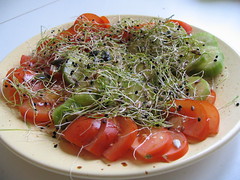
Three-minute salad One trick I’ve discovered for salads is to not prepare them in a salad bowl. It sounds silly, but one of the biggest hassles with food for me is the washing up. I have a bottle of balsamic vinegar which is made to be sprayed on things, so I just put the green things on a plate, spray them with balsamic vinegar and add a little oil. One possible result of this effortless process can be seen here in the photo.

Another trick (for fruit, particularly) is not to buy packages with 10 kiwis or 6 apples. If I buy two apples and put them in my fruit bowl, I’ll eat them. If I have 6 of them, that’s too much — and I won’t. I also noticed that so-called organic fruit, or simply fruit that you by individually, is more tasty.

Fish three times a week isn’t too difficult to achieve using the steamer (stick fish in steamer, cook five/eight minutes, yum!) — concentrate on the Omega-3 rich ones like tuna/salmon/sardines. Fresh raw tuna is delicious too, but don’t overestimate how much you can eat.

One month later, I’m still happy with the improvements I’ve made to my diet. I have to say that the simple fact I “have this food thing under control” has taken away a lot of guilt and stress, and is in itself making me feel much, much better. Of course, it’s not perfect — but my experience with life tells me that striving for perfection is the best way to Not Get Things Done ™. I suspect I don’t usually get my three meals and two snacks each day. When I eat out, things go to the dogs (though I do now always order a salad with my pizza). I don’t think I get my five portions of veggie/fruit, it’s probably more around four. Well, you get the idea — but I’m headed in the right direction.

One thing I plan to do is to conjure up some kind of monitoring sheet where I can cross out my veggie portions, meat/fish consumption, meals etc. I tend to have very little awareness of what I’m doing/not doing — for example, I was totally incapable of answering many of my doctor’s questions on what I was/wasn’t eating. So writing it down would allow me to be aware of how regularly I skip meals, for example, or to notice if my fish consumption goes down to once a week or less. I’ll blog the document if I get around to doing it.

Exercise

Another painful chapter was opened when my doctor asked “so, what about physical exercise?”

Uh-oh.

What? But, don’t I, like, do a helluvalot of judo? What do I have to worry about exercise? Well, the “helluvalot” part might have been true ten years ago, when I was training 4-5 times a week, but for the last years, between things like injuries, too much work, and car accidents, it’s more around once a week on average over the year. And, let’s face it, with thirteen years of judo underneath my black belt, I can also go to training and not tire myself out if I’m feeling lazy or out of shape.

So, I need another source of exercise. Leading a geeky lifestyle is all very well, but even without being addicted to the internet (it might just be technological overload), one has to agree that sitting in front of a computer all day, many days a week, is not exactly physical exercise, and probably not what the human body was designed for. Specially when you’re working from home and you live alone — trips to the kitchen and the bathroom don’t really add up to very much.

First, as with food, motivation and encouragement: something like cutting the risk of developing breast, stomach or colon cancer by 50%, just by doing 30 minutes of exercise per day. Wow. There are a whole lot of other benefits on your health, of course, but this is the one that struck me. So, 30 minutes a day? Damn, that would mean I have to take “time off” to exercise.

In summer, I go rollerblading by the lake. It’s nice, it’s good exercise (an hour or so from university to Ouchy and back), but it’s not so great when it rains. I need something I can do whatever the weather, says my doctor. Hmmm. I don’t like swimming. Dancing counts, he tells me — I don’t really like dancing either. Walking is ok, if it’s a brisk walk and not a gentle stroll in Ouchy on a Sunday afternoon. Cycling is ideal, he adds, specially on an indoor bike. Well, I have a bit of a space problem — but as he says, it’s all a matter of me deciding how important it is. You can buy a kind of tripod that you can stick a real outdoor bike on to turn it into an indoor bike, so it’s not that expensive (150CHF). Unfortunately, I don’t already own a bicycle.

So I decided to give walking a try. All the walking I did in San Francisco certainly helped me take the plunge. Minimal duration for the walk to be worth anything is 10 minutes (so 3×10 minutes = 30 minutes, good!) Café-Café rehearsals, my brother’s place, shopping, post office — all those are 10-15 minutes away. No more taking the car to go there. I tried walking down to town, without taking the bus. Gosh, Place Chauderon is only 20 minutes away! Café de l’Evêché, 30 minutes! That’s about as central as it gets. No more taking the car to go into town either. There’s a bus-stop a minute away from where I live if I’ve done enough walking for the day and don’t want to walk home. And overall, the Lausanne bus system is pretty good and can take you more or less anywhere in the city.

One added advantage of walking places is that it means longer commutes (OMG! who would want that!) and allows me to listen to podcasts on the way. I miss the singing-at-the-top-of-my-lungs sessions in the car somewhat, though. Longer commutes are also good because they force me to reduce the pace of my sometimes mad days — I can’t pack meetings or activities wall-to-wall in three different places in and around Lausanne because I think “it’ll just take me five minutes to get there”. I get breathing space, and I get alone-time (time spent on the computer blogging, IMing, Skypeing and IRCing does not count as alone-time).

Going No-Car

I was telling a friend all this during LIFT’07, and the fact that my as my car was now spending many a day sitting on my parking space I was certainly not going to get a bigger one, when he flat-out suggested that I sell my car. Yeah, but… I need it to go to my sister’s, to my dad’s, etc. “Rent a car when you need it.” Hmmm, why not, but rental agencies are at the station, which is quite far off… Anyway, I dismissed the idea and enjoyed the rest of the conference.

A few days later, the background process had worked its magic, and I ended up spending a fair amount of time on the Mobility website, looking up prices and figuring out how it worked. Basically, it’s a web-based car rental service which allows you to book your car, open it with your magnetic card, use it and bring it back — without having to involve another human being. You can also rent cars from AVIS and Hertz through them at a reduced rate. And more importantly, they have cars everywhere. At the Migros where I usually do my shopping. At the Coop in Prilly. Down the road. Up the road. All within walking distance.

It made sense to have a car when I had to drive daily to Saint-Prex or Bussigny, which is not a practical journey by public transport from my place. But now that I’m not commuting regularly anymore… The amount of money I pour into the car sitting in that parking space could just as well be spent on taxis and rental cars and leave me with extra aeroplane budget.

Bottom line? I’ve taken a four-month Mobility trial subscription, and I’m selling my car for March 9th. I’m losing my license for a month on that date because of my car accident this summer — so it’s a good time.

Thanks for the nudge, Stowe! 😉

Wrap-Up

I don’t know how many people will have the courage to read through this horribly long post, so here’s a quick wrap-up of what I’ve effortlessly changed about a month ago, and kept up with. All because the importance of a reasonably balanced diet and regular exercise for my (mental and physical) health really sunk in.

  • 3 meals a day, plus two snacks (I’m still working on turning my breakfast into a “meal”)
  • 5 veggie/fruit portions a day — build the rest of the food around those
  • fish 3 times a week if you manage, meat/fish/eggs once a day
  • eating frozen or ready-made stuff isn’t disastrous, just add salad/fruit
  • commute on foot — many distances aren’t that huge if you take the trouble to try
  • if you don’t use your car regularly, it might be more economical to go cab/rental.

More important than the specifics, what’s to note here is a change of attitude. Details are important, of course, as they are often what’s needed to make an intention into Things That Happen (check out GTD again). But alone, they are not sufficient. In my case, it took a few months of feeling rather unwell, and the fact that my doctor took the trouble to talk to me about these issues, for me to realise (a) they were important (b) they were probably having an impact on my life right now and (c) I wanted to do something about them.

Today, instead of thinking “what do I feel like eating” or “do I want to go rollerblading/walking”, I think “where am I with my quota of veggies/exercise, and what do I need to eat/do to reach it”. I don’t do it in an obsessive way, mind you. It’s just that food and exercise have become goal-driven, and there are rather effortless things I can do to move towards a goal I find worthwhile — so I do them.

On the road to being healthier geeks!

Travel Adrenalin Rush [en]

[fr] Projets de voyage: 28 mai - 5 juin, Copenhague pour la conférence reboot. Puis un ou deux mois à San Francisco (encore à déterminer) dès le 18 juin. Décision pas facile, parce que je dois me décider vite (sinon je perds l'option) et que ce sont des billets non remboursables et non modifiables.

On the way back home from judo by this bright sunny springy afternoon, I decided it was high time to hop in at the travel agent’s my brother had recommended and give a little bit of substance to my travel intentions.

Well, oh my! I wasn’t quite expecting as much substance. I’ve got a pre-reservation for San Francisco (June 18th to August 19th — two months!) and one for Copenhagen (May 28th to June 5th), for reboot (is reboot happening this year?) Both are quite cheap, but the downside is that I have to give confirmation very soon (3 days for SF, one for Copenhagen) and that there is no flexibility in the dates (I can’t decide to fly back a few days later), and if I cancel I still have to pay the full price of the ticket.

I’m thinking now that maybe two months in San Francisco is a bit of a plunge. There are two issues:

  • money (most of my paid work is done face-to-face — speaking engagements, consulting, training — so I can’t really “do stuff through the internet” for my clients here while I’m away)
  • the cat (he’s 10 now, I’m very attached to him, and a bit torn between leaving him here and being afraid something will happen to him when I’m gone — I have a good cat-sitter and a good cattery, so there are options open, or taking him with me and having him not be able to go outside in SF, depending on where I’m staying)

So, maybe one month would be more reasonable. Specially as I’ve been told summer could be quite cold (50F=10C?! can anybody confirm that?) in the city, whereas it’s beautiful in Lausanne during July and August. And maybe come back in autumn? Heck. I need to go to Montreal and India too.

Now, just in case I do decide to come over to SF for a month, starting June 18th… Are there any events taking place mid-July that I should know of? As I said, once I fix the return date, it’s set in stone — and I would hate to be biting my fingers off because I’m leaving just that one day early and I could have known…

Back to San Francisco? [en]

[fr] Je tente de prévoir un peu mes voyages. Angleterre en principe début avril, puis pourquoi pas San Francisco en mai-juin? Par contre, je peine à trouver un vol au-dessous de $1000 -- si vous avez des tuyaux, c'est volontiers. Peut-être je devrais viser l'automne?

I’m thinking about my travel plans right now. Looks like UK (Leeds + London) beginning of April (awaiting confirmation from family and kind hosts). I started looking at flights to San Francisco, for example in May-June, but I can’t find anything under $1000 (GVA-SFO).

Is it because May-June is too close to now? Am I not looking at the right airlines? Should I aim for autumn instead?

Any advice/tips welcome.

Steph+Suw Podcast: First! [en]

[fr] Suw et moi avons enfin enregistré le fameux podcast-conversation dont nous parlons depuis notre première rencontre, en mai 2004. C'est en anglais et c'est assez long, mais on s'en est pas trop mal sorties pour une première!

Each time Suw and I meet, we talk about recording a podcast together. We met for the first time in June 2004, and if I believe the Podcasting and Beercasting Thoughts I wrote a little less than a year later, that was indeed when we first started talking about using audio to record conversations.

I’m definitely sure that we talked about it at BlogTalk 2. I don’t think Skype was in the air then, but we talked about hooking up our phones to some audio recording device, and left it at that. At that time, people were getting excited about “audioblogging” (did we already talk about “podcasting” back then? It seems a long, long time ago) and we agreed that were audio really became interesting was in rendering conversations. (See the Podcasting and Beercasting Thoughts post for more about that.)

Anyway, now we have Skype, and Call Recorder (which reminds me, I need to write up a post about the ethics of recording audio conversations), and we finally got round to doing it. It’s a bit long-ish (40 minutes — not surprising if you know us!) and has been slightly edited in that respect, but honestly, it’s not too bad for a start.

Here is roughly what we talked about.

  • San Francisco, web geek paradise
  • City sizes (see this London-SF superimposition map)
  • Segways
  • The cat/geek Venn diagram (Twitter error message)
  • I really want a Wii
  • IRC screen names
  • The difficulties of pronouncing S-u-w
  • When geeks name children: A unique identifier or anonymity?
  • Stalkers and geoinformation
  • Perceptions of security
  • Giving out your phone number and address, and personal boundaries
  • Airport security (background…)
  • Risk and expectations of risk
  • Death, religion, and the medical industry
  • Naming our podcast… something about blondes, apparently
  • Clueless marketeering from the Fabric nightclub in London
  • The repercussions of having a blog that people think is influential (even if
    you don’t think it is)

Let us know what you liked and didn’t like! View Suw’s post about this podcast.

Airport Security [en]

[fr] Je déteste les procédures de sécurité dans les aéroports. Devoir enlever ses chaussures systématiquement, déjà, en signe d'humilité et de respect devant la "sécurité de la nation" (les responsables qui se couvrent en cas d'incident, plutôt), et maintenant, être en mesure de prouver durant 15 secondes que l'on ne prend à bord "qu'un seul sac". Encore un traumatisme de voyage pour moi, super.

I officially hate going through airport security.

It’s bad enough to have to submit to random searches, and go through metal detectors which will beep regularly depending on what jewellery or shoes you’re wearing. Actually, the shoes issue is solved now in many airports by demanding that passengers remove their shoes and walk through the detectors in socks or barefoot.

I personally find this rather degrading. Think of it. As far as I know, removing one’s shoes is a sign of submission, respect or humility before a figure of power, most of the time in some way religious or spiritual. Think temples, kings, and washing others’ feet.

So now, we are forced to walk “barefooted” through the holy ground of airport security, and submit to procedures which, if you think of it honestly, are probably there more to ensure that certain arses are covered in case of a security incident. When metal detectors beep and bags are searched day after day, and all these are “false alarms”, surely the efficiency of the security screening process suffers. Imagine an anti-virus program which generates many false alerts everyday — inevitably, you’re going to pay less attention to them.

Anyway. I’d more or less started to get used to removing my laptop from my bag, sealing my liquids in a transparent bag, taking off shoes and bracelet and patiently let people wave metal rods around me or open my bags.

I’m about to climb on my 11th plane since the end of September (lots of bad connections, I’ll admit, but still — I’ve been through security a bit). Here in London Heathrow, I have just discovered yet another feature of the security screening process: “one bag only”. As far as I can remember, cabin luggage has always been “one bag only”, and it meant that women could still carry their handbag in addition to that. Unfair, yeah, poor guys, but that’s how it was. And indeed, I’ve never had a problem with that before today.

So, freshly off my totally uneventful British Airways flight from San Francisco to Heathrow (thanks partly to melatonin-induced slumber), I was following the connecting flights signs when I was stopped by a first security barrier. As an aside, it always kind of amazes me that you have to go through security multiple times when you have connecting flights. I assume this means that airports do not trust security staff in other countries to conduct security screening properly.

Anyway, this was “one bag only” pre-screening. I had my new Hello Kitty laptop bag, crammed with stuff like clothes to sleep in on the plane (really worth it), and my (equally new and Hello Kitty) handbag with the usual random stuff I carry with me everywhere (including laptop, camera, sunglasses, notebook, purse, phone, etc… — I put all the cables in my check-in luggage, for those who were thinking about asking). The security guy stopped me, and rather harshly told me that it was one bag only, to which I pointed out that one of them was my handbag. The line was repeated, with a little extra information: “One bag only, so unless you can make them into one bag, you can’t come through.”

Great. I couldn’t make them into one bag, I told — and showed — him. “Then you have to go through passport control, find your airline, go through check-in.”

That sounded weird. My first thought was that this was some kind of express security passage, but I had a sneaking doubt the idea behind that option was to make me check in one of my bags. I queued at passport control, on the verge of tears (I’m starting to realise travelling is a perfectly dreadful and stressful experience, and really need to find a way to not end up in tears each time I travel at the point where obstacles start showing up.)

I told the immigration guy I wasn’t really sure why I had been sent this way and what I should do, and he told me that indeed, if I went out this way it would be to check one of my bags in. When I told him I couldn’t (neither of my bags were fit for it), he basically said it wasn’t his problem, that he could show me where to go to check one of my bags in, that he refused to argue with me, and that I could go back to argue with the security guys instead. Well, guess what, that was just what I needed to hear to take from fighting tears to giving in to them. I tried to tell him I didn’t want to argue, I just wanted to know who I could talk to. He stuck to his script, and told me to go and argue with security again.

I was stuck, and what I needed just there was somebody I could talk with to try to figure out a solution, and who wouldn’t just spew out script lines at me. Immigration on the left, security on the right, and they had both proved equally unfriendly and drone-like in that respect.

Back to security anyway, I picked another guy than the one I had dealt with to start with, and was lucky (or maybe I was just crying enough by that time). Anyway, this one was nice, stepped out of the line, listened to me, took matters into his own hands by throwing out my empty water bottles, removing my laptop from the bag (I could carry it by hand), and squashing my poor handbag into my bigger Hello Kitty bag, which almost needed to be sat on to be shut. Great, I had one bag.

I thanked him, walked straight through that first bit of pre-security without anybody even looking at me, got into the longer line for the proper security screening, and promptly separated my too bags again — I was afraid my laptop bag would explode and my more delicate stuff would be crushed.

Nobody asked me to “make them into one bag” to screen them. Basically, I went through all that to prove during 15 seconds that my two bags could pass for one.

I just feel totally disgusted by all this. Next time I’ll carry a strap so I can strap my two bags together to “make one bag” instead of squashing them.

I'm really liking San Francisco [en]

[fr] J'aime bien San Francisco 🙂

The streets of San Francisco have this weird feeling of infinite possibility floating around them. The weather is sunny, spring-like for me. I spent two days walking up and down town, and it’s just teeming with life. There are stores, there are parks, there is really nice food — and not just the Asian variety. The skyscrapers, which I thought nothing but ugly when I was first here eight years ago, are beautiful when they glitter in the morning sun and when they light up from the inside as night falls.

San Francisco is locked up in a space of 49 square miles, a roughly square-like surface with sea on all sides but one. And I think that may very well be what helps me like it: it’s rather small, compact, walkable. A little world of its own, in which websites I use daily become offices and nicknames in IRC chatrooms become people to hang out with.

Two days ago as I was walking along the bay, I found myself thinking that I wouldn’t mind packing up Bagha and coming to spend a few months here (well, maybe he would mind — doesn’t seem to be too much of a life for an outdoor cat around here). After my year in India, it took me several years to really settle down again. I had a pretty hard time coming back, actually. And this is the first time I find myself somewhere thinking “hmmm, I wouldn’t mind moving here for a few months”…