Livre: je me jette à l'eau [en]

[fr] Prompted this evening by a conversation with Peter Hogenkamp about what I might talk about at BlogCampSwitzerland, I've decided that after many months of not acting upon my decision to write a book, it was time to take a deep breath and jump in. The conversation I had at LIFT with Sarah, Stowe and Trine-Maria clearly also prepared me to take the plunge.

The book will be in French, so I'm afraid this is not very exciting news for my English-speaking-only readers. I'm more comfortable writing in French than English, and also, there is already a clear local and francophone interest for the book topic: teenagers, blogs, the internet, the chasm between parents and children when it comes to social media and online culture, and what can/should be done about it in terms of "media education".

The first draft of the book contents was made in English, though, so you'll get a copy of it when that post comes up. Oh, and if you were thinking of suggesting that I write the book in French and English at the same time... you probably haven't thought it through 😉

Il y a plusieurs mois, suite à une longue discussion avec mon ami David Galipeau, je me suis retrouvée en fin de soirée un peu surprise et la tête légère à me dire qu’écrire un livre paraissait soudain possible, et que je tenais un sujet. Le lendemain, j’ai rapidement établi un plan général de ce que pourrait être le livre dans Freemind.

Puis, j’ai passé près de six mois à ne pas avancer. Je souffrais d’un accès aigu de TMS, donc pas question de me mettre à rédiger avant d’avoir installé Parallels et le Dragon. L’opération a échoué, entre autres pour cause de mal aux mains qui m’empêchait de mener à terme l’installation (ironie!). Aussi, j’avais décidé que je voulais bloguer l’écriture du bouquin, et je n’étais pas trop sûre si j’allais le faire sur ce blog ou un autre. Puis, last but not least, écrire ça prend du temps, et j’étais un peu inquiète à l’idée de me lancer dans une entreprise comme ça chronophage alors que je n’étais pas encore très sûre dans quelle mesure mon job de consultante indépendante me permettrait de tourner confortablement ou non.

Bref, des tas de très bonnes raisons, mais franchement, surtout la trouille de me lancer dans quelque chose que je veux faire depuis aussi longtemps que je me souvienne (écrire un livre), mais qui m’intimide.

Ce soir, discussion avec Peter Hogenkamp, un des organisateurs de BlogCampSwitzerland, auquel je me suis inscrite un peu plus tôt. Je ne sais pas encore vraiment de quoi je vais parler à BlogCamp, et je lui disais que je pourrais peut-être faire quelque chose au sujet des ados, des blogs, et d’internet, comme c’était aussi le sujet du livre que je mijotais (enfin, là, je suis encore en train d’éplucher les patates, pour être tout à fait honnête). Du coup, on a parlé du livre, je lui ai raconté tout ce que j’ai récrit plus haut dans ce billet, j’ai dit un peu en riant que je pourrais m’y mettre et en parler à BlogCamp. Dont acte: il est temps d’arrêter d’en parler à tout mon entourage et de me lancer à l’eau. Le travail que j’ai fait dernièrement pour ciao.ch m’aide aussi à trouver le courage de m’y mettre, car si ce n’est pas le même public, c’est bien le même sujet.

Donc, quelques décisions et remarques:

  • Je vais écrire le livre en français. J’ai hésité, bien sûr, mais d’une part je suis quand même plus à l’aise dans l’écriture en français (faudra que je fasse la chasse aux anglicismes, tout de même), et d’autre part, il y a déjà un intérêt local et francophone pour ce que j’ai à apporter à la problématique blogs-ados-internet.
  • Je vais bloguer le processus et le contenu du livre au fur et à mesure que je le produirai ici sur CTTS (je ne crois pas à la multiplication des blogs). (Catégorie Livre.)
  • Le livre sera mis à disposition/publié sous une licence Creative Commons.
  • Je ne sais pas trop comment je vais m’y prendre, c’est la première fois que je fais ça, et vous allez donc me voir patauger joyeusement.
  • Je n’ai pas encore de titre pour le livre. Lorsque j’ai fait le premier jet du plan (en anglais!), je l’ai appelé “The Blogging Divide” — je ne sais honnêtement plus si ça me plaît ou pas (il y a des wagons, avec des mots pareils). De toute façon, je ne pense pas qu’il faille un titre pour que je m’y mette. On verra bien ce que je trouverai.
  • Si je choisis de construire ce livre en public, c’est parce que je pense qu’il sera plus riche de vos remarques et de vos critiques que si je l’écris seule dans mon coin. Mon but est avant tout de faire un livre utile. N’hésitez donc pas à réagir à ce que je publierai.
  • J’ai encore besoin de clarifier un peu le sujet du livre, et ce sera l’objet d’un billet futur. Mais ça tournera autour des adolescents, de l’internet social, du fossé entre “adultes” relativement peu branchés et ados “digital natives”, et de ce qu’il y a à faire en matière d’information et de prévention — ce pour quoi j’aime utiliser le terme “éducation aux médias”. Le public cible se situera plutôt du côté des parents, enseignants, éducateurs que des ados ou des geeks.
  • Je publierai dans un autre billet (et un autre jour, il se fait tard, là) ma première ébauche de plan, une fois récrite en français.

Voilà pour ce soir. C’est donc parti!

Geeky Frustrations [en]

[fr] Quelques râlages (comme quoi je ne fais pas ça qu'en français) au sujet de certains outils que j'utilise quotidiennement.

Right, so, just so I can get it off my chest, here is a list of little things that bug me with the tools I use daily. If I save them for a “proper write-up” they probably will never be posted, so… here goes.

  • Twitter: let me see a differential list of those I follow and those who follow me, both ways. I need to know who is following me that I’m not following (maybe I missed somebody out) and who I’m following but they’re not (to keep in mind they won’t see stuff I twitter).
  • Twitter: let me tag my friends, or sort them into buddy groups. Then let me activate phone alerts for only certain groups. One-by-one management is just impossible with 100 or so friends.
  • Adium: let me turn off Gmail notifications. I have Google Notifier for that. I hate having to click “OK” on that window all the time.
  • Google Reader: let me drag’n drop feeds from one folder to another.
  • Facebook: let me import more than one RSS feed in my notes.
  • Nokia 6280 and Macbook: please sync with each other each time I ask you to, not once out of three.
  • Nokia 6280: gimme a “mark all as read” option for my text messages, please!
  • Nokia 6280: I’d say something about the really crappy camera, but there isn’t much you can do about it now, can you.
  • iPod: let me loop through all episodes of a podcast instead of having to go to the next episode manually.
  • iTunes: let me mix playlists as a source for Party Shuffle (30% My Favorites, 30% Not Listened in Last week, 40% Artist I’m Obsessing Over These Days… for example)
  • Google Reader and del.icio.us: find a way to allow me to automatically post Shared Items to del.icio.us too.
  • Flickr: let me link to “My Favorite photos tagged …” so I can show my readers what I’ve found.
  • Added 18.02.07 0:10 Google Ajax-y Homepage: let me Share Google Reader items, not just star them.

Certainly more, but these were those which were bugging me badly just now. Well, they’re off my chest, now I can go back to fretting about all the stuff I need to get rid of in my flat and which is still lying around because I haven’t quite figured out the optimal way to dispose of it.

LIFT'07 Social Networking Map Experiment [en]

[fr] Si vous étiez à LIFT'07, remplissez le questionnaire pour l'expérience de Social Networking Mapping!

I can only encourage you to participate in the LIFT’07 Social Networking Map Experiment if you attended the conference. It takes a little while to complete, depending on how extroverted you are, I guess. And if you hang out with evil supernodes, too.

Listing the people I knew before the conference wasn’t too hard, though of course I had to plough through the list. Here are the names I came up with:

Henriette Weber Andersen, Jean-Christophe Anex, Bieler Batiste, Yoan Blanc, Florent Bondoux, Stowe Boyd, Raphaël Briner, Stefana Broadbent, Lee Bryant, Marie Laure Burgener, Riccardo Cambiassi, Jérôme Chevillat, Marco Chong, Matthew Colebourne, Samuel Crausaz, Thierry Crouzet, Pedro Custodio, Nicolas Dengler, Jens-Christian Fischer, Antonio Fontes, David Galipeau, Bruno Giussani, Tanguy Griffon, Matthias Gutfeldt, Laurent Haug, Peter Hogenkamp, Dannie Jost, Christophe Lemoine, Thomas Madsen-Mygdal, Yann Mauchamp, Geneviève Morand, Philippe Mottaz, Hugo Neves da Silva, Nicolas Nova, Bjoern Ognibeni, Roberto Ortelli, Jean-Olivier PAIN, Marc-Olivier Peyer, Bernard Rappaz, Andre Ribeirinho, Martin Roell, Pascal Rossini, Robert Scoble, Rodrigo Sepulveda Schulz, Joshua Sierles, Nicole Simon, John Staehli, Elisabeth Stoudmann, Sandrine Szabo, Olivier Tripet, Guido Van nispen, Benjamin Voigt, Alfonso Von Wunschheim, Ellen Wallace, Bertrand Waridel, Mark Wubben, Chris Zumbrunn, Jan Zuppinger

“New people” I met at the conference was more difficult, firstly because I didn’t get the names of everyone and business cards are only so helpful, particularly when you don’t have any for the people you talked to, and secondly because many people did not include a photo in their profile on the site, or any information about themselves. Here’s the list I managed to compile:

Jeremy Allen, Paula do O Barreto, Nuno Barreto, Brian Cox, Florian Egger, Ramon Guiu Hernandez, Noel Hidalgo, Lisette Hoogstrate, Tom Klinkowstein, Trine-Maria Kristensen, Maya Lotan, Gia Milinovich, Glenn O’neil, Nortey Omaboe, Michele Perras, Ivan Pope, Derek Powazek, Thomas Purves, Dieter Rappold, Colin Schlueter, Maryam Scoble, Sebina Sivac-Bryant, Jewel THOMAS, David Touvet, Remo Uherek, Sarah Wade Hutman

A much smaller list, as you can see. Well, as I knew quite a lot of people to start with, I guess it’s expected to be short — but I’m sure this is at most the two-thirds of the people I met. If we talked and you’re not listed, let me know!

One methodological problem I can see with the survey is that “already knew” and “met for the first time” are not clearly defined. I’ve taken a really wide interpretation of those expressions for this survey. I’m not sure absolutely everyone on my first list would consider they “know” me. Or if I haven’t met a person yet but we’ve got common friends and I’ve followed a lot about them, do I “know” them? Ditto for “met for the first time”. I’d interacted with Gia online after LIFT’06, but this is the first time we talked offline, for example.

Anyway… interested in seeing what will come out of this. Please take the survey!

Que d'anglais [en]

[fr] Just an explanation to my French readers about the amount of English here recently. Has to do with a post-LIFT'07 effect and the hard time I have coming back to "where we are with blogs and stuff in Switzerland". (Answer: frustratingly behind. Yeah, I'm grumpy and certainly a little unfair.)

Oui, je sais, je néglige à nouveau mes lecteurs francophones et j’écris des tartines en anglais. Je reviens de la conférence LIFT’07 (l’année dernière, LIFT’06 avait quelque peu changé ma vie), des rencontres plein les yeux et des idées qui résonnent encore dans les oreilles.

La langue que j’utilise ici dépend de l’humeur, du contenu du billet, du public imaginé. Là, j’avoue, je suis un peu coincée en anglophonie. Un peu difficile, après un workshop magistral donné par Stowe Boyd et toute une série d’intervenants fascinants de remettre les deux pieds en terre vaudoise, où les journalistes tentant de se mettre au blog essaient d’épingler les blogueurs pour une tournure malheureuse (ah oui, c’est Stephanie sans accent si jamais, puisque vous tenez à la précision), les cours d’initiation aux blogs sont annulés de façon répétée par manque d’inscriptions alors que la demande est là, pourtant (appels, interviews, cartes de visite, demandes… et j’en passe), les gens veulent des blogs mais quand même pas trop “blog” (mais parlez en “je”, bon sang, ça veut pas dire que vous devez “raconter vos vies”), où internet fait peur et où les journaux, en passe d’épuiser le filon, tentent de faire les gros titres avec la fin des blogs.

Donc, vous me pardonnerez, mais juste là, je retourne explorer Facebook, garder un oeil sur l’évolution des blogs d’Intel qui ont profité de mes services plus tôt cette année, parler boutique avec Headshift, lire Stowe, Bruno Giussani et David Galipeau, rester en contact avec ma tribu de LIFT, commencer à travailler à mon futur livre sur les ados et internet (surtout: sur quel blog l’écrire), mettre mon nez un peu dans ce que fait Derek Powazek avec JPG Magazine, guetter les dates de reboot et planifier ma prochaine expédition à San Francisco

Un peu grinche, la Mère Denis, et probablement un peu injuste aussi, du coup. C’était le coup de gueule du jeudi après-midi. Vous en faites pas, amis romands — je vous aime quand même.


Merci à noneck pour la photo.

Pour me faire pardonner, allez, quelques photos-souvenirs (de moi et d’autrui) de LIFT’07.

Je passe à Orange Maxima [en]

[fr] I've switched to a flat fee mobile phone subscription. A good investment for the money saved by cancelling my land line.

Voilà, c’est fait. Hier, j’ai appelé Orange (et on m’a répondu sans que je doive attendre) pour passer au nouveau plan tarifaire Optima avec les trois numéros gratuits. Du coup, je suis allée jeter un oeil sur le site, et j’ai vu les conditions pour le plan tarifaire Maxima. En résumé:

  • 89CHF/mois
  • appels gratuits vers fixes et mobiles Orange, -.30/min pour les autres mobiles
  • 0.15/sms, MMS option, option Travel Pro pour le roaming international
  • remplacement du téléphone à tarif avantageux en cas de perte (en 24h en Suisse)
  • 2Mb de données gratuites par mois (WAP, GPRS, UMTS), 2.50/Mb pour la suite.

Je trouve que c’est une bonne utilisation des 25CHF/mois économisés suite à la résiliation de mon téléphone fixe.

Si je décide de retourner à Optima, je peux le faire pour la fin de n’importe quel mois une fois les six premiers mois de mon contrat passés. Par contre, pour avoir droit à une offre pour un téléphone, je dois attendre juillet 2008… On dirait que je suis coincée avec mon Nokia 6280 pour encore un moment. Quoique, d’ici là, on aura tous des iPhones!

Please Make Holes in My Buckets! [en]

[fr] Tour d'horizon de mes différents "profils" à droite et a gauche dans le paysage des outils sociaux (social tools). Il manque de la communication entre ces différents services, et mon identité en ligne s'en trouve fragmentée et lourde à gérer. Ajouter des contacts en se basant sur mon carnet d'adresses Gmail est un bon début, mais on peut aller plus loin. Importer ses livres préférés ou des éléments de CV d'un profil à l'autre, par exemple.

Facebook is Stowe‘s fault. Twitter was because of Euan. Anne Dominique is guilty of getting me on Xing/OpenBC. I can’t remember precisely for Flickr or LinkedIn or — OMG! — orkut, but it was certainly somebody from #joiito. The culprits for Last.fm, DailyMotion and YouTube have disappeared into the limbo of lost memories. Kevin encouraged me to sign up for a good dozen of blogging platforms, open a MySpace account, and he’s probably to blame for me being on Upcoming. As for wordpress.com, I’ll blame Matt because he’s behind all that.

Granted, I’m probably the only one responsible for having gotten into blogging in the first place.

Let’s get back on track. My aim here is not primarily to point an accusing finger to all my devious friends who introduced me to these fun, addictive, time-consuming tools (though it’s interesting to note how one forgets those things, in passing). It’s more a sort of round-up of a bunch of my “online selves”. I feel a little scattered, my friends. Here are all these buckets in which I place stuff, but there aren’t enough holes in them.

Feeds are good. Feeds allow me to have Twitter, del.icio.us, Flickr, and even Last.fm stuff in my blog sidebar. It also allows me to connect my blogs to one another, and into Facebook. Here, though, we’re talking “content” much more than “self”.

One example I’ve already certainly talked about (but no courage to dig it out, my blog is starting to be a huge thing in which I can’t find stuff I know it contains) is contacts or buddies — the “Mine” in Stowe’s analysis of social applications. I have buddy lists on IM and Skype, contacts on Flickr and just about every service I mentioned in this post. Of course, I don’t want to necessarily have the same contacts everywhere. I might love your photos on Flickr and add you as a contact, but not see any interest in adding you to my business network on LinkedIn. Some people, though — my friends — I’ll want to have more or less everywhere.

So, here’s a hole in the buckets that I really like: I’ve seen this in many services, but the first time I saw it was on Myspace. “Let us peek in your GMail contacts, and we’ll tell you who already has an account — and let you invite the others.” When I saw that, it scared me (“OMG! Myspace sticking its nose in my e-mail!”) but I also found it really exciting. Now, it would be even better if I could say “import friends and family from Flickr” or “let me choose amongst my IM buddies”, but it’s a good start. Yes, there’s a danger: no, I don’t want to spam invitations to your service to the 450 unknown adresses you found in my contacts, thankyouverymuch. Plaxo is a way to do this (I’ve seen it criticised but I can’t precisely remember why). Facebook does it, which means that within 2 minutes you can already have friends in the network. Twitter doesn’t, which means you have to painstakingly go through your friends of friends lists to get started. I think coComment and any “friend-powered” service should allow us to import contacts like that by now. And yes, sure, privacy issues.

But what about all my profile information? I don’t want to have to dig out my favourite movies each time I sign up to a new service. Or my favourite books. Or the schools I went to. I mean, some things are reasonably stable. Why couldn’t I have all that in a central repository, once and for all, and just have all these neat social tools import the information from there? Earlier today, David was telling me over IM that he’d like to have a central service to bring all our Facebook, LinkedIn, OpenBC/Xing, and MySpace stuff together. Or a way to publish his CV/résumé online and allow Facebook to access it to grab data from it. Good ideas, in my opinion.

I’ll mention OpenID here, but just in passing, because although in my dreams in used to hold the promise of this centralised repository of “all things me”, I don’t think that it’s what it has been designed for (if I get it correctly, it is identity verification and doesn’t have much to do with the contents of this identity). Microformats could on the other hand certainly come in handy here.

So, please, make more holes in my buckets. Importing Gmail contacts in sticking feeds here and there is nice, but not sufficient. For the moment, Facebook seems promising. But let me use Twitter for my statuses, for example, or at least include the feed somewhere (I can only include one feed, so I’ve included my suprglu one, but it has a huge lag and is not very satisfying). Let me put photographs in my albums directly from Flickr. Talk with the profiles I made with other similar services. Grab my school and work info from LinkedIn and OpenBC. Then make all this information you have about me available to republish how I want it (feeds, feeds, feeds! widgets! buttons! badges!) where I want it.

Also, more granularity. Facebook has a good helping of it: I can choose which type of information I want to see from my contacts. I can restrict certain contacts from seeing certain parts of my profile. I’d like fine control on who can see what, also by sorting my people into “buddy groups”. “Friends” and “Family” as on Flickr is just not enough. And maybe Facebook could come and present me with Stowe-groupings of my contacts, based on the interactions I have with them.

Share your wild ideas here if you have any.

Addicted to Technology! [en]

[fr] Une longue tirade, malheureusement pas vraiment traduisible vu l'heure et la longueur, sur la dépendance à internet, qui est à mon avis un faux problème. J'y parle de notre définition de la technologie (une voiture, c'est aussi de la technologie, et on ne s'alarme pas des gens qui seraient "dépendants de leur voiture" comme on le fait de ceux qui sont "dépendants de leur ordinateur"), de la valeur (petite) généralement accordée aux rapports humains qui passent à travers un ordinateur, de l'insuffisance de la "déconnexion" pour résoudre un problème d'utilisation excessive de cet outil, puisqu'il reste un outil valable et même indispensable pour certains, même si c'est un lieu privilégié de fuite.

Help! we’re all becoming addicted to technology! Think of it… we’re soon going to be merged to our computers and cellphones, and we already have a hard time living without them. Heck, we can’t even spend a day without chatting or checking our e-mail! Or our blog comments! Where is the world going?

What technology?

Let’s take a few steps back, shall we? First of all, please define technology. Do we consider that we are “addicted” on our cars? Our clothes? Our flats? The postal system, goods manufacturing and distribution, the newspaper? Oh, but those things are actually necessary, not superfluous like all this internet/computer/techy stuff. That’s what we mean by “technology”. People could communicate very well without IM and cellphones and e-mail, couldn’t they? So, shouldn’t we strive to remember that “real” human relationships happen outside the realm of all this “technology-mediated” communication?

Wrong.

Cars are technology. The banking system, and similar infrastructures our world relies on, are in their way a form of technology, and certainly, built upon technology. People who argue that cars, fixed landlines, or shoes are more “necessary” than IM are simply stuck with views on what “technology” is and its value that are dictated by the state of the world when they came into it. (Read original material by Douglas Adams.)

We consider things like fixed phones and the postal system like something we need because they have been around for so long that our society and the individuals inside it have completely adapted to having them around, relying upon them, and using them. It is “normal” to feel uncomfortable or jittery if your phone landline is cut or if your watch breaks down. But somehow, it is not “normal” to feel uncomfortable or jittery when we can’t check our e-mail for 24 hours.

Computers, the internet, and the various programs we use are tools, like the phone and our vehicles. They allow us to get things done, interact and connect with others, and also enjoy some recreation. Of course, they can be over-used. Of course, some people will have an unhealthy or even pathological utilisation of them. But they differ from the classical objects of “addiction”, like drugs, which (usually) do not serve a directly constructive purpose.

Addicted to our cars

I find it very problematic to speak about “addiction” regarding computers or the internet, partly because it makes it look like the problem is with the tool (instead of the person), and partly because it is very difficult to draw the line between healthy and unhealthy use of the tool without taking in many environmental and personal factors.

I think that making a comparison between computer and car usage is quite enlightening in that respect. They have in common that they are a form of technology, they have a use, and can be abused. Yet we worry about addiction to computers, but not so much about addiction to cars. Let’s have a closer look.

A car is not a vital necessity. Before cars existed, humanity managed to survive for quite a long time, and wasn’t necessarily worse off (I guess that judgement depends on one’s view of progress). However, nowadays, depending on where you live and what your lifestyle is, it’s hard to get by without a car (though possible by making some arrangements). Would we consider somebody who uses their car everyday “addicted”? Most certainly not, because probably the main reason the car is needed is to commute to work. But what if one likes going to drive around in the countryside every week-end? Or takes the car to drive to the store when it is 5 minutes away on foot? Or uses the car for comfort, when public transport could be used? What about the distress one can end up when a car breaks down and has to be taken to the garage? Would anybody dream of speaking of addiction here?

Just as the car allows us to easily cover long distances, the computer allows us to do things we could not normally do without. It’s technology. Now, if the way we live tends to require or expect us to do these things, the technology becomes “necessary”, and not “superfluous”. Makes sense?

Nurturing online relationships has little value (not)

One problem with applying the reasoning I did for the car to the computer has in my opinion been touched upon in the LIFT’07 panel I mentioned previously: the blurring of the distinction between what is “work” (ie, “necessary”) and “personal” (“not that necessary”). Aimlessly chatting on IRC can actually be very important for my professional life. In general, taking care of one’s network (really: taking care of the relationships we have with other human beings we know) is something which should not be considered “superfluous”. During the panel, Stefana Broadbent mentioned that technology allowed us to actually keep alive (“manage”) a greater number of relationships than what we would be capable of without. Which leads us to the second problem: human relationships which take place “through the internet” are less valued in today’s world than the “real” ones which take place face-to-face.

What’s missing here is that “virtual” (how I hate that word in this context) interaction is not there to “replace” face-to-face interaction, or traditional communication technologies like the written letter, the fax, or the phone. IM, chat, blogging and e-mail most often keeps people in touch when they would not be communicating at all. I would not be keeping friendships alive across the Atlantic without my computer. And some of these friendships are no less valuable than the relationships I have with people I get to see in the flesh more often because they live in my hometown.

But more than that, these “poorer” channels of communication open up different dimensions in the way we relate to others. I’ve heard this said twice recently (though I’ve been aware of it through personal experience for years). First by Regina Lynn in her (well worth reading) book The Sexual Revolution 2.0. At some point, she explains that for those who are used to texting and IMing in the context of a romantic relationship, the absence of these “channels” makes it feel like there is something missing in the relationship. Second, Stefana Broadbent (again on the LIFT’07 panel, link above) mentioned that the arrival of Skype and VoiP did not kill chat — people are still chatting even though they could use the richer communication channel and actually talk.

This is not surprising. We know that some things are easier to say or more adapted to this or that communication channel. It’s not news either — using letters or the phone rather than face-to-face is not always a choice made for questions of distance or availability.

If not addiction, then what?

Of course, as I mentioned, there are unhealthy uses of computer technology. And computer technology has characteristics that help us get “hooked”, so it won’t be surprising that people might use it compulsively or excessively. And for people who for a reason or another (and I at times can include myself in that lot) need to “escape” life/reality/pain, goofing around aimlessly online or chatting for hours with random strangers can be used as an alternative to getting drunk/stoned/passing out in front of the TV/reading all Harry Potter books cover-to-cover without interruption. But is it right to talk about “addiction” in such cases?

Whatever you call it, the problem here is that you can’t just tell the people to “unplug” as a solution. For most people who have built part of their life around the internet, the computer is a valuable tool for work and social life. And anyway, even with substance abuse addictions, going “cold turkey” does not solve the real problem, though it’s usually better for your health. (I have personal experience from “the other side”, here: I have never in my whole life even tried smoking a cigarette, because I sense that if I did, there are high chances I would turn into a heavy smoker. I’m not free. One could say I have an addiction problem, even though it is not manifest in substance abuse. It’s latent and finds an expression in total abstinence.)

If the computer is used excessively, it is necessary to address the real underlying problem. The “thing” that makes people need to escape to somewhere. Because the line between “normal use of the tool” (I need to chat to some extent to keep in touch with my friends/family/collegues) and “excessive use” (I spend all my free time chatting, forget to eat, and don’t go out anymore) is drawn in quality rather than quantity and does not comprise a clear border like a different environment, schedule, or tool, the “easy” solution of “quitting” does not work.

Then, how does one determine if one’s use of the computer is excessive? I like to say that the main defining criteria for this kind of problem is pain. Is the intensity with which one uses the computer (or cellphone, or whatever) a source of suffering? Does the person feel that it’s out of control, and would like to do something about it? Is it having concrete effects like work loss, strain on relationships, or is there dissimulation regarding the time spent at it, hinting at a general unease about the time that is used on the computer? The secondary criteria would be purpose. Addiction or escape serve a purpose (shields one from something). Is it the case? What is this purpose? It’s not a simple question, and it often doesn’t have a simple answer, and addressing it might even involve a therapist.

Not that addicted…

I find that the mainstream press and certain specialists (doctors or teachers I’ve met) are a bit quick to shout “addiction” when faced with the importance the computer and the internet have taken in our lives. I’m not an “addict” because I get uncomfortable if I haven’t accessed my e-mail in 24 hours. I’m not an “addict” because I chat to my friends from the other side of the pond every day. I’m not an addict because when I think of something interesting, I feel an urge to write about it on my blog. I’m not an addict because I need my computer to take notes during a conference, rather than a paper and pen with which I’m illegible and which hurts me. I’m not an addict because I sometimes choose to stay in and catch up with what people I know are saying on their blogs rather than go out clubbing.

Yes, when I’m not doing too well I will easily turn to my computer to escape from the world or myself. Before I had a computer and a social life on the internet, I used to turn to the TV in such occasions, or drown myself in books or music. One isn’t better than the other. But here, clearly, the problem is me, and not the nasty technology.

If you’ve read all this, let me know what you think. I suspect I might have taken a few shortcuts here and there, and I’ll be more than happy to make them explicit if you point out what isn’t convincing.

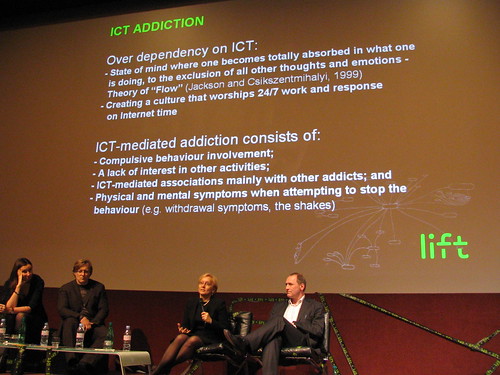
Technological Overload Panel [en]

Technological overload (oh, I hadn’t realised this was a panel!) — again, Bruno has some nicely-written notes to share.

Fun crackberry video from YouTube.

The moderator loves his crackberry, but he’s an addict.

The panelists don’t blog! What a shame! Not much IM either… (that was a steph-note)

steph-note: We’re asked to close laptops for Nada Kakabadse’s presentation. Reminds me of “Le Test du Moi” where they wanted to take my laptop away for a week — not realistic given my line of work. In my case, I’m using the computer to take notes because my handwritten notes are illegible because of my RSI. => no notes on the first part of the presentation, but I took photographs of the slides.

Internet Addiction Slides 1

Internet Addiction Slides 2

Internet Addiction Slides 3

Internet Addiction Slides 3

Internet Addiction Slides 5

Panelists seem to agree that one can’t assume people are “addicted” because they resist closing their laptops in a given situation (I resisted, saying I was using it to take notes, but was asked to close it).

Stefana has seen the private come into the workplace much more than the opposite, carried by technology (e-mail, IM, etc). Keeping our social network alive at work too.

Trick question: how many of you use e-mail for personal use during work? Trick, because the line between personal and private is not clear. steph-note: agreed — I didn’t raise my hand. In my situation, it’s worse, because my “private life” and “work” have merged to a great extent.

Suffering.

Information overload, burn-out, addiction: are we mixing things up here?

Sharing: burn-outs? addiction? “My name is … and I’m an internet addict.” steph-note: is this turning into an AA session?

Robert Scoble: too many feeds, too many e-mails. Solution? Maybe addiction, but also allows him to do his work, and happy about that. steph-note: if I got that correctly, Robert…

Risk in curing addiction: reduction of productivity. (Stefana)

“poorer” channels actually have something that allows more than “richer” channels like VoIP (people have Skype, but continue to chat hours a day). (Stefana)

Bruno Giussani: where exactly is the addiction? not to the Blackberry.

Stefana: average number of contacts for non-social-networking person is around 20. The digital channels actually allow people to maintain this high number of contacts. steph-note: wow, technology actually allows us to handle more relationships…

Quality of online/offline relationships? Stefana: there is anyway a multiplicity of qualities of relationships.

Question: can we really multitask? (cf. continuous partial attention, etc steph-note: done to death imho)

Stefana: with routine, things that seem to require attention actually have become only monitoring.

steph-note: wow, all this talk about addiction. Looking forward to my talk at the Centre for Addictions in Geneva very soon.

Stefana: real issue = what is the acceptable response time for an e-mail (20 minutes, half a day, a day, a week?) The pressure comes from what we consider an acceptable response time. For IM? steph-note: you can not respond, cf. Stowe

Wrap-up: how do you unplug?

Stefana: what is the cost of unplugging? it can be compared to “stop talking to everyone!” steph-note: totally agree

Fred Mast: no need to switch off, we can be addicted and happy steph-note: don’t agree, “addicted” contains unhappy — if you’re not unhappy, you’re not addicted

Nada Kakabadse: upto each and every one.

steph-note: “quality-time” can also happen online, folks. This session is getting me slightly worked up.

Stefana: keep in mind the overload issue is touching a tiny amount of people, most people would be thrilled to have 7 instead of 5 e-mails a day!

No Notes Today… [en]

No notes today, my love has gone away…

Well, not really “love”, but my brain is even too fried to find an adequate replacement. No energy today to take notes and blog them, I’m afraid. Just a few photos, and trying trying to listen and understand.

You’ll have to make do with Bruno’s notes — but they’re better than mine, anyway!

Creative Commons and Ads on Blogs [en]

[fr] L'utilisation de contenu Creative Commons comportant une licence permettant uniquement une réutilisation non-commerciale des oeuvres n'est pas autorisée si le site a du contenu publicitaire. Logique, mais j'ai bien peur de ne pas avoir fait assez attention à ça jusqu'ici...

Creative Commons and the limit between personal and commercial use came up in the conversation in the LIFT panel moderated by Philippe Mottaz.

Over the last months, I’ve had this question nagging at me in the background: if you put ads on your blog, are you allowed to use NC Creative Commons content or not? I kind of suspected the answer would be “no”, but kind of preferred not knowing for sure. A little chat with Stowe just lifted my last doubts (LIFT is good at lifting stuff).

Now: “ouch, have I made my clients aware of this or not? have I led them to mistakenly believe the answer was ‘yes’?” Need to check on that. And also take a closer look at third-party CC content I might have included on this blog…