The Ugly Indians Are Cleaning the Streets of Bangalore [en]

[fr] A Bangalore, un groupe de volontaires nettoie et reprend possession des rues remplies de détritus. Tout ça en s'organisant en ligne, bien entendu. Ça rappelle un peu les Riot Wombles des émeutes de Londres.

If you’ve been to India, you know that the streets there are not a model of cleanliness. As for myself, coming from very-clean Switzerland, I always had a hard time with the idea that the accepted thing to do with your plastic cups when you’re travelling by train is to throw them out the window in the countryside.

20040202_street_life_117

Not in Bangalore, but a very typical sight in India, sadly.

Well, it seems that there are non-Swiss people who also think like me: The Ugly Indians (don’t just click on the link; go through the first pages of the site and take the tour of their work — it’s very well done).

It’s a grassroots citizen mouvement, which reminds me a lot of the Riot Wombles in London and elsewhere in the UK, concerned citizens who showed up in the aftermath of the infamous riots with brooms and buckets to clean up the mess.

The Ugly Indians are anonymous and self-organizing. They decide on a spot to reclaim, clean and prettify it, identify the main sources of “dirtification”, and once reclaimed, keep it that way. Less broken windows.

Read the piece the BBC did on The Ugly Indians. Like them on Facebook. Share with your friends, in India and elsewhere. Most importantly, read through their success stories — it’s incredible what they’ve accomplished!

Living in India, and feeling inspired? You just have to e-mail them.

Outraged and Furious: First Encounter With a Full-Body Scanner (in the UK) [en]

[fr] Furax: je découvre qu'au Royaume-Uni aussi, il faut passer par un de ces scanners-qui-vous-déshabillent. Et je découvre ça coincée comme un rat dans une cage en verre dont la seule sortie passe par un de ces scanners. Et contrairement aux USA, pas d'autre option: c'est ça ou je ne vole pas.

I am furious and outraged like I have rarely been.

You’ve heard about the full-body scanners they’ve been using in the US, right? And the “enhanced pat-downs” you go through if you opt out of the scanners? Thought that was bad?

I did.

You probably already know — if you know me a bit — that all the security theatre around flying angers me no end. Somebody tries to smuggle explosives on plane in their shoes? Let’s make everyone take off their shoes. Liquid explosives? Great, let’s put restrictions on liquids in carry-on luggage. Explosive underwear? Even better, let’s ask everyone to get naked. You know.

I won’t get into the details of why this is a complete pile of horseshit, others like Bruce Schneier have done it (and are still doing it) way better than me.

Now, if you’ve been flying to or from the US, chances are that you’ve wondered what you thought about them. Do they invade your privacy? your intimacy? are the “enhanced” pat-downs you can choose instead something you’re willing to subject yourself to? are they as safe as we’re told?

And, like us all when we travel and have to jump through hoops, you’ve probably reached some kind of agreement with yourself about the price you were willing to pay (in terms of hassle or loss of freedom or invasion of privacy or possible unproven health risks) to benefit from the comforts of air travel.

Or, maybe, if you don’t have any intention of flying to the US in the near future, you’ve put off that particular decision until you really have to make it.

I know I did.

Actually, I have taken the US off my list of “places I’m going to fly to” — unless I have a very good reason to change my mind.

Yes, because of the bloody scanners.

I’d actually pretty much made up my mind that before going through the “enhanced security theatre”, I would rather get to the US by road, flying first to Canada. Or something like that. But having no immediate plans to go to the US, I didn’t give it that much thought.

Now, back to why I’m writing this in Manchester airport departure lounge, having used up a pack of hankies because I feel so outraged that I don’t know what to do with myself and can’t stop crying. (Writing is helping, though, so now I just look like a mess but I’m not dripping a puddle on the floor anymore.)

I’m on my way back home, having visited my grandparents as I regularly do. I know the security theatre drill: liquids separate, take out the laptop, make sure I don’t pack too many cables, finish my water before going through security, remove extra and potentially beeping clothing before going through the metal detectors, and prepare to be quickly frisked because the darn things are so sensitive that anything can set them off. (Except in Geneva airport, where I can safely go through with clothing that will beep anywhere else.)

Well, not this time.

This time I went through the detector, which beeped, and I ended up trapped like a rat in a glass room — only way out through a full-body scanner.

I wasn’t prepared for this.

I didn’t even know they were used outside the US, or for travelers going to tame places like Switzerland from the UK.

I had no clue I should also have been thinking about whether I wanted to continue going to the UK by air (actually: coming back from the UK), or if I preferred to switch to the Eurostar.

I called out to the guy who was making the people before me go through, expressed my surprise at finding the scanner there, and asked what the other option was. He told me there was no other option, that once I had been selected for search, it was that — or don’t fly.

I exclaimed that I hadn’t had time to think about this, and he told me to “take my time” — but that was before I’d realized they were not giving me any other options.

He quickly called his superior who stepped into the box with me and started telling me it was safe, necessary, would be quickly over, etc. I tried explaining why I didn’t want to go through but we were clearly in a “dialogue de sourds”, and I started getting pretty upset (understand: crying from anger — I tend to do that, it’s really annoying).

I don’t know how long I stayed stuck there (at least 10 minutes I’d say), but it was pretty clear that I had no other option but to go through — unless I wanted to give up on my flight (yeah, sure).

I gave in, told the guy I was furious, refused his offer to give me documentation, picked up my stuff (my shiny new MacBook Air had been lying in an open tray in front of everybody during all that time) and sat down to continue having my meltdown on my own.

So, what went so wrong here?

Clearly, the fact that I discovered the existence of full-body scanners in Manchester Airport while I was trapped like a rat in a glass cage and pretty much forced to go through one.

That put me in the unenviable situation of having only a few minutes to make a difficult “ethical” decision that I’d been putting off because I wasn’t expecting to have to face this kind of situation: do I cave in to security theatre and fly, or do I refuse, and pay the price by not being able to board my flight?

I hadn’t even decided, with the US scenario, if I preferred to go through the scanner or submit to an invasive pat-down.

Also, although the two security staff I interacted with were very kind and polite, it would probably have helped if the guy in the box had actually been able to hear what I had to say and sympathize (maybe that’s too strong a word).

Instead, he insisted on telling me I was wrong, that this was necessary, that it was for my safety, that it wasn’t dangerous and would only take a few seconds, that he could give me all sorts of documentation to explain this to me.

For somebody who has read a lot on the topic of airport security (even if I haven’t written that much about it, except for rants like this one when things get too frustrating), it really didn’t help to have him talk to me as if I was just a scared uninformed passenger. I mean, he even told me that they hadn’t had any problems coming out of Manchester (regarding security), and so that they must be doing something right. I hope all of my readers can spot the flawed logic there. It doesn’t mean anything.

Wishful thinking probably, but I think that faced with somebody who would have said “I agree, all this security is probably overkill, I’m unfortunately as stuck with regulations here as you are, and I’m really sorry you didn’t know about this beforehand” — it would have helped more than pressuring me by saying that if I wanted to fly I had to go through and that I was making a fuss for nothing.

Time to buy some of that scanner-proof underwear, methinks.

The Trap of Happiness: Big Things and Small Things, Outside and In [en]

[fr] La clé, pour être heureux, n'est pas dans les événements ou circonstances extérieurs, mais dans nos activités. En nous, et non au dehors de nous. Ce n'est pas très intuitif, d'où le piège. ("Quand ceci ou cela arrivera, alors je serai enfin heureuse.")

I realized today that many of the things I agonize over, the big things of life, are probably not worth spending so much energy on.

These big things of life — work, relationships, where to live — are just the measly circumstantial 10% component of our happiness (50% is due to our happiness “set point”, and the remaining 40% depends on certain intentional activities).

If I’m agonizing over whether to pursue a relationship or not, whether to keep my current line of work or change it, stay put or move to another continent, I’m doing so because at some level, I believe those decisions hold the fate of my happiness. But they don’t.

This is not to say that major life changes have no impact on how we feel. Of course they do. And of course bad decisions can lead to pain and anguish. But if things are going reasonably well and the drive is to be happier, the research presented in The How of Happiness (which I’ve already blogged about) tells us that these major changes will probably have way less long-term effect on how happy we are than certain more modest-looking intentional activities that have been show to reliably increase happiness.

Major events give us a “happiness high”, which is maybe one of the reasons we keep on looking to them as the solution to our lasting happiness. Hence the trap of happiness:

We think that big important things like being in a relationship, having a great job, having kids or living in our dream city are going to make us happy, when in fact it is small day-to-day activities that make use happy.

So when we’re unhappy, we yearn for big changes and stay stuck on “if onlys” rather than doing something that will actually make us feel happier.

For me, there is an important corollary to this:

The key to our happiness is inside of us, and not in exterior events.

This is nothing new under the sun, but I think that today I have really understood it.

You see, in addition to agonizing over “big decisions”, I spend a lot of energy hoping or waiting for things to happen which I expect will make me feel happier. Things that are outside my control or depend on other people. Without getting into details, this energy sometimes pushes me down alleys where I do things which I know are doomed to failure, which I know are a bad idea (and I can even explain why), but I have a very hard time stopping myself from doing them.

And I have understood today that the way to fight these “dysfunctional” urges is to remember where they come from: they come from feelings of unhappiness that I’m trying to address in the wrong way. I’m trying to make big things happen outside of me, rather than certain small things that involve only me — the “happiness activities” or “intentional activities” Sonja Lyubomirsky describes in her book.

Not surprisingly, some of them are already part of my “toolkit” for making myself feel better. Before reading The How of Happiness, however, I think I just hadn’t measured how important they were. And now I have extra stuff to add to my happiness toolkit. Yay!

So I’m making a note: to fight my gosh-I-wish-I-wasn’t-heading-for-that-wall-again urges, pick an activity out of my happiness toolkit. And I’m putting “working on being happier through daily activities” above my big “existential issues” on the priority list.

I find it ironic, in a way, that something as important as how happy we are (I mean, a huge amount of what we do, we do because in some way we’re trying to be happy) can be influenced by so small and seemingly trivial things.

It does explain, though, how we can tumble from “happy” to “not happy” in just a few clicks, and climb back to “happy” by answering two e-mails and cleaning the bathroom sink.

It’s not rocket science.

Variety is the Spice of Life [en]

[fr] De l'importance de varier les choses que l'on fait pour être heureux, les façons dont on s'organise, et le type d'article qu'on publie sur son blog. La routine ne tue pas seulement le couple. Vous avez d'autres exemples?

I’m in India. I’m reading “The How of Happiness“. The two are completely unrelated aside from the fact they come together to give me the title of this article.

Spice
Photo credit: Sunil Keezhangattu/Flickr

Don’t let the slightly corny title put you off as it did me, The How of Happiness is an excellent, solid, well-researched and practical book.

I don’t want to delve into the details of the book, but just share with you something that has fallen into place for me during the last week. It has to do with variety.

You see, in her book, Sonja Lyubomirsky doesn’t only go through the various things you can do to make yourself happier, or help you pick those that seem the best fit for you: she also insists on the necessity of varying the way you put them into practice.

The example that really made this point hit home for me was the one on “counting your blessings” (yes, corniness warning, directly from the author herself, but don’t let that stop you).

First, the test groups who were asked to write down the things they were thankful for 3 times a week ended up seeing less improvement in their happiness than those that were asked to do it only once a week. Doing it only once a week makes it more of an event and keeps boredom/immunisation at bay.

Second, even then, Sonja Lyubomirsky invites the reader to not do it in the same way every week. By writing, by conversation with a friend, upon certain occasions, about certain areas of your life, or in yet a different manner, so that it remains a meaningful practice. (Page 97, if you want to look it up directly.)

This immediately reminded me of a flash of insight I had one day walking in the mountains around my chalet. I can’t remember exactly when it was, but I can see the road I was on and I remember the insight quite clearly.

Update: I found the article I wrote at the time, it was in 2009!

I was thinking of the different ways in which I had got organized, and how I seemed to become “immune” to a given method after some time had passed. The flash of insight was this: “maybe I just need to keep on finding new ways of getting organized.” I brushed off the idea, because it wasn’t comfortable, and wrote it down to the need to have different techniques for different contexts. For example, there are times when I’m more stressed than others. Times when I have more work than others. Times when I feel productive, and times when I need to kick myself down the two floors from the flat to the coworking space to get to work. Even my recent musings on freeform versus structured work go in that direction.

But in fact, I was right. Just like it’s important to vary “happiness activities/techniques” to prevent habituation (or worse, boredom), I think it’s important to vary one’s organization methods. Or at least, for me, it is. And it could well be because there is a “happiness” component for me in the act of getting organized. I like the feeling of being on top of things, of finding solutions to be productive despite my built-in procrastination engine, of learning how I function, of coming up with strategies to prioritize and get things done. And maybe — maybe — for me, trying to find one method that I can just stick to is a big mistake.

Another area I’ve recently connected “variety is the spice of life” to is blogging. I’ve been hanging out with the communication team at Wildlife SOS these last days, volunteering a bit of my time and expertise to help them make better use of social media.

As I was inviting them to vary the type of article they publish on their blog (at the moment, almost all the stories are animal rescue stories), I realized that this was another example of this theme at work: “variety is the spice… of reader engagement?”

Even if as a reader, animal rescue stories are my favourites, I will actually enjoy them more if they stand out against other types of articles. And for another reader, the favourites might very well be “behind the scenes” articles or “get to know the team” ones.

By publishing only one type of “top post”, one turns it into the “average post”. Add a sprinkle of intermittent reward to the mix, and you’ll probably positively influence the way readers perceive your content. Isn’t it more exciting to head over to a blog which might or might not reward you with a new article, which might or might not be the type that moves you most?

Now think about relationships: don’t we say that routine is the biggest love-killer? Oh, some habits are nice — but you also want new stuff, changes from the habitual, different way of being together and relating to one another. Surprises. The unexpected. This is nothing new.

So, let me summarize. Variety is the spice of life. Not only should you flee excessive routine in your marriage or relationship, but also in the following areas:

  • activities that make you happy
  • how you get organized (work, and probably life too)
  • the kind of content you publish on your blog

Can you think of other areas where it’s a little counter-intuitive, but it actually turns out to be really important to add variety to the way you do things?

10 Years Ago [en]

[fr] Il y a dix ans, le 9 septembre 2011.

10 years ago I was in Rishikesh with other Hindi students. The internet connection was really bad, and I saw a post on Dave Linabury’s blog about the attacks. I didn’t know whether to believe it or not.

I went down to the hotel rooms, a bit shaken, to see if the woman from our party with a radio could tell me anything. She was thinking it was a horrible hoax when I arrived, and it took us less than 10 words between the two of us to realize it was for real.

It was the evening in India. We huddled in a hotel room with a TV to follow the news. I remember thinking very hard (it would have been praying if I prayed) “I hope Bush doesn’t do something really stupid like invade Afghanistan”.

Deux jours à Morat, avec croisière des Trois-Lacs: c'est top! [fr]

[en] You know Switzerland is beautiful, right? My recommendation: Morat, and the 3-lake cruise from there. Check out Fribourg Region for more info.

J’ai la chance de faire partie des quelques blogueurs à qui Fribourg Région a offert un week-end détente, dans le cadre de la promotion de leur “Grand concure” (permettant de gagner une cure anti-stress dans la région).

Concure Fribourg Région Morat Trois Lacs 4.jpg

Vous apprendrez sans grande surprise que j’ai sauté sur la cure “courbature”: deux nuits à Morat, accompagnées (pour moi) d’une journée à vélo et d’une journée de croisière sur les Trois-Lacs. Le tout pour deux personnes, bien entendu.

Concure Fribourg Région Morat Trois Lacs 2.jpg

Concure Fribourg Région Morat Trois Lacs 6.jpg

Après mes mois de mai et de juin sans souffler, ça m’a fait le plus grand bien de passer un mois de juillet un peu “vacances”, à l’étranger comme plus près d’ici.

Eh bien, j’avoue que j’ai été absolument ravie de ma petite escapade au Pays des Trois-Lacs. C’est joli (vous êtes déjà allé à Morat? non? grave erreur!), très joli, il y a de l’eau, du relief, on y mange bien, l’hôtel est sympa… et en plus c’est à 1h30 de Lausanne. Que demander de plus?

Concure Fribourg Région Morat Trois Lacs 15.jpg

Après avoir reçu le bon pour ma “cure”, j’ai contacté l’office de tourisme de Morat. On m’a fait remplir un petit formulaire en ligne pour choisir mes activités. Deux à choix: j’ai bien hésité à prendre le papillorama, mais je me suis dit que je voulais insister sur les courbatures, alors j’ai pris le vélo; quant à la croisière des Trois-Lacs, ça ne faisait aucun doute que j’allais la prendre!

Concure Fribourg Région Morat Trois Lacs 7.jpg

Le projet initial consistait à passer la première journée à vélo (départ relativement tôt de Lausanne, donc), puis à reposer nos courbatures durant la croisière le deuxième jour. Et le troisième, tranquillement se réveiller, prendre ses affaires, et rentrer à d’autres obligations (vacancières en l’occurrence).

Les CFF et le temps se sont mis de mèche pour réduire à néant nos bonnes intentions pour cette première journée: train annulé (on arrive donc une heure plus tard que prévu) et en plus, il pleut… Heureusement, les bons pour la journée à vélo sont valables encore quelques temps. Cela nous fera une excuse pour revenir dans la région pour pédaler!

On a donc profité de cette première journée pour flâner un peu dans Morat, et ça aurait été dommage de nous en priver. C’est une ville à deux étages, qui me fait penser en celà un peu à Thonon — mais les étages sont moins éloignés et mois… déséquilibrés. Morat, c’est une ville fortifiée, pleine de jolies ruelles remplies de magasins et de restaurants, touristique sans trop l’être (en tous cas quand on y était, fin juillet en semaine), entourée de remparts sur lesquels on peut se balader, avec une vue imprenable sur le lac par-dessus les toits de la ville.

Concure Fribourg Région Morat Trois Lacs 3.jpg

Au hasard de notre promenade, nous découvrons que Morat a un cinéma open air. La classe! On passe à l’office du tourisme se renseigner et dire bonjour à la gentille dame avec qui j’avais eu contact pour préparer le séjour. Le hasard fait bien les choses: elles avaient justement deux invitations pour le soir même qu’elles n’allaient pas utiliser, et dont elles nous ont fait cadeau.

Notre hôtel était situé juste à l’intérieur des remparts, assez simple mais très joli et propre. J’ai dormi un peu dans les couvertures, ayant oublié de les prévenir à l’avance de mon allergie, mais à part ça, rien à redire. J’ai un peu fait la tête en voyant que c’était WC et douches à l’étage, mais c’était super propre, juste en face de notre porte, et on n’a jamais eu à attendre 🙂

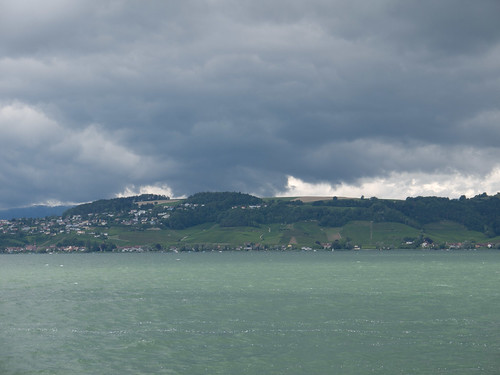
Le lendemain, journée lacustre: Morat-Neuchâtel-Bienne-Neuchâtel-Morat. On a réservé notre repas sur le bateau la veille et embarqué à 10h, heure encore raisonnable. Il ne faisait pas très beau, ce qui veut dire qu’il y avait de la place pour s’asseoir (dedans!) — et comme toujours lorsque je me retrouve dans un cadre magnifique sous un temps non-idéal, j’ai pris note que c’est beau, très beau, même quand il fait moche. Moralité: quand il fait moche, allez dans la nature, plutôt que de rester en ville.

Concure Fribourg Région Morat Trois Lacs 1.jpg

Concure Fribourg Région Morat Trois Lacs 5.jpg Concure Fribourg Région Morat Trois Lacs 8.jpg Concure Fribourg Région Morat Trois Lacs 9.jpg

J’ai adoré cette croisière. Une journée à ne rien faire. Au retour de Bienne, il faisait un peu plus beau, et j’ai passé l’après-midi à l’extérieur, bien emmitouflée dans mes diverses couches et mon ciré.

Concure Fribourg Région Morat Trois Lacs 12.jpg

Les canaux qui relient les lacs sont vraiment jolis et calmes.

Concure Fribourg Région Morat Trois Lacs 11.jpg

Concure Fribourg Région Morat Trois Lacs 13.jpg

Concure Fribourg Région Morat Trois Lacs 10.jpg

Et allez, la petite famille de cygnes, juste pour le plaisir des yeux et du coeur:

Concure Fribourg Région Morat Trois Lacs 14.jpg

Bref, pour ceux qui aurait sauté un peu tous les passages descriptifs pour se retrouver à la fin de mon article (et pour ceux qui désirent un résumé):

L'intimité au travail (Stefana Broadbent) — à lire absolument [fr]

[en] A great read, if you understand French: "L'intimité au travail" by Stefana Broadbent. If you wan't read her book, at least watch her TED talk.

IMG_1749.jpgJe viens de finir de lire “L’intimité au travail”. Stefana Broadbent fait une lecture fine et pertinente des enjeux liés aux nouvelles technologies à la place de travail, et met le doigt sur ce que je “sens” et tente d’exprimer maladroitement depuis des années. Les problèmes ne sont pas ces technologies en elles-mêmes: elles dérangent (comme le téléphone mobile et facebook à la place de travail) en tant qu’elles rendent visible des transgressions du contrat social à la place de travail, par exemple.

A lire absolument pour tous ceux qui s’intéressent:

  • aux médias sociaux et aux nouvelles technologies à la place de travail
  • à l’intégration des TIC en milieu scolaire (un splendide exemple vers la fin du bouquin)
  • à la question de la frontière entre vie privée et vie professionnelle, et son effilochement
  • à contrer l’argument-massue-bidon de la “perte de productivité” si on donne accès aux médias sociaux dans l’entreprise
  • aux réels facteurs de danger et de risque dans les incidents impliquant l’usage abusif de la technologie
  • à l’évolution de la notion de “travail” et des mesures de contrôle variables en fonction de sa nature
  • je pourrais continuer…

Ce sera en tous cas une lecture chaudement recommandée aux étudiants de la formation de Spécialiste en médias sociaux et communautés en ligne!

Solar Impulse fait demi-tour et la presse fait… trois petits tours? [fr]

Update mardi 14 juin, 12h30: Solar Impulse effectue en ce moment sa deuxième tentative pour rallier le Bourget, à suivre en live sur le site!

Bon, écrire un titre, je vous l’accorde, ce n’est pas toujours simple. Mais franchement, depuis que Solar Impulse a annoncé que l’avion retournait sur Bruxelles plutôt que de continuer vers Paris, je suis simplement scandalisée par la piètre qualité de certains titres et papiers rapportant l’incident.

Solar Impulse décolle de Bruxelles, dans les nuages. Photo : Claude M. CAUWE.

Primo, les sources accessibles à tout un chacun via le site de Solar Impulse, en particulier:

Malgré mes rapports professionnels avec Solar Impulse ces temps, je n’ai pas eu accès à des infos privilégiées sur ce coup-ci, donc tout ce à quoi j’ai eu accès, le reste du monde y avait accès aussi (y compris les journalistes).

Au moment du demi-tour, il était très clair pour moi que:

  • André n’avait pas pu rentrer le train d’atterrissage, mais que ce n’était pas un gros problème en soi de voler avec, si ce n’est que ça freinait un peu l’avion
  • L’avion avait décollé tard de Bruxelles (18h36), avec donc peu de temps de vol “jour” pour stocker du soleil
  • Il y avait pas mal de nuages, pas mal de vent, et je crois même avoir entendu qu’il s’est fait pleuvoir un peu dessus
  • Avec un fort vent de face, l’avion avançait à 17 noeuds au sol au lieu des 30 escomptés: les batteries allaient donc se décharger plus vite, et le vol durer plus longtemps.

Quelle n’a donc pas été ma surprise (et ma déception!) quand j’ai commencé à voir pleuvoir sur Twitter des tweets parlant de “problèmes techniques” et même “d’incidents en série”. J’avais l’impression de n’avoir pas assisté au même vol! C’est peut-être une question de définitions, mais pour moi, “météo” ça ne rentre pas dans la catégorie “incident technique”.

Je ne mentionne même pas l’utilisation généreuse du mot “échec”, qui, franchement, pour un prototype qui effectue un vol encore jamais tenté auparavant et dans des conditions relativement peu favorables (météo), est un peu… ingrate?

Vous voulez des exemples? En voici.

Lesoir.be, pour qui “Solar Impulse fait demi-tour suite à des problèmes techniques” (on lit même dans l’article “L’avion a connu de nombreuses difficultés depuis son départ de Bruxelles.”) — lesoir.be qui s’est d’ailleurs déjà distingué en faisant subir un changement de sexe à la merveilleuse Elâ Borschberg, qui administre de main de maître le blog, le compte Twitter, la page Facebook, le supporters’ program, et tant d’autres choses.

[blackbirdpie url=”http://twitter.com/tdgch/status/79644994977280000″]

La Tribune de Genève titre hier “Problèmes techniques: Solar Impulse fait demi-tour et retourne à Bruxelles” et ne se rattrape pas aujourd’hui avec “Solar Impulse atterrit à Bruxelles après une grosse frayeur” (coupable du même titre: 24heures — et en passant c’est vraiment bête, parce que leur article n’est pas si mal).

7sur7 nous dit que “Solar Impulse rebrousse chemin pour soucis techniques“. TF1 ne nous étonne pas avec “Solar Impulse et le coup de la panne” (mythique, à ce stade j’imagine déjà l’avion rentrer en clopinant à Bruxelles, tracté par un petit avion de tourisme). A la RSR: “Un premier échec technique pour Solar Impulse“.

Ladépêche.fr nous annonce “Echec de l’avion solaire” — là, c’est tout le projet qui tombe à l’eau, visiblement. (On note en passant l’utilisation d’une image de synthèse de l’avion qui date de Mathusalem, alors que rien que sur Flickr, on a déjà bien mieux — j’ose à peine mentionner les magnifiques images disponibles de la part du service de presse de Solar Impulse.)

En anglais, on tweete des choses comme

[blackbirdpie url=”http://twitter.com/entrepreneur_uk/status/79837567809372161″]

qui donnent l’impression que l’avion n’ira finalement pas à Paris (vous savez comme c’est, Twitter: on ne lit pas toujours les articles, on voit passer les titres, et ceux-ci sont du coup d’autant plus importants comme véhicule d’information). Ici aussi, “Solar-powered plane abandons Paris flight“, où l’on rapporte allègrement “a series of technical problems” et “a series of glitches”, du resucé de l’AFP, en fait.

Après, il y a aussi les petits détails qui nous montrent à quel point un certain journalisme est du copier-coller de communiqués (on le savait déjà, mais au point d’y laisser des guillemets au mauvais endroit, ça donne vraiment l’impression qu’on ne lit pas ce qu’on colle):

[blackbirdpie url=”http://twitter.com/stephtara/status/79854855803514881″]

Guillemets mal placés, on regarde même plus ce qu'on copie

France Soir essaie de corriger la citation (“Solar Impulse: Echec et demi-tour“) mais du coup, André Borschberg se retrouve porte-parole plutôt que pilote:

Solar Impulse : Echec et demi-tour | France Soir

Oups.

Heureusement, il y a aussi des choses bien.

[blackbirdpie url=”http://twitter.com/BreakingNews/status/79711854166949888″]

Futura-Sciences: “L’avion solaire de Solar Impulse n’a pas pu atteindre Le Bourget“.

Aerobuzz: “Solar Impulse contraint au demi-tour“.

RTBF a pris la peine d’inviter André sur leur plateau et a fait un petit sujet bien informatif, j’ai trouvé.

Il y a aussi les tweets d’André (je suis très fière de mon élève), son compte-rendu sur le blog, l’atmosphère sur Twitter entre “suiveurs de #solarimpulse“, et les magnifiques vidéos tournées par l’équipe multimédia. Celles-ci, par exemple, du décollage et de l’atterrissage à Bruxelles:

Je vous conseille aussi de lire l’article de Martin Gillet, dans la même veine que celui-ci: “Why Solarimpulse’s return to Brussels is not a failure“.

Swiss Vibes: faire connaître la musique suisse à l'étranger, from jazz to pop [fr]

[en] Swiss Vibes is a project I worked on -- a musical compilation to help the rest of the world discover upcoming Swiss artists. Listen to it, read the blog (if you understand French) and join our Facebook page!

Lors de ma conférence sur les médias sociaux à Montréal le mois passé, j’ai mentionné parmi les exemples que j’ai présentés un chouette projet auquel j’ai collaboré tout récemment: Swiss Vibes.

Swiss Vibes, from jazz to pop.

Swiss Vibes, c’est une compilation musicale présentant des artistes suisses, ayant pour vocation de les faire connaître au-delà de nos frontières. L’opération, qui a déjà eu lieu il y a deux ans, a été mise sur pied par Pro Helvetia et le magazine Vibrations — et cette année, sur l’initiative d’Elisabeth Stoudmann, Swiss Vibes prend pied fermement dans le monde numérique, avec un blog, une page Facebook (à “liker” SVP! ;-)), etc.

Sur le blog, interviews (Stefan Rusconi par exemple), vidéos (le “derrière la scène” de Imperial Tiger Orchestra), et toutes sortes d’infos sur ces artistes dont on ne parle pas assez.

Bref, allez écouter la compile (c’est varié!), allez lire le blog pour en savoir plus sur ces artistes helvètes, et parlez-en autour de vous, histoire qu’on sache qu’on fait de la chouette musique en Suisse, et pas juste du chocolat (si c’est valable pour les startups, ça l’est aussi pour la musique!)

Pendant que je suis dans le chapitre “musique suisse”, j’en profite pour attirer votre attention sur Jval Festival, qui a lieu à Begnins (vue superbe!) du 25 au 27 août, et dont le programme contient nombre d’artistes suisses (il y avait l’année dernière entre autres Oy et Anna Aaron, par exemple, qui font partie de la compile Swiss Vibes). Et n’oublions pas non plus de mentionner mes amis Laurent Brunetti et Mario Pacchioli. Ce dernier chante d’ailleurs toute cette année à Paris, accompagné d’Astrid Alexandre!