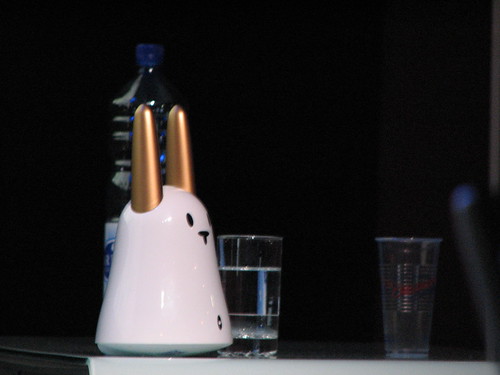
LIFT08: David Sadigh (User Retention) [en]

*Live notes of David Sadigh’s talk, possibly incomplete or misunderstood. Standard disclaimer, you know the drill.*

LIFT08 161

Who was connected to the Internet in 95?

Internet users get the same content, however they behave. But people are different! They should get different content.

– homepage bounces
– marketing and e-marketing campaigns are not well-optimized

98% of visitors leave an e-commerce site without buying.

2008: billions invested to drive more people to these websites. Lots of traffic but not enough sales. We would never accept results like that offline, why do we accept them online?

We don’t focus on user retention and customer experience.

Opportunity: sell more by delivering more relevant content.

Techniques: intentional, geographic, event, behavioral targeting. Push.

Intentional targeting example: you type “family holidays in Italy” in Google, and you get a sponsored link. When you click on it, you would land on the website but get a photo of a family instead of a boat on the sea in the header: that’s intentional targeting.

*steph-note: bunch of stuff on what is more clickable amongst certain Nespresso images.*

It’s not about clickthrough, though, but about sales. Or page views by a specific user.

*steph-note: a very quantitative approach, which is personally not very appealing to me, but which I understand is crucial for business settings today.*

Qik Interview by Robert Scoble [en]

Yesterday morning, Robert caught me for an express interview on Qik with his cellphone. Here it is. I speak about the beginning of my LIFT08 experience, and about Going Solo, of course.

Here is my blog post about the open speech talk I gave just earlier.

LIFT08: Paul Barnett [en]

Creative director. Between the creative vision and the huge raft of people who do all the work.

Is going to try and strip the gibberish away.

LIFT08 158 Paul Barnett

“Lots of people online doing things.”

Bother, too large to talk about! One of the things you can do online with lots of people: you can socialize. Social networking is massively popular and theoretically worth billions and billions!

Lets of people are making things and showing them off. “User generated” 🙂

“My cat was sick all over my grandma, and I videoed it. Wanna see it?”

*steph-note: this guy is really fun and I like his accent!*

Strange word: “entertainment games that make old-fashioned… something (money?)”

Objective: they do this really well, I want to give them money!!

Profit! Something his mum understands. Virtual making real money. Not sure why!

Decided to talk about two things:

– history of cinema
– ?? *steph-note: missed that*

Just like mainstream movies, games have:

– too many people working on them, cost way too much, miss their deadlines, and when people experience them, they go “I can do better!”

History of cinema: color… weren’t sure it would catch on. TV came, and they were convinced TV was dead. DVD. And yet, movies flourish.

They don’t have 5 changes in 50 years, but 50 changes in 5 years. They don’t have the generational thinking. People who are successful in this business build rockets to the moon and never come back. Technology keeps changing and they don’t know how to use it. They don’t have a clue about what’s going to be “the platform of the future”. They don’t know how to monetize it either. Problem: all the games that appear to make money online were built years ago. Problem in a moving market.

The online space is fun and draws new speakers.

Designers who design for designers cost a lot of money, speak gibberish, and you just have to believe them. Paul is the middleman, between various players in the industry who have different languages.

Casinos: like movies and games (cost a lot, not ready on time, and when you walk in “I can do this?”) Subscription model. Community management.

American system: if something works for somebody, build it bigger, better, faster… But that doesn’t work in the long run.

New design and thinking is happening online. Take your game design people, and put them online — fight insular thinking. Need to embrace the online industry.

LIFT08: Guy Vardi (Casual Games) [en]

*steph-note: live blogged notes, may be incomplete, etc.*

LIFT08 163 Guy Vardi

Casual games?

– “silly, stupid games”
– “games for the housewife”

*steph-note: video went way too fast for me.*

If a hardcore game is a full meal, a casual game is a snack.

Snacks are not dinner, say the WoW fans.

People play 2-3 hours a month, 3-15 times a month. (*steph-note: not sure I got that right.*)

Second largest money waster in the US after the subprime crisis 😉

Stats: rising phenomenon. People spend more time playing online games than watching clips on YouTube or interacting in social networking sites like Facebook.

Bite-side episodes. People want short stuff (video clips, TV episodes, music).

LIFT08: Robin Hunicke (Game Design) [en]

*steph-note: live blogged notes, may be incomplete, etc.*

LIFT08 151

Computers aren’t really fun. Frustrating. Games and AI, on the other hand, are.

Building and sharing is better than just building by your self.

A little bit of vocabulary to think about how games work, now.

Fun is a problematic word. Means different things to different people.

System: MDA

– Mechanics = rules as system, any game has rules
– Dynamics = what happens when the player interacts with the rules, without a player a game is just a set of rules
– Aesthetics = resulting experience, what comes from all these things together

Why kill books to make digital books? Why kill games to make digital games?

Games we played:

– dolls
– fort/army
– charades
– tag
– spin the bottle
– 4 square
– soccer

What is true about all these is that they involve groups of people. People are fun. Competition, mock violence, lies, hidden information, misinformation, love, family…

Power is hard to simulate. Magic circle.

What about digital games? Here’s what you might do in a game.

Start somewhere, do an activity, and when you’re good enough at it, you get a star. Progress! You get to upgrade: more weapons, cooler pants, more friends. Over and over again. (Scary!)

Not unlike going to work every day until you get a promotion, or going on dates until you get engaged.

Some popular aesthetics:

– I am a surgeon in a soap opera emergency room (Trauma Center)
– I am a girl discovering her past, which is strangely haunted (Trace Memory)
– I am an attorney solving odd crimes and protecting the innocent (Phoenix Wright – Ace Attorney)
– I am a warrior in a war-torn land (…)

There is a reason these aesthetics get explored in games.

What are we learning?

Making things we get out of games seem more and more real: hard work! The aesthetics can override the mechanics: ex, the Wii.

Take the power of something that’s pretty complex, simplify it into a smaller form, you get something magical. The market is saying they want more of that.

Facebook is a game. One of the most compelling social applications out there.

– chatty
– social
– automatic
– selective
– fast
– repetitive
– rewarding

Adding friends, chatting, adding, chatting, adding, chatting…

It’s a huge franchise from a games perspective.

Stars?

– more friends
– graffiti
– gifts
– hugs
– laughter
– wins
– pictures

Work and rewards

It lets me decide how to use it. Lets me decide what the game is about. I don’t have to have the hugs application. Facebook is about me the human being, about the people who use it.

Aesthetic on Facebook: I am a person living a fun life… 🙂 I am loved.

Do you give hugs?

LIFT08 155 Robin Hunicke

Flickr, Dopplr. Not giving people actual points, but giving them space to create and play.

– I vote
– I invest
– …

Small steps: mobile, creative, communicative, always almost now.

House of the future. Aesthetics that are available to me. Game design is literacy. All apps can do this. Smile more.

LIFT08: Zentrale Intelligenz Agentur (Holm Friebe & Philipp Albers) [en]

Very incomplete notes. What these guys are doing seems really exciting.

Quality and nature of work changing. Lots of people from our generation are discontent with the opportunities they find in organizations, career opportunities.

The Hedonistic Company. How do you integrate the new generation into companies?

LIFT08 143

7 NOs:

  • no office
  • no employees
  • no fixed costs
  • no pitches
  • no exclusivity
  • no working hours
  • no bullshit

steph-note: guys, we need to talk about Going Solo! Gah, computer crash… rebooting

LIFT08: Kevin Warwick, the "Cyborg" [en]

steph-note: live blogged notes, may be incomplete, etc. Kevin is exploring where the machine starts and the human stops.

Two things:

  • chips in humans
  • rat brains in robots

LIFT08 139

Working with Parkinson’s disease — deep brain scans to try to detect the illness before the tremors begin.

Research partly to help people, partly for enhancement. Eg. man who lost his arm to cancer, and has a robotic hand, but must use his exiting hand to control the robot arm. A bit silly! Would be better if he could control it directly — that would require an interface between the arm and the brain/neural system.

Increase sensory range.

Kevin has a chip with 100 electrodes implanted (fired!) in the nervous system of his left arm. 4mm in diameter.

steph-note: wondering if that hurt?

For three months had his nervous system partly out of his body. (Had to be careful to not short-circuit it when taking a shower). Part of this was to experiment stuff to help people with disabilities.

steph-note: not sure I quite understood what the thing sticking out of his arm was — something to link him to the computer — and also if the chip was removed after three months or not.

When Kevin was connected to the internet, if you had known the IP address of his nervous system… But what they did is not tell anybody what they were doing until they had done it. Careful not to get your nervous system spammed or hacked!

Highlights from the experiment. Output from the sensors fed to his nervous system (fancy thing on his wrist).

LIFT08 141

When an object came closer, his brain received and increased frequency of ultrasounds (?). So basically with a blindfold on, Kevin was able to move around and detect objects pretty accurately. Not what they were, but where they were.

“It felt like something was coming close to me.” Extended the sensory range. Like “what does it feel like to see something”?

LIFT08 142

steph-note: showing a short video clip. It makes Kevin sound like Terminator! Will add link if somebody gives it to me.

Experiment with his wife: when his wife moved her hand, he felt it. He could actually feel her movements.

steph-note: Daleks in the video!!! I find it hilarious — the angle this video takes.

Jewellery his wife wears, and the colour changes with his excitement: blue, calm, flashing red: excited. “What is he doing? and with who!?”

Through the internet, made a robot hand mimic what his hand did, with feedback. Objective: hold an object. Good news for people who have been amputated. But also, stretching Kevin’s body across the Atlantic.

His wife had wires pushed into her nervous system from the outside. Very painful! But no anesthetic, because the doctor said he needed to see if he made good contact. It hurt!!

Linked their nervous systems. When she moved her hand, his brain received pulses. Worked very well. Vice-versa: “like lightening running through her hand” when Kevin moved his.

Kevin’s research is now moving from nervous system to the brain directly. Brain to brain communication! Telepathy. Ideas, codes, concepts, images. Upgrade these humans. Communicate in a respectable way!

Questions:

The implant was taken out because the wires coming out were starting to break, it was an experiment — a lot of practicalities.

Kevin’s experiment changed the way people look at things medically. “Cyborg” is not anymore a purely SF term.

Lots of things could have gone wrong with the experiment, but as a scientist, it was tremendously exciting! Discovered stuff about the nervous system that nobody knew, because nobody had done this before. Scary but really exciting. Rollercoaster.

It took Kevin’s brain six weeks to recognize the electric pulses it was receiving as a “distance radar”. Boring time, but it took that time to train his brain, and it adapted — he actually “felt” how far things were.

What next? Research on Parkinson’s, by analysing deep brain scans to predict tremors. Also with epileptic patients to try to see when the fit is coming. Parkinson’s: can predict tremors 15-20 seconds before they happen! With epilepsy, 25-30 minutes! steph-note: wow. This can change the patient’s lives!

Cultured brains. After a week, a rat’s brain starts having some “neural firing” (activity), and after a month it’s starting to act like a brain. All the brain knows is that it drives the robot. Not good drivers! Now, trying to teach these biological brains how to drive the robot better. Lots of philosophical questions. steph-note: so, from what I understand, they don’t remove brains from rats, but grow them. Cultured neural networks. Artificial intelligence. steph-note: Cylons!

Watch the video:

Watch a shorter video excerpt about extending his sensory range.
On Being Wiped Out [en]

[fr] Epuisée mais contente. Si je ne vous reconnais pas, si je vous demande trois fois votre nom, si j'essaie de vous donner des cartes de visite trois fois... soyez indulgents. Je suis hyper contente de la réception de mon discours sur l'histoire de Going Solo.

My poor brain can’t follow anymore. I’m loosing track of who I speak to, who I’ve met, who I’ve given Going Solo moo cards too (even to my friends). I’m delighted with the reception of my speech about Going Solo — swept off my feet, even.

Many people have come to tell me they liked my speech, that it was inspiring, that they are going to come to Going Solo, that they want to interview me (I’ve lost track of the number of interviews I’ve given today, honestly), or talk about partnerships or possible synergies.

I’m feeling bad, because I was invited as one of the electronic media crowd to live-blog the event, and I think I’ve done a really crappy job of it. I hope to earn my pass tomorrow.

I’m not feeling overwhelmed as I was at FoWA, because I’m happy rather than frustrated and anxious. But I can’t keep up. Don’t get me wrong, I want to speak to you, and I’m going to. I also know that this is important for my event 🙂 — but if I look a little exhausted, if I ask you your name three times, try to give you Moo cards twice, or forget what you just told me… please be indulgent!

LIFT08: Eric Favre [en]

*Live notes that don’t really do justice to the talk — I had trouble keeping up.*

LIFT08 088 Eric Favre

Passion is a necessary ingredient to invention (hence the presence of his wife here). Eckert is one of the first inventors, for Eric Favre. He invented a 20-ton, 18’000-light machine: the first “computer”. Modern maths.

How to make the best coffee: put the coffee in a little bag. Found a place where they made the best coffee in Italy. His wife befriended the guy who made the best coffee and asked him the right questions. Each time he lifted the “piston” he inserted air in the coffee — that was the trick. Air + water + coffee = expresso.

Role of women in marketing a product.

*steph-note: sorry, I’m having trouble following this coffee stuff. I don’t drink coffee…*

Innovation and invention are not the same thing.

Eric’s father was an inventor (lived his whole life off the invention he made when he was 18). In the genes? Maybe more contact with inventors.

LIFT08: Rafi Haladjian [en]

*Note: live notes, probably incomplete, possibly misunderstood. Please post comments, links to photos, videos, or other coverage in the comments. Rafi founded Minitel start-ups, and now makes wifi rabbits.*

LIFT08 087 Rafi Haladjian

Calm technologies. Attention economy: screens require an exclusive attention span — putting more things on the screen is maybe not a solution. Why not provide information through other channels?

In the beginning, chips were expensive. 1 computer for several users. Then chips became more affordable, and today, so cheap you can stick them everywhere. 1 user, several computers.

Why do teddy-bears speak? They used to be pure plush, and now they have a chip and sing stupid songs.

All home appliances networked: never happened. Why?

– not that appealing, no fun
– expensive and not that sexy (too much effort)
– proprietary tech, complex to set up
– loss of control

Violet’s strategy:

– affordable products
– not too useful, because too useful is boring
– expanding the internet, not something radically new
– user in the middle, control
– don’t think you can do everything: open standards, let the community in

Nabaztag

LIFT08 086 Nabaztag

– proof of concept
– “If you can connect a rabbit, you can connect anything.”
– somewhat absurd
– rabbits are cute and have ears
– there is a life after the PC
– light, speaks, music, reads, moves ears, hears, RFID reader — does all sorts of things
– use? short reports, read RSS feeds…
– emotional messenger, physical avatar of your friends
– rabbit marriage — very stupid but people love it (ear movement sync)
– sold with Gallimard RFID-enabled children book (can read it — a step back from the idea that the future of books is electronic)