Short FOWA Complaint [en]

[fr] FOWA: wifi foireux et peu d'accès aux prises d'alimentation. C'est suffisant pour gâcher une bonne partie de la conférence pour les participants-blogueurs (surtout si on leur a donné un passe pour couvrir la conférence en direct)...

I’m here to live-blog, which must be a recognised activity as I got a “blogger” pass for it. However: the wifi is crap (sorry, I know it’s easy to complain, but it’s making my life difficult — uploading photos is a nightmare), and the power plugs are right at the back of the room. I think that crappy wifi and lack of power supplies are two things which can single-handedly ruin a good part of the conference experience for blogging attendees. Oh, and the rows are so tight that unless you sit in the front row, there isn’t enough space to type comfortably.

Do they really believe that people live-blogging the sessions are going to sit right at the back of the room? I take photos too, so I need to be in front. And the whole “power up then go back to it” idea just doesn’t work: there’s a session going on while I “power up” which I might want to follow!

Then, please let me say a word about the £4 sandwich I bought at the break. I know this is England, but… arghl! There are water fountains at the back of the room, but really (particularly when you’re blogging) bottles are way more practical. Which reminds me… I have an empty bottle with me, so I’ll do something smart and fill it up instead of just complain aimlessly (blame a bad day yesterday, food deprivation, and dehydration).

Oh, and next time, I have to remember that these boots are not good for sitting cross-legged on the floor. The talk in this room (which I’m only half-listening to, unfortunately) is about accessibility and actually sounds very interesting. I saw Suw typing madly a bit further down the row, so hopefully I’ll be able to read about it.

Aside from that, I’m really happy to be here and see everybody!

SET MODE GRUMPY OFF

Update: Suw wasn’t very happy either.

FOWA: We've Got This Community: Now What? (Heather Champ & Derek Powazek) [en]

[fr] Notes prises à l'occasion de la conférence Future of Web Apps (FOWA) à Londres.

Here are my live notes of this Future of Web Apps (FOWA) session with Heather Champ and Derek Powazek. They are probably incomplete and may contain mistakes, though I do my best to be accurate. Chances are I’ll be adding links to extra material later on, so don’t hesitate to come back and check. See Derek’s post about this, and Suw’s notes of this session.

FOWA 2007 7

Telling stories.

Chelm Sweet Chelm

Angels, trying to distribute something (?), and one of the sacks ripped and the contents spread out in the valley, and that valley became the town of Chelm (idiots). steph-note: sorry, very confused, wasn’t concentrated.

So, lots of stories around that. When you run a community site, you sometimes feel like you are living in Chelm. How can you make the most of your life in Chelm?

Heather and Derek are going to tell us some Chelm stories.

Derek will tell the first one, because it’s embarrassing to Heather’s employer.

Yahoo including photos tagged “wii” in a page. But you don’t really tell anybody about it. Users revolt: start tagging all sorts of things “wii”:

FOWA 2007 15

Heather: being the mothership, you’re always held to higher standards by your community. Do the right thing, beyond the legal requirements. Yahoo had the right to do this, but that didn’t make it “right”.

Derek: provide copious opt-outs.

FOWA 2007 17

Heather: last year, Flickr realised they were going to have to take the DB down (it was bad). So they decided to turn it into a contest instead of just displaying the “massage” message. Something like 2000 different entries. People responded really well. Gave away something like 16 Pro accounts instead of the 1 they had planned.

Derek: when you fucked up, say you fucked up. Confess. You can earn a lot of credibility like that. When you suck, own up.

FOWA 2007 18

Other example: FOWA sending out marketing e-mail to the “wrong list”, the ones who had opted out. “We screwed up!”

Don’t keep score. Here are the top… can be a really excellent way to motivate people when you’re playing a game. But with most web apps, it’s not about playing a game, it’s about sharing your photographs, telling stories… Use these scoreboards when you want to play a game. Otherwise it can actually work against your community.

Heather: Flickr interestingness. This is the only place in the Flickrverse where people are ranked. It was pretty bad when they launched (500 most…). It created aggravation and angst. Now it’s a randomly loaded page.

Derek: the goal of interestingness is to see some interesting photos. The error was showing them in a ranked order. “Hey, look how many photos are more interesting than mine!” Gaming behaviour can lead to a negative experience. (e.g. people trying to get to the front page of digg.)

Use scores where they make sense.

Heather: important to put an editorial layer on the “stuff”. “Contribute a photo of your day”: 20’000 people in the group, 7000 contributed photos, and 122 selected to be in the book. One way of bringing people to the forefront and rewarding them in a more collaborative way than just ranking.

Derek: producing print stuff is often seen as a money-maker. But actually, providing physical real-life things is actually a great motivator to encourage people to participate in your online community. JPEG Mag. Great photographers online, but never seeing anything in print. Getting published in the book was enough to get people motivated to participate in the virtual community.

Rip that band-aid (Heather): the old skool merge thing. Flickr knew at some point they would have to migrate everyone to Yahoo IDs. Waited 18 months, and at some point… it’ll be in 6 weeks. Significant change that’s difficult for the community: don’t wait 18 months. 6 weeks is a good time. Discuss about it, answer people, but then do it, hold firm. Sometimes you have to do things that are unpopular. If Flickr hadn’t waited 18 months… would probably not have been that painful.

Derek: community, manage thyself. Give people the tools they need so that they can be the community manager for you. Build tools to support that. In Flickr: I manage comments for my own photos. It’s my spot, so I’m my own community manager. Heather: it allows people to establish the guidelines for themselves.

Community expectations: Heather loves lawyers. Pages and pages of terms of service. Expectations of what your role is to be in that community. Flickr didn’t have community guidelines when it began. At some point, they understood they needed a way to put those expectations in human-readable format. “Don’t be creepy. You know the guy. Don’t be that guy.” 4-5 bullet points. Doesn’t supercede the TOS, but helps make expectations understood. Understand that nobody reads those legalese TOS.

Derek: don’t create supervillains. We usually have sites with free membership. Anybody can create an account. First community moderation tool: “boot member”. But the booted member can come back, create another free account, but this time he’s pissed. Booting people creates supervillains. Come up with clever ways to minimize their damage, contact them directly, person-to-person. Design community so one person can’t make too much damage. E.g. one site, if you get on their “bad list”, the site just gets slower and slower for you. That’s clever!

Heather: members of your community are passionate. Passionately good, and passionately… passionate.

Derek: know your audience. Eg. Tahoe thing: create your own ad. But actually, all you could do was actually add some text. So they went wild, of course. Be careful how tiny the box is you put people in. Here it was tiny, people rebelled. You couldn’t do much. Constraints are good, but if there are too many, people rebel. Also, their site was available to everybody on the internet, not just Tahoe owners.

Last and most important lesson: embrace the chaos. When you create something where people have a voice, they’ll do something you don’t expect.

Heather: small company which had 4 computers stolen, one of the laptops had PhotoBooth set up to upload automatically to Flickr. Some dude with astounding tattoos unwittingly uploaded PhotoBooth photos to the company’s Flickr stream. “OMG, this could be the guy who got our computer!” To cut a long story short, this guy was “known to the police”, and his lawyer saw a piece about this in the local paper, and told him to turn himself in… which he did.

Ex: person who used geolocating photos to spell “fuck” over Greenland. Lots of hard work there!

Incorporate these things as you go forward.

Derek: pet profiles on Friendster, which they wiped out in a week-end! Created a business opening for Dogster/Catster. When people misuse your site, they’re telling you there’s something to do there. Sometimes the misuse is the most valuable input you can get.

Q: how do you deal with requirements from the mother company regarding the way you manage your community?

A (Heather): not much has “come down”. Often, the answer is education. Talk to people — lots of misguided “requirements” come from the fact they don’t really understand your community.

Derek: design for selfishness.

Q: How do you balance community with commerce?

A (Derek): fable that community and commerce have to be separate, but that’s wrong. We talk about “commerce” a lot with our friends (products, etc). JPEG: been very upfront about “what we’re doing with your work”, “what you get out of it”. Set expectations well in the beginning.

Heather: two kinds of Flickr accounts. Pro, you don’t see ads. Is it worth the money for user X? Running a community costs money. Somebody has to pay for it. “The web is free”: to a certain extent, but when it involves huge amounts of hardware, somebody has to pay for it.

Q: (?)

A (Heather): if you have a global community, you want to ensure that people can express themselves — but when it gets member-on-member, that makes her uncomfortable (abuse). “What’s acceptable in the community?” Have a “report abuse” link in the footer of every page of the site. If you come down too hard saying “you can’t say that”… Trout-slapping. Huge question. Some people join communities just to be trolls.

Derek: if something inappropriate is happening in a global forum, create a place where it’s appropriate, and send people there to discuss it, so the rest can get on with their lives.

FOWA: What is the Future of Web Apps? (Ryan Carson, Om Malik, Michael Arrington) [en]

[fr] Notes prises à l'occasion de la conférence Future of Web Apps (FOWA) à Londres.

Here are my live notes of this Future of Web Apps (FOWA) session with Om Malik, Michael Arrington, and Ryan Carson. They are probably incomplete and may contain mistakes, though I do my best to be accurate. Chances are I’ll be adding links to extra material later on, so don’t hesitate to come back and check.

steph-note: arrived really late to this session (not quite as late as Arrington, though), so vaguely trying to pick up a few snippets here and there as I get organized for the day.

FOWA 2007 3

Gphone. Gphone. Gphone. steph-note: as I was entering the room.

Launching a DRM-free music store would be a good business idea right now. But please, says Om, not another Office clone. We have enough.

Plugins. Facebook. Organizing the buddy-list. Facebook Appls: we haven’t seen that many game-changing apps (besides Scrabble, says Om).

Om: Facebook as directory service. Ryan: critical mass. BBC/Radio4 talk about Facebook.

Arrington thinks there is a chance that Facebook will go the portable social network way. (Ryan seemed skeptical.)

Arrington: more mobile stuff, and more “virtual reality” — using your body to interact with the computer.

Om loves his Crackberry.

BarCamp Lausanne: former des « webmasters 2.0 »? [fr]

[en] Discussing the differences between skills of the old-school webmaster and the "webmaster 2.0" (eeek!) -- basically, a profile for the one to take care of site maintenance once we've done shiny 2.0 things with WordPress and plugins. It's a different skillset, and I'm not certain it's the same kind of person.

Samedi, à l’occasion du premier BarCamp Lausanne, j’ai animé une discussion sur l’avenir du métier de webmaster. Je pense que c’est un rôle qui se voit profondément transformé par l’arrivée du tout l’attirail « 2.0 », et qui est donc effectivement en voie d’extinction tel que nous le connaissons encore aujourd’hui. Je pense cependant qu’il reste une place pour ce que j’appellerai le « webmaster 2.0 », quelque part entre les consultants, développeurs, designeurs, professionnels de la communication ou autres qui se partage le gâteau 2.0.

Cela fait quelques années maintenant que « j’aide les gens à faire des sites » (c’est malheureusement principalement comme ça que je suis perçue — j’ai encore de la marge côté efforts en communication). Je me rends compte que si des outils magnifiques comme WordPress permettent de se libérer du webmaster pour de nombreuses tâches (c’est en effet un « argument de vente » : plus besoin de s’adresser au webmaster pour mettre à jour le contenu de votre site), ils ne sont tout de même pas autosuffisants : ils cessent des fois de fonctionner pour des raisons mystérieuses, il faut les mettre à jour, installer des plug-ins, faire des modifications mineures… Bref, ils requièrent de la maintenance.

Mon point de départ pour cette discussion lors de BarCamp était de mettre en regard les compétences du « webmaster » (j’expliquerai tout soudain les guillemets) avec celles qui seraient à mon avis nécessaires pour la maintenance de sites simples « 2.0 ». Ce rôle (je préfère parler de rôle plutôt que de « métier ») de webmaster disparaît-il, ou bien évolue-t-il ? S’il évolue, les compétences sont-elles assez similaires pour que ce rôle soit repris par la même personne, ou bien ce qu’il requiert un « background » différent ?

Donc, « webmaster » entre guillemets. Inévitablement, je vais parler ici en utilisant des clichés. Les webmasters qui me lisent ne se reconnaîtront probablement pas, et je le sais. Ce que je décris, c’est un des rôles un peu stéréotypés qui intervient dans l’écologie du site Web. Ce rôle (tel qu’il m’intéresse pour cette discussion) se retrouve dans des petites structures (petites entreprises, associations). Il y ait des professionnels qui portent le titre de « webmaster » dans des entreprises plus grandes ou avec plus de moyens, et qui font un travail qui n’a rien à voir avec ce que je décris ici. Le « webmaster » auquel je pense n’est souvent pas un professionnel de la branche, et ne fait probablement pas ça à temps plein. C’est quelqu’un que l’on paye à l’heure ou sous forme de forfait pour l’année, et dont on utilise les services de façon plus ou moins régulière.

Sandrine a eu la gentillesse de spontanément filmer le début de ma présentation, disponible en vidéo chez Google. Il y en a pour treize minutes, je vous laisse regarder si le coeur vous en dit.

Malheureusement, cela s’arrête lorsque la conversation démarre (le morceau le plus intéressant, à mon avis !) — j’imagine que des impératifs techniques sont entrés en ligne de compte…

Pour simplifier, même si je n’aime pas les étiquettes, j’ai proposé que l’on parle de « webmaster 1.0 » et de « webmaster 2.0 ».

Webmaster 1.0

  • FTP
  • mise à jour de contenu
  • HTML/DreamWeaver
  • scripts Perl/PHP
  • images (redimensionner, insérer dans HTML)
  • design (un peu)
  • mailing-lists/newsletter

Webmaster 2.0

  • mises à jour (versions) des « CMS 2.0 »: WordPress, Drupal, MediaWiki, PhpBB…
  • choisir et changer des thèmes/skins
  • compréhension de base du fonctionnement d’un CMS (applications Web PHP/MySQL, quelques notions de base de données, utilisation de PhpMyAdmin…)
  • (X)HTML/CSS, standards Web
  • installer des plug-ins

En fait, le rôle du webmaster 2.0 correspond un peu à celui d’un apprenti sysadmin. Cela reste un rôle technique, la gestion de la communauté étant à mon avis du ressort des personnes qui vont créer le contenu.

Ma motivation principale à tenter de définir ce rôle est en fait économique : bien sûr, un développeur ou un consultant un peu branché technique (comme moi) est tout à fait capable de remplir ce rôle de webmaster 2.0. Mais il n’est pas nécessaire d’avoir toutes les compétences d’un développeur ou d’un consultant pour faire ce genre de travail. Cela signifie qu’il ne devrait pas être nécessaire pour le client de payer du travail de maintenance relativement simple (même s’il requiert des compétences techniques qui dépassent celles de l’utilisateur lambda) à des tarifs de consulting ou de développement. Et personnellement, ce n’est pas (plus !) le genre de tâche que j’ai envie de faire pour gagner ma vie.

Mon expérience est que malheureusement, les personnes en place à jouer le rôle de webmaster 1.0 peinent souvent à acquérir par elles-mêmes les compétences nécessaires pour assurer la maintenance des sites « 2.0 » plus complexes techniquement. Si le webmaster 1.0 est souvent autodidacte, les compétences « 2.0 » sont à mon avis plus difficile à acquérir par soi-même — à moins d’être justement tellement immergé dans ces technologies que l’on est déjà un développeur.

Qui donc pourraient être ces « webmasters 2.0 » qui manquent à mon avis cruellement dans le paysage romand ? Peut-être serait-il intéressant de mettre sur pied une formation continue pour « webmasters 1.0 » ? Le problème avec ça à mon avis, ce que beaucoup de webmasters le sont à titre bénévole ou presque. Est-ce qu’il y a des CFC qui pourraient inclure ce genre de compétences à leur programme ? Pour le moment, la solution qui me paraît le plus immédiatement réaliste est de considérer ce rôle comme une étape de l’évolution professionnelle de quelqu’un. À ce moment-là, cela pourrait être un travail idéal pour des personnes en cours de formation.

Quentin Gouédard, à la tête de l’hébergeur unblog.fr, a suggéré lors de la discussion que ce genre de service pourrait être intégrée à une offre d’hébergement. C’est une idée que je trouve très intéressante.

J’aimerais revenir sur un pont qui a occupé pas mal notre discussion : il y un certain nombre de tâches de maintenance, qui même si elles sont techniques, sont encore relativement simples, et qui ne nécessitent à mon sens pas de faire intervenir des développeurs. Je pense qu’à l’avenir, on va avoir de plus en plus besoin — par intermittence probablement — de personnes ayant cet éventail de compétences, sans pour autant qu’ils aient une spécialisation plus poussée. Je pense aussi que (durant les quelques années à venir en tout cas) ces personnes devront avoir une présence locale. Le contact humain direct reste important, surtout pour des associations ou entreprises dont le métier premier n’est pas le Web.

J’ai conscience que ma réflexion n’est pas encore tout à fait aboutie. J’envisage en ce moment de former deux ou trois étudiants à qui je pourrais confier la maintenance (ou tout du moins une partie de celle-ci) des sites que je mets en place avec mes clients, pour un tarif raisonnable. Je ne peux en effet pas proposer à mes clients des solutions pour leur présence en ligne, si je n’ai rien à leur offrir côté maintenance. La maintenance ne m’intéresse personnellement pas en tant que tel, mais j’avoue ne pas avoir connaissance dans la région d’individus ou d’entreprises dont les compétences sont satisfaisantes et qui ne facturent pas des tarifs de développement (sauf ceux dont on a parlé, Samuel, et c’est justement la solution « étudiante »).

Avec un peu de chance, mes informations sont incomplètes, et quelqu’un va laisser un mot dans les commentaires en proposant ses services 🙂

Y a-t-il un webmaster (2.0) dans la salle ?

Ils parlent de cette discussion sur leur blog:

BarCamp Lausanne: Privacy (Julien Freudiger) [fr]

[en] Privacy... a tricky issue, as ever.

“Nothing to hide.” Est-ce que ça justifie de ne pas se préoccuper de privacy?

Julien fait une thèse sur le sujet. steph-note: j’espère qu’il ouvre un blog pour documenter sa recherche!

BarCamp Lausanne 33

Surveillance:

  • CCTV (on peut reconnaître quelqu’un à sa démarche => porter des schlaps) => et peu efficace côté incidence sur le crime
  • Wiretapping (CALEA) conversations téléphoniques + tous les ISP doivent laisser des portes ouvertes. Mais Skype, pas, car Skype est européen. Donc pour le moment, OK.
  • Banques (SWIFT): transactions internationales… les USA arrivent à contrôler les sommes d’argent transférées dans et hors des USA, alors que c’est interdit dans les autres pays.
  • Avions: doivent donner numéro de carte de crédit, peuvent fouiller nos affaires…

Ça semble un peu dramatique… ça fait beaucoup d’information! La NSA a un des systèmes informatiques les plus puissants au monde… caché quelque part.

=> Privacy Enhancing Technologies

  • Internet Anonymity: Tor
  • Data Confidentiality: PGP (bien, mais trop complexe)

steph-note: sympa, ce MacBook Pro sur lequel je tape… clavier très agréable… et pas si lourd!

Ces services fournissant l’anonymat sont aussi des sortes d’aimants attirant beaucoup de traffic “sale”, ou potentiellement illégaux. (e.g. gens qui utilisent Tor pour faire du P2P…)

Deux systèmes qui marchent bien mais que personne n’utilise.

Travail de doctorat de Julien: trouver des motivations économiques pour que les gens utilisent de tels services. Lack of concern. Lots of info on social networks. “Nothing to hide.”

Privacy vs. Security: si on renonce à notre privacy, on donne plus d’informations pour aider le gouvernement à nous garder en sécurity. Comme: la torture est interdite, mais si on demande aux gens s’ils tortureraient une personne pour en sauver 1000, bien sûr que oui.

BarCamp Lausanne 34

Terrorisme: aux USA, en fait, on “torture” des millions pour préserver quelques miliers. Les USA disent qu’ils ont gagné la guerre froide car ils avaient la liberté… Mais maintenant? le contraire…

Le fameux “nothing to hide” argument: steph-note: guilty. On perd la conscience d’être regardés/observés, sur Internet. La privacy n’est pas important que lorsqu’on a des secrets. C’est pas pour les secrets, ou les choses qu’on a à cacher. Ce n’est qu’un aspect de la privacy. “Web of things.”

Lorsqu’on perd des petites quantités de privacy, pour (on espère) gagner en security. Métaphone: Orwell; Kafka. Kafka a imaginé une société qui en sait plus sur nous que nous-même. Elle sait prévoir ce qu’on va faire — perte du sens de contrôle sur notre propre vie. Une petite série d’actes mineurs qui s’aditionnent. Sur internet, si on dit une chose une fois, c’est dit pour de bon. Très difficile de retirer de l’information.

La privacy c’est quelque chose de pluriel.

Data:

  • collection
  • processing
  • dissemination

Risque potentiel. Possibilité aussi que toutes ces données à notres sujet soient mal interprétées.

Valeur sociale de la privacy. Nécessaire à la construction de l’identité. Chacun a un espace de liberté dont la société bénéficie. Protéger la privacy = devoir social.

“Torturing Our Privacy”

BarCamp Lausanne 35

Où sont les abus?

WiFi: AP data sniffing. Pas très difficile de déterminer qui utilise un réseau (e.g. via l’accès à son serveur mail). Beaucoup de choses sont en clair. (Rajouter le s à http:// quand on est dans gmail…)
Social community phishing (“can I be your friend?”)
L’an dernier, il y a eu plus d’argent gagné par le cybercrime que le traffic de drogue.
Location tracking.

Compliqué: c’est utile pour moi comme utilisatrice, cette ouverture. Donc je n’ai pas envie d’y renoncer… mais quand même, comment protéger ma vie privée contre les abus, tout en l’ouvrant pour ma communauté.

Passer les captcha pour les spammeurs: ils les intègrent dans les sites pornos, donc les visiteurs les tapent pour voir l’image suivante, mais en fait sont en train de valider un spam quelque part.

ORG, EFF.

BarCamp Lausanne 36

BarCamp Lausanne: Wuala (Dominik Grolimund) [en]

[fr] Wuala: pour partager des données en ligne.

Wuala launched last week. Demo. (Closed Alpha.)

BarCamp Lausanne 30

Storing, sharing, publishing files. Desktop application. Allows you to search for files. “Free, simple, and secure.*

What’s new about it? Different technology. Decentralized.

Advantages:

  1. Free because uses resources provided by participating computers.
  2. You get 1GB free, and get more by trading unused disk space. steph-note: so basically, this is a service that allows you to convert local disk space into online storage — it doesn’t give you significant extra storage. You need to be online for at least 4 hours a day to do that. *steph-note: I find 1Gb very little. Gmail offers 3 times that.
  3. No traffic limits.
  4. No file size limits.
  5. Fast downloads. P2P. Like BitTorrent.
  6. You can stream music and video files.
  7. “We think it’s a great application.” Drag’n drop. Upload in the background.
  8. Simple.
  9. All in one place.
  10. Security and privacy. All the files are encrypted on your computer. Your password never leaves your computer. Not even Wuala people can see your files.

Demo.

BarCamp Lausanne 31

BarCamp Lausanne 32

steph-note: I feel annoying. I always ask if there are “buddy list groups” or complain about their non-existence (Facebook).

Use: mainly to share a few files with other people. steph-note: not sure I’d call this “online storage” as I find it a little misleading (gives the impression you get extra storage space outside your local drives) — this is really file sharing, Pownce-like but without the timeline. For example, Dominik’s mum is going to use this to share photographs with him, because she’s not comfortable putting them on Flickr as it’s “on the internet”. steph-note: I see this as an interesting alternative to dropsend and the like.

Question: what is the business model? Ads in the client. steph-note: alternate business model would be to make people pay to have more actual “storage”.

Privacy: in Switzerland, there are “anti-spying” laws which would protect Wuala from having to surrender data to the CIA etc., for example. Wuala doesn’t see what is private or shared (regarding content). Very strong emphasis on privacy. steph-note: “illegal” music and TV series sharing system of choice, if there is more storage. Problem with this strong emphasis on privacy is when people start using the service to trade kiddie porn. Dominik says one of the solutions to this could be to limit the size of groups.

Careful! if you lose the password, you lose your files. steph-note: ouch! this sounds unacceptable to me… no possibility to reset it? Secret question: I hate them, because they are usually very weak. What’s the point of having great encryption, secure passwords, if people give secret answers to secret questions which aren’t so secret?

Should keep a local version of all the files you share. steph-note: so this is really not extra storage. What makes it so different from a prettily dressed up FTP client, besides the fact that the underlying technology is different? From a user point of view? Encryption, and sharing with friends/groups.

steph-note: a bit skeptical about this, though parts do indeed sound interesting. Not sure what I’d use it for. Maybe to swap music.

BarCamp Lausanne: Facebook (Raphaël Briner) [fr]

70% des gens inscrits à BarCamp Lausanne sont sur Facebook. 30 contacts (médiane). Idée intéressante: donner à Facebook un fichier texte avec des noms, et en retirer une liste des relations etc. entre ces gens.

BarCamp Lausanne 24

Raphaël est sur Facebook depuis février 2007 (steph-note: je vous mets une saisie d’écran de son profil? 😉), n’a pas fait grand chose en deux mois. Juillet/août: lancement des applications Facebook => pénétration++.

Audience européenne a triplé en 2 mois. 42’000 en Suisse. Tilllate a des soucis à se faire. (Si ça continue, FB aura 200’000 utilisateurs en Suisse à Noël — autant que Tilllate.)

Design graphique old school en L. 5 tailles de typo, minimal. [analyse détaillée du design de Facebook.] Petits détails soignés, tout de même, malgré un design super classique.

Développé en PHP. Marche relativement bien.

BarCamp Lausanne 29

Objects à usage social principalement. Applications: plate-forme géniale pour ça.

Par rapport à MySpace, possibilité de se différencier: pas de MP3 illégaux, d’images dont les droits ne sont pas respectés, de vidéos piratées — ou uniquement via des applications tierces.

Intérêt de Facebook: pour l’individu, générer du “bruit” diffusé à un public restreint. Evite les problèmes de droit de distribution.

steph-note: intéressant comme présentation, bonne analyse du design (même si j’ai pas tout remis ici, ça me dépasse un peu j’avoue) — mais une analyse des enjeux sociaux est à mon avis à faire. Je me rends compte que j’ai des articles à écrire sur ce sujet en français.

BarCamp Lausanne: Marketing, communication etc. (Sandrine Szabo) [fr]

[en] Live notes of a talk on marketing at BarCamp Lausanne.

mes notes, avec toutes les imperfections d’usage.

Sandrine se retrouve souvent à l’interface entre le monde de la technologie et celui du marketing et la communication.

BarCamp Lausanne 17

“Le marketing, c’est comme la soupe: on aime pas forcément toujours, mais faut en manger quand même.”

Le marketing c’est indispensable, et comme la communication, on le fait déjà naturellement, sans s’en rendre compte. Une question de vocabulaire.

Situation type: “j’ai fait un super truc, mais je sais pas pourquoi, ça prend pas” — en général, symptôme d’un manque côté marketing/communication.

Soucis courants quand on lance un projet:

BarCamp Lausanne 18

3 aspects principaux d’un projet:

  • savoir-faire (technique, management)
  • faire savoir (se mettre en valeur, expliquer, faire qu’on en parle — communication, quoi)
  • ressources (finances)

Ce qui fera la différence (pour le deuxième point):

  • branding: être concis dans l’explication du but du projet. Les gens ont une mémoire de poisson rouge, et pour qu’ils retiennent les choses, il faut les percuter, en s’adressant à leurs émotions. Donc, y accrocher des valeurs. Choisir un nom court, facile, et transportable pour qu’il soit viral. steph-note: à mon avis, avant de s’intéresser au nom, il faut avoir quelque chose derrière — c’est beaucoup plus important que le nom ou le branding.
  • l’usage, pas le technique: c’est pas les fonctionnalités qui importent, c’est ce que les gens vont en faire.
  • mettre en avant ce qui vous rend spécial: qu’est-ce qui vous différencie des autres? Y rendre les gens attentifs. steph-note: marketing 101.
  • créer un comité de soutien: les outils pour faire ça aujourd’hui sont colossaux. Créer une communauté. Il faut chercher à la créer, l’entretenir, s’assurer qu’elle a son comptant d’informations (?). Tenir les autres au courant de ce qu’on fait. Y’a jamais d’overdose de communication, on ne communique jamais trop. steph-note: pas d’accord. Il n’y a que de la mauvaise communication.
  • rendre ce qui est complexe, simple: ce qu’on fait doit améliorer les choses; rendre la technique élégante. Simplifier au niveau de la communication.
  • parler 1 fois, écouter 2: dans la communication, l’élément le plus important c’est l’interactivité. Règles en communication: être pertinent, constant, progressif. Les gens se sentent très peu écoutés de nos jours. Etre à l’écoute, nous permet de récolter des argument très utiles pour la suite.
  • impliquer les autres: à tous les stades du projet, demander toujours l’avis des gens. Plus les gens participent, plus ils seront confortés dans l’idée que ce qu’on fait est une bonne chose.
  • être transparent: faire ce qu’on dit, dire ce qu’on fait. C’est pas toujours facile. Ex: Sandrine sur son blog, s’est retrouvée parfois à pas savoir comment dire une information.
  • soigner ses supporters: très important. Il faut les bichonner sans arrêt (pas les soudoyer ou les corrompre, quand même). Si on réussit ce qu’on fait, c’est par eux que va passer la communication virale. Si ce qu’on fait est suffisamment mémorable et réussi, c’est eux qui en parleront aux autres. C’est pour ça que les messages courts sont importants. Ça rend plus facile pour les supporters de les transporter.
  • faites ce que vous savez faire de mieux: ceci est très important, mais c’est un des dix points! Les points d’avant mettent ceci en valeur. En être convaincu soi-même. On sait ce qu’on sait faire, et ce qu’on ne sait pas faire. Faire que les gens soient conscients.

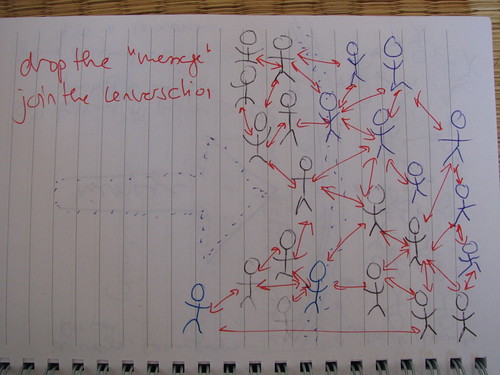
Discussion: Sandrine et moi sommes en désaccord avec l’importance du concept de “message”. Pour moi, les stratégies développées plus haut restent dans la même conception fatiguée de “marketing comme message”. Personne n’a envie d’écouter un “message”. Les relations priment sur le message. Oui, bien sûr, par mes actes, je communique des choses (“on ne peut pas ne pas communiquer”). Mais je crois personellement que pour “changer la façon dont nos projets sont perçus”, il faut dépasser cette notion de “message”. Quand je raconte ce que je fais dans mon projet sur mon blog, je ne suis pas en train de fabriquer un “message” (même inconsciemment), je suis en train de raconter une histoire. De parler en tant qu’être humain. Et ça c’est mille fois plus important que tout ce qu’on peut dire autour de “rendre un message viral”. cf. les notes de ma conférence sur les blogs en entreprise, où j’explique l’importance des constats du Cluetrain Manifesto. Pour moi, on est resté coincés (dans cette présentation) dans une conception “pré-Cluetrain” du marketing et de la communication. Il faut abandonner ce concept de “message” plutôt qu’essayer de le sauver à tout prix et de l’intégrer dans quelque chose où il n’a pas de place. On s’en portera bien mieux. Et en plus j’ai faim.

BarCamp Lausanne: Introduction à Django (Mathieu Meylan) [fr]

[en] An introduction to Django at BarCamp Lausanne.

J’ai pas mal entendu parler de Django, mais encore pas eu le temps de m’y intéresser. C’est l’occasion! Voici mes notes de la session.

Mathieu travaille chez ElectronLibre, et suit le développement de Django depuis 5 mois.

BarCamp Lausanne 13

  • objectifs et intérêts de Django
  • mécanisme
  • parcours d’une requête

Framework web. Permet, grâce à bibliothèques, de développer du web de façon plus rapide. Django permet de segmenter la conception du site. En gros, on gagne du temps, c’est assez facile à apprendre. Adapté à tous types de site web (y compris multilangue). steph-note: j’aimerais voir comment ça marche!

Django, en fait, c’est comme Rails pour Ruby, c’est un framework Python. Rails est un peu plus complexe à apprendre et intègre AJAX.

[présentation des caractéristiques techniques de Django]

Le niveau requis en Python dépend de la complexité de l’application qu’on veut développer.

Exemples:

  • http://www.lawrence.com/
  • http://www.washingtonpost.com/
  • http://chicagocrime.org/
  • http://www.tabblo.com/studio/
  • http://wattwatt.com/

steph-note: exemples de code, ça a l’air abordable.

Certaines vues sont si courantes (vue par date, ajout/mise à jour/suppression) qu’elles sont inclues telles quelles dans Django — donc pas besoin d’écrire de code pour les utiliser.

Possible de produire autre chose que du HTML/XML: e-mails, texte brut…

steph-note: en voyant tout ça, je me demande combien de travail ça nécessiterait de re-créer WordPress (par exemple) avec un framework comme ça, et ce qu’on perdrait par rapport à PHP/MySQL

Intérêt grandissant pour Django.

Pour démarrer:

  • djangoproject.com
  • djangobook.com
  • djangosnippets.org
  • django-fr.org (fr)
  • Bien débuter avec Django chez biologeek.com (fr)

Discussion:

  • refaire WP avec Django? faisable, mais moyennement intéressant. Django, c’est pour quand on a des besoins spécifiques, faire un site “from scratch”.
  • charge: java/tomcat, 6 machines — passé sous Django, une machine.
  • possible d’utiliser Akismet avec un site développé avec Django

How Blogging Brings Dialogue to Corporate Communications [en]

[fr] Notes d'une conférence que je viens de donner à Zurich sur les blogs en entreprise.

As promised to the participants of this (Monday) evening’s event, here is my slideshow of the talk, notes, and links. note: notes written up on the train on the way home, I hope the links aren’t too broken and that it makes sense; let me know in the comments if there is anything weird.

Thanks to everyone for participating so well 🙂 Please feel free to add notes, comments, further questions, things you took away from the talk in the comments to this post.

note: the beginning of the notes are roughly what I said; questions and answers are not included — there were lots; I gave an accelerated version of the second part of the presentation, as we had talked a lot, and actually, covered much of what was important anyway.

For links related to corporate blogging, see those tagged corporateblogging and 20070924 for those linked to today’s talk. Click on the “related tags” on the right to explore further.

I’ve added slide numbers in brackets roughly when they appear. Not that the slides are that interesting, of course…

[1] [2] Blogging is a tool that brings dialogue, and the point of this talk is to see how that happens in a corporate context.

[3] Two main aims:

  • understanding the “bigger picture” blogging is part of
  • practical advice on introducing blogs into a business setting.

[4] As you’ve probably noticed, I’m not a Powerpoint wizard, so won’t be dazzling you with fancy slides and lots of buzzwords. I’d like to have something approaching a conversation with you. I’m obviously expected to do quite a lot of the talking (that’s what I was asked to come for!) — but you know lots of things I don’t, and you’ll have comments and questions. Please ask them as we go along… I’d rather go off-track from my presentation and be sure to address the things you’re wondering about. note: and yeah, that’s exactly what happened! got so caught up in our conversation that I lost track of time! This way of doing things, you’ll notice, is related to what blogging is about.

[5] First, I need to know a bit more about you. I know you’re communication executives and I’m told you’re already familiar with blogs — that’s a start, but I need more:

  • who reads blogs?
  • who has a blog? (personal, corporate, work-related?)
  • who is blogging this talk? (nobody — hopefully in 2 years from now, half the room)
  • who uses a feed-reader (NetNewsWire, BlogLines, Google Reader)
  • who is in a company that uses corporate blogs?
  • who has employees/clients who blog?
  • who has read The Cluetrain Manifesto? Naked Conversations? (required reading!)
  • who is in a company that is blogged about? do you know?

[6] Before we get to the meat (practical stuff), let’s clarify

  • what is blogging?
  • where does it fit in?

There’s a lot of confusion there.

Blogging is:

  • a tool/technology
  • a culture
  • from a business point of view, a strategy

Different layers.

Blogs@Intel · Intel Corporation

[7] Using just the “tool” layer often fails, because it’s just publishing “official communications” in a different wrapping. And official communications are boring — I hope I’m not breaking the news to anyone. Example of this: blogs.intel.com. Not very exciting.

I think a lot of corporate blogging failures can be attributed to stopping at the “tool” aspect of blogging, and underestimating the cultural aspects.

Listening and Learning Through Blogging

[8] Example that gets the “culture” layer: Listening and Learning Through Blogging on McDonalds’ CSR blog.

I’ve just finished my second posting, and I’ve realized how much there is to learn about the blogosphere. I’ve spent a lot of time looking at other blogs, listening to what others are saying about what we’re doing, and picking up some suggestions along the way. (McDonalds’ CSR blog)

From a business point of view, adopting blogging is a strategic decision, because it impacts the culture. It’s not just a shiny tool we can use to do the stuff we do usually, it’s linked to deeper changes.

[9] So we’re going to concentrate on the “culture, strategy” side of blogging, which is the first part of this presentation. So we’re going to have to backpedal, zoom out, and look at the big picture: [10] The Internet, The Cluetrain Manifesto.

So, what’s the Cluetrain about? It started as an online rant, and grew into a book in 2000. It’s still valid today.

Basically, the Cluetrain says that conversations are happening, inside and outside your organization, and they can’t be stopped.

[11] People are tired of being talked at. They (inside: employees; outside: customers) are too busy having [12] real conversations with their friends, people they know and trust. Offline as well as online. They won’t listen to fabricated discourse (a lot of marketing). I know that when I receive my bank statements, I’m interested in how much I’ve spent, and the flyer giving details about my bank’s latest service goes straight to the bin. What about you?

[13] These conversations are everywhere. They’re talking about you — you the companies. A lot of our day-to-day conversation is about brands, consumer products, services… These conversations [14] can’t be controlled. Control is a big issue when it comes to corporate blogging.

Is communication something you control?
Are conversations something you can control?

[15] We know how important word-of-mouth is in marketing, and in the shaping of buying decisions we make. We listen to our friends (people we trust) way more than advertising.

Do great stuff. Care. Let people know. They’ll talk about you.

[16] Blogging is about jumping in there, being part of the conversation. And this conversation is bigger than just blogging.

Not that easy, but not that hard: remember what it is to be human. To be passionate about something. To care. Bring that into the conversation.

So the important question becomes: how will this fit into my corporate culture — or not? Is it compatible?

[17] What I mean by corporate blogging: blogging that has to do with corporations, businesses. Blogging beyond the tool (culture). Everything is possible.

  • internal
  • external
  • one author
  • multiple authors (group blog)
  • very official
  • unofficial
  • employee blogs
  • news outlet (with the danger of missing the “culture” and falling back into the “just tool” use)

[18] Some quick examples of real “corporate” blogs. A lot of damage control in my examples — one thing blogs are good at.

[19] Who should blog?

Corporations do not blog. Humans do, people. You can’t remove the person from the blog. Businesses with a “do the right thing” attitude. Enthusiasm needed! [20] Bad guys shouldn’t blog. Businesses who mistreat customers and employees shouldn’t either. Not if you’re dull or cheesy or very controlling. (See Naked Conversations, pp. 134-138.)

[21] Why should one blog? Very important question.

  • to communicate differently, humanise the company
  • not just another channel to push the same tired message through.

Where does blogging fit in strategically? => who, what exactly…

See possible objectives here. Basically, anywhere there are people doing things. Except probably high-confidential security stuff.

[22] How?

You want to get blogs going for all the good reasons, but how does one

  • start blogging [23]
  • blog well? (ongoing work!)

No real “one size fits all”. Many answers to this, depends on the situation/culture of the company in question.

Some general answers, however.

[24] Check out the corporate blogging 101, very precious stuff there.

enable blogging. Encourage employees to blog. Blogging is a grassroots phenomenon, but it needs support form the top. There are maybe people already blogging — find them, and use them to encourage more blogging.

[25] have a purpose (that important Why? question). Don’t blog to blog. Figure out what current needs can be adressed by blogging. You can start small:

  • event?
  • product?
  • “news”?
  • project?
  • office life?
  • expertise on one topic?

This is very context-dependant. Need to understand the context well to be able to choose/advise wisely.

Careful! If you’re using a blog to post the usual “official communications”, you’re missing something.

[26] learn the culture: this is the big bit. Listen to bloggers (online and offline, in-house and out). Get training (this is where it’s worthwhile to put your money, as you’ve saved on expensive software).

Before going to India, I studied the culture, but it couldn’t prepare me totally for what I found when I went to live there. You need to go to a foreign culture to really “get” it. Blogging is a foreign culture.

Learning to blog well can take time. Not everyone is a natural. Ongoing effort!

[27][28] Remember, blogging is about Me & You, having a conversation.

  • dialogue
  • relationship
  • people

[29] Listen. Read blogs. Read comments. Be open. Get a feed-reader.

[30] Passion. Believe. Be passionate. If you’re not interested, it’ll be boring.

[31] Style. HUGE subject. How to write on a blog. It’s difficult.

  • write for the web
  • use “I”
  • use links, make your writing 2D instead of 1D
  • informal
  • short paragraphs
  • simple, direct language
  • no jargon or corpspeak
  • tell a story, as if to a friend
  • author name, but don’t sign posts like e-mail

[32] Time. Don’t kid yourself, it takes time. Commitment. Easily an hour a session, a few times a week. But it’s fun 🙂

If you try to remove any of these ingredients, I doubt your blog will be successful and survive.

Best practices?

[33] DO:

  • eat your own dog-food
  • trust your bloggers
  • read other blogs
  • be part of the community
  • use a feed-reader
  • link! even to competition, negative stuff
  • be human
  • learn the culture
  • use an existing blogging tool
  • discuss problems
  • define what is really confidential
  • give existing in-house bloggers a role (evangelists! learn from them!)
  • tag, ping, use the “kit” and other social tools

[34] DON’T:

  • try to control
  • use a ghost-writer or outsource blogging
  • “roll your own” tool
  • ignore established blogging conventions, they’re there for a reason
  • copy-paste print material in posts
  • use corpspeak
  • force people to blog
  • write happy-clappy stuff
  • write blog posts or comments as if they were e-mails (starting with Hi… and ending with a signature)
  • be faceless (signing with the name of the company instead of the person)

[35] FUD: fear, uncertainty, doubt. Cf. Naked Conversations pp. 140-145 for discussion, really, it’s all there:

  • negative comments
  • confidential leaks
  • loss of message control
  • competitive disadvantage
  • time-consuming
  • employee misbehaviour
  • ROI absent…

[36] ROI of blogging (google for “ROI blogging” — without quotes). Comes up often (need for quantitative measurement), but still very debated topic. Respected experts all over the map, from “it doesn’t/can’t apply” to “here is a way to calculate it”.

Distinguish:

  • hard returns
  • soft returns

There is a return, it’s a worthwhile investment, say those who do it. How to measure it is another story. Sorry 🙁

[37] A closer look at some examples… coComment [disclosure: ex-client]:

coComment blog -- Corporate Blogging Example

[38] Read the first sentence… what is wrong here? Not a human speaking. Don’t post press releases as blog posts. You might cite them, or link to them, or comment on them, but don’t stick them in there as posts. How does the reader think his “feedback” will be received when he’s being spoken at to start with?

coComment -- Corporate Blog Example 1

[39] Privacy concerns raised on other blogs. Good to address the issue and respond, instead of hiding! (it would just get worse… cf. Kryptonite). “Click here” looks bad, though, and hints that the medium (blogging) isn’t really understood.

coComment blog -- Corporate Blogging Example

[40] OMG. What is this doing here? Did somebody smoke something? First-time author on this blog — an introduction would have been more appropriate.

coComment blog -- Corporate Blogging Example

[41] Note that this is a multi-author blog, which is usually the case with an “official blog”, though often there will be one “main author” who carries it. Apology for painful upgrade, that’s good. E-mail-like signatures on each post, however, again point to incomplete understanding of the culture.

Flickr: great example (and great photosharing service too, sign up today).

Flickr Blog -- Corporate Blog Example

[43] Look at that outage notice. It’s fun! Really fun. And there are updates. Two of them. As a user/customer, I feel that they give a damn.

Flickr Blog -- Corporate Blogging Example

[44] Coverage of what’s going on in the community. Blogging is a lot about community, nurturing it.

Flickr: it's not just blogging

[45] Here, a forum post. It’s not just about blogging, remember the “bigger picture”? But same kind of attitude. How you engage with others in the community. Treat them as people and not like numbers. Look at how well this issue is documented, with links and all — and this is a “problem situation”. We’re not shoving the dirt under the carpet here.

Moo note: if you got a business card from me, this is where they come from!

MOO | Blog -- Corporate Blogging Example

[46] So, this is a promotional posting (ad, marketing, oh my!) but look… it feels like she was e-mailing a friend, rings true.

Up for debate (bloggers will tell you “yes”): can you feel if somebody put his/her heart into a post?

[47] Closing notes:

Blogging is a strategy. Deep change in communications. Not pushing a message anymore, but

  • conversations
  • relationships
  • trust
  • people

The question to ask is:

Is my company/department/team ready for this?

Blogging is a grassroots phenomenon, so bottom-up (you can’t force people to be passionate about something and blog about it), but needs support from top-down. There are maybe already blogs in your company, and you might not know it!

Read The Cluetrain Manifesto and Naked Conversations to start. (I’m serious.)

Eat your dog food. If you’re going to introduce blogging in your company, you need to start blogging — before. Open a WordPress.com account and start writing about stuff you’re interested in. Use your blog as a backup brain, writing things as they occur to you. For you first, and for sharing with others in case it’s of interest to them.

Blogging is technically cheap, but culturally expensive.

[48]

Some extra stuff, off the top of my head (some from off-presentation discussion):

Blogging tools: WordPress, Movable Type and Typepad (SixApart), Drupal.

Looking up stuff in blogs: use Technorati or Google BlogSearch. Use Technorati Cosmos to see who linked to a given blog post.

The “Because Effect”: I make money because of my blog, not with my blog.

Discussion of trust and reputation in the blogosphere. Auto-regulating medium.

A few sketches I made while preparing this talk, but didn’t use:

Cluetrain 101 Sketch 1

Cluetrain 101 Sketch 2

Cluetrain 101 Sketch 3

Open-sourcing the invitation copy.

Good example of an “event blog”: LIFT conference (and go to the conference, too, it’s a great event).

promotional 😉 note: if you would like to have me come and give this talk (or another!) elsewhere, please don’t hesitate to get in touch. This is one of the things I do for a living.