Competition, Colleagues, or Partners? [en]

[fr] Avec mon projet de démarrage de boîte, je me retrouve à me demander comment exactement l'on définit la concurrence. Qui seront mes concurrents? Quelle genre de relation peut-on avoir avec "la concurrence", surtout lorsque ceux-ci sont des amis ou des connaissances? Est-il possible d'aspirer à un rapport s'approchant de celui de collègues, plutôt qu'une guerre sans merci? Vos idées et expériences sur la question m'intéressent.

In the last ten days I’ve started planning, thinking, and talking about my new company. One of the things I’m struggling with at the moment (besides finding a name which isn’t already taken, isn’t too lame, and won’t get me sued) is how to consider others that are in the field I want to step into (I haven’t told you yet, have I?)

Very obviously, they are competition. My company is going to be doing stuff similar to theirs. But I don’t have the feeling it’s really clear-cut. I mean, look at the “social media consulting” business. Amongst my acquaintances and friends, there are many people who do similar things to me. But they feel more like colleagues than competition.

Is it simply because our skills overlap imperfectly, and our markets are geographically or economically separated?

As I understand it, to be competition, two companies (or people) need to be competing for the same clients/users, and this competition has to be exclusive. By that, I mean that if the client/user decides to go with company A, company B is going to lose his business. I guess this is pretty obvious.

So this is what I’m wondering about. I’m preparing to enter a market which is not totally new. There are already people/companies doing what I want to do. But I’m going to do it in a unique way — mine. Does that still mean the others are “competition”? and in that case — for those of these others who are friends or contacts — does that mean that I will be perceived as a threat, and that any “network benefits” I would have had from those people is to be considered lost? Is it going to have a negative impact on these relationships?

This seems pretty tough. (Maybe it’s just the business world, and I need to toughen up, but I don’t like this side of it, if it is.)

I’m not here to put others out of business. I want to do things better, appeal to a different audience, or “increase the consumption” (horribly way to phrase things, but I don’t have anything better on the tip of my tongue without being more specific) of the current “audience”.

I’m aware I might be coming across as terribly naive to all of you seasoned entrepreneurs and business people out there. But I’d like to believe it’s possible to “play nice” with “competition” — maybe not to the extent that they become partners, but at least something resembling a relationship between colleagues. A relationship where help can be given, contacts shared, advice and lessons learned dispensed. Even if I wouldn’t go so far as to expect partnership.

What about partners, then? Can they be involved with the competition? Could they have interests in one’s competition? (That sound like a bad idea, said like that.) Conflicts of interests aren’t good, that’s certain — but can we really be free of them?

I know that without the specifics this may seem a little abstract, but I’d really love to hear what you all think about this.

Netvibes Widget of my Shared Items [en]

If you read this blog “on the blog”, and look at my very cluttered sidebar, you probably noticed there is a feed of my “shared items” from Google Reader hidden in there (grab the feed!). “Sharing” is the reason I switched to Google Reader over a year ago.

I’m sitting in a workshop about UWA widgets at Paris Web, which had me looking at netvibes again. Even though it never clicked for me, I know lots of you use it (I check my stats, yes I do).

So, here we go. One thing leading to another, I created a widget with my shared items in it. It’s more for fun than because it’s really useful, as you netvibes users can create it really easily — but hey, here it is:

Add to Netvibes

Update: how disappointing! I thought it was going to look like this in the blog post:

My Shared Items Netvibes Widget

Not there yet, it seems.

Update 2: something I’ve been wanting to do with netvibes (not sure how feasible it is, actually): create a tab with “my stuff” in it. See, I’m scattered online. And the stuff I “share” is also scattered. If I found it through my feed reader, it’ll appear as a whole post in my shared items. If I was randomly browsing around, it’ll be in my del.icio.us links. If it was a video I watched on YouTube, it’ll end up in my VLog. If I wanted to share a quote, it’ll be in my Tumblr. Creating something to collect all these “things of others that I consider worth passing on” would be really nice. I wonder if a netvibes tab would be a solution — and if people would use it at all.

Berlin, Belgrade: Two Contrasting Airport Experiences [en]

[fr] Je déteste vraiment la sécurité dans les aéroports. C'est d'une hypocrisie primaire et le résultat principal en est une péjoration du comfort des voyageurs. Je raconte dans ce billet deux expériences contrastées (mes deux derniers vols).

L'aéroport Tegel a Berlin, où tout s'est passé comme sur des roulettes, même si j'ai eu bien peur de rater mon vol (imaginez: je me suis pointée au faux aéroport, moins de deux heures avant décollage). A Tegel, le taxi vous dépose directement au terminal. Le check-in est à 5m de la porte. Le contrôle des passeports est à côté (vraiment) du check-in (disons 3m). Le contrôle sécurité est droit derrière. Et la zone d'attente pour la porte est juste après. De check-in à salle d'attente, 10m et 5 minutes à tout casser.

A Belgrade par contre... Ce fut moins fun. Personnel peu agréable, renseignements médiocres, vilain sandwich tout sec... et pour couronner le tout, "double" sécurité. Eh oui, non seulement faut-il faire la queue pour faire passer aux rayons X toutes ses petites affaires avant le contrôle des passeports, mais encore faut-il passer par le même cirque à la port, pour accéder à la zone d'attente. Je vous passe les chaises en métal et les courants d'air...

Inutile de dire que je suis ravie de rentrer à Lausanne en train depuis Paris, et que j'espère que les grèves continueront à ne pas avoir d'influences sur les TGVs à destination de la Suisse!

Flying out of Berlin could have been a nightmare. It actually turned out to be a rather smooth experience. The nightmarish bit is that I went to the wrong airport to catch my plane. I flew in to Shönefeld (?), so naturally assumed that I would be flying out from there two.

When I arrived at the airport less than two hours before take-off, I checked the departure board and couldn’t find my flight. Suddenly, it hit me: this wasn’t the only airport in Berlin. A brief panicked enquiry at the airport information desk later, I was grabbing a taxi, calling the JAT office in Tegel Airport to explain the situation (they had my ticket waiting there for me), and deciding that 70€ to take the predictable but longer motorway route (it was peak hour and the town was gridlocked) was better than missing my flight.

My taxi driver was nice, reassuring, and cut quite a few lines to get me there on time.

Here is where it became smooth. Like most of you I guess. I’m used to airports where you need to wait in line for check-in, then walk to passport control, wait in line again, then walk to security, wait in line again, then finally, walk to the gate.

None of that nonsense at Tegel Airport. I had been given the terminal number by the person I spoke to at the JAT office, who told me my ticket would be waiting for me at check-in. My taxi dropped me off at the terminal.

I went through the door.

I walked 5 metres.

I waited 2 minutes at check-in, was greeted by a smiling hostess, given my ticket, and checked in.

The door to security — no kidding — was just next to the check-in desks. 10 steps away. And passport control was just before the door to security. And the gate itself (the waiting area) was just behind security. From check-in to the gate: less than 10 meters. Within 5 minutes I was through all of it.

And I wasn’t (by far) the last person to check in. I was early, actually.

Contrast that with my departure from Belgrade, five days later. (Oh, let me mention in passing that I had the most frightening landing of my life in Belgrade. I’m not a frightened flyer, but the weather was really very rough and stormy, with the plane rocking left and right and dropping abruptly as we were approaching the landing strip. And once on the ground, it didn’t stop either — precisely because the plane wasn’t slowing down, and was making dreadful noises. We stopped OK in the end, but from my point of view we were moving way too fast on that runway for way too long.)

Back to my experience this noon in Belgrade Airport. First, I have to say it was overall not very friendly.

I asked the check-in woman where I could change money and eat. She indicated two places for that, which meant I had to change money (lots of dinars) first and eat (paying in dinars) second. Great. Then, the change office didn’t have Swiss francs. Even greater (I now have enough euros to settle down in Paris for a month, nearly.)

I got a really nasty sandwich for a small fraction of the money I had been advised to keep for the meal, and then realised that I could change money on that floor too. They had Swiss francs, but with the amount of dinars I had it was more interesting to change in euros. Then, once I’d gotten rid of all my dinars, I noticed there was at least one other food place — nicer than the one I’d been to, of course.

Oh well.

I queued through security, did my usual Empty Half Your Bag And Get Half Undressed stunt, waited in my socks while the person at security control searched the bags of the woman before me (one person per machine, takes care of searching too, so when a bag is searched, the machine stops too — efficient, isn’t it?), and headed to passport control.

A rather unfriendly woman there gruffly asked me for my boarding pass (it had slipped out of my travel documents into my bag) and put a nasty wet stamp on it before folding it back into my passport. I had to wipe the wet ink off the (thankfully plastified) page with all my personal details.

Once in the “sterile” area, I noticed there were another two places where I could have eaten (oh, well) but no board with flight numbers and gates. I asked a member of staff who was passing by, and she pointed me to the travel information desk where I got the answer I needed.

I walked down the corridor to the gate and was quite surprised to find the place rather empty (this was about 10 minutes before announced boarding time). There was an open door with a corridor leading somewhere cold, and a closed door next to the flight details for the gate, behind which I could see a security machine and a bored young man in a uniform.

There were a few metal seats in the draughty corridor.

I tried to open the closed door, but it was — closed. I made interrogative signs to the young man, who got up to open the door and tell me that this was the right place, only later.

I therefore sat on a draughty metal seat and waited.

Slowly, more people arrived. Airline and airport employees, too. The door opened. Closed. Opened. Closed. Passengers got up and started to form a line (boarding time passed), so I got up too.

And waited in the cold. And cursed at the security machine I could see through the glass door.

You probably know I’m sick of airport security. It’s hypocritical (there mainly to cover some people’s precious arses), basically abusing poor passengers and making our lives miserable when we travel under pretense of keeping us safe from “terrorists”.

Right. So when you make everybody entering one part of the airport (what I call the “sterile area”) go through security and show ID… and you do the same thing again later on… what kind of message are you sending?

You’re basically saying: oh, well, our sterile area isn’t really sterile, you see — we don’t trust our own security screening. So please, let us screen you again. You know, just in case one of you entered this part of the airport without going through security, or managed to sneak a gun or explosives past us.

What do you think my opinion of airport security is now?

The cabin crew went through first, and for a wild moment I thought that maybe this was just for them, because for some reason they might not have had to go through the same long line of waiting for bags to be searched as us.

But I was wrong. One by one, 15 minutes after announced boarding time, we put our stuff in the X-ray machine again. Did I mention it was cold and draughty? I wasn’t happy to be in my socks again. And no, I didn’t feel bad about holding up the line because I put my stuff in four different trays to make sure I don’t raise any flags (got searched for cables in my bag, once — now they go through separate).

Colour me grumpy.

So, now that everybody had been doubly screened and that we were doubly safe, we got to sit down in more draughty metal chairs and wait. And then, stand up in line again and wait.

I am so glad I’m going back to Lausanne by train from Paris.

I just hope the strikes in France continue to not affect connections to Switzerland…

I'm Starting a Company [en]

[fr] J'ai décidé de créer une entreprise. Eh oui. Sans donner trop de détails, je peux déjà vous dire qu'il ne s'agira pas principalement de consulting web (même si je ne renonce pas à mes activités professionnelles courantes) et que ce ne sera pas non plus une application web. Par contre, ce sera l'occasion de faire bon usage de mon réseau.

Un peu étrange pour moi, mais ce sera aussi la première fois dans ma vie que j'entreprends quelque chose dans le but avoué de gagner de l'argent. Bien entendu, ce ne sera pas aux dépens des produits/services/clients/utilisateurs/employés/collaborateurs/partenaires... Je reste qui je suis et j'ai des valeurs auxquelles je tiens 😉

If you follow me on Twitter, then you’ve certainly already heard the news: I’m starting a company. Now, though I’ve told a few people online and off what it was about (shhh), I’m not going to spill all the beans right now (have to keep you wondering for a bit, right?).

What I’ll say for the moment is the following:

  • I’m not “retiring” from any of what I’m doing now (I’m still for hire for my usual consulting/speaking/experiential-marketing/etc. stuff, though I might be a bit busier in the coming months, so plan ahead!)
  • my company’s main business will not be consulting, and it will not be a web app (that narrows it down, doesn’t it?)
  • strange as it may sound for me to say this, for the first time in my life I’m making a professional decision with the intent of earning money (though not at the expense of my products/services/users/clients/employees/partners, obviously)
  • I’m still thinking about a name (“Pink” stuff is out, unfortunately — that should give you a serious hint)
  • this will be a chance for me to put my network to good use (amongst other things, I intend to surround myself with great advisors/partners/collaborators).

I’m excited! Full of questions and ideas, but really excited 🙂

Talk: Being a Blogging Consultant [en]

[fr] Notes d'une conférence que je viens de donner en Serbie sur ce qu'est le travail d'une "consultante en blogs" (notez les guillemets). Je préfère en fait me définir comme une spécialiste de l'internet vivant (celui des dialogues et des relations humaines) et de sa culture. J'interviens partout où ce genre de connaissance est utile à mes clients.

Here are some rough notes of the talk I gave at Blogopen, reason of my presence in Novi Sad, Serbia. I hope they can be useful to some. Number between square brackets refer to slide numbers (presentation on Slideshare embedded below).

If you have notes of this talk or by any chance have recorded it, please leave a link in the comments.

update: yay! some short recording snippets. see the end of this post.

[1] [2] Two years ago I was a teacher, and if you had told me then that I would be here in Novi Sad, talking about what it is like to be a freelance blogging consultant, you would probably have seen me make a face like this:

Expressions (Stephanie Booth) 9

[3] Later on I’ll tell you about what a “blogging consultant” like me actually does, but first of all, here’s my story. I grew up with computers in the house, discovered the internet in 1998 and soon after created a website. I started blogging in 2000 and gradually built a small reputation for myself online. By the time the Swiss media discovered blogs in 2004, I’d been at it for a while. When they started looking for Swiss blogs, they found me, and the phone started ringing.

You know how it is with the media: once one journalist has written about a person or a subject, all the others follow. I started giving interview after interview, exciting at first, but somewhat tedious after some time. But I was lucky to have very good local media coverage, which did help people find me or hear about me.

Just before the press started to show an interest in me (and blogs), a friend of mine asked if I could explain to her how to make a website. We sat together for two hours, and I told her how the internet was made of servers, and websites were in fact files that lived on those servers, files you can make in a text editor with special markings known as HTML, with CSS to control the visual aspect. She said “wow, you’re really good at this, you should get people to pay you to do it!” I was a bit skeptical, but thought it would be cool. So just before my first appearance on TV, I created a professional website (just a few pages, and if you look at it now, it’s really out-of-date — I’ll be working on it during the “Website ‘pro’ day” in a bit over a week). And on that website, I made a page saying something like “I’ll explain to you how to make a website, this is how much it’ll cost”.

Shortly after my TV appearance, I was contacted by a school who wanted me to come and talk about blogs to a class of teenagers. It went surprisingly well and I really enjoyed it, so I added an extra page on my professional site saying “I give talks in schools”. Little by little, through word of mouth mainly, I started having clients. And at one point about 18 months ago, I started having enough clients that I could consider quitting my day job (teaching).

That’s how I became a professional blogging consultant.

[4] So, what does a “blogging” consultant do? It’s not just about blogs. Actually, one of my ongoing struggles is to find a “job title” to define myself. “Blogging consultant” already existed, and people knew about blogs, so it wasn’t too bad.

[5] Blogging is more than it seems. It’s a tool, but it’s more than that. It’s also a culture, and if you’re a company or an institution, blogging is a communication strategy. We see companies and media corporations using the blog tool to publish press releases or official documentation. That’s using the tool, but they don’t get the culture, and they haven’t changed their strategy. (You might want to see the notes on my talk “How Blogging Brings Dialogue to Corporate Communications” if this topic interests you.)

[6] One expression we hear a lot in this kind of context is “social media”. Traditional media go in one direction. Journalists write, people listen (or put their fingers in their ears). It looks like this:

Cluetrain 101 Sketch 1

With social media, on the other hand, we have a new type of media (well, reasonably new) where conversations take place. Communication goes both ways:
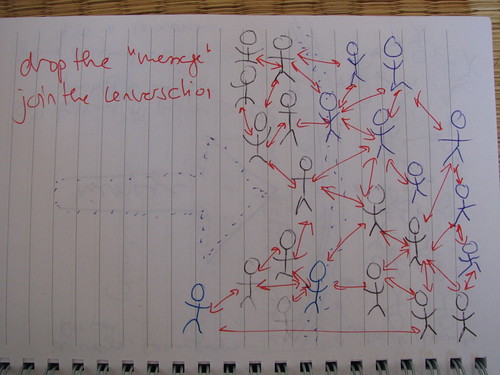
Cluetrain 101 Sketch 3

So basically, being a “blogging” consultant has a lot to do with social media. (Understanding and explaining it.)

[7] All this kind of stuff is explained in a great book that everybody should read: The Cluetrain Manifesto. You can read it for free on the Internet or buy it as a real book if you prefer. The Cluetrain Manifesto was written in the year 2000, so quite some time ago, but it’s still spot on. It tells us how people are sick of being marketed at and talked at, and how people are already having conversations everywhere about brands, companies, and these conversations are happening on the internet. Companies, politicians, and media empires would be smart to step in and join the conversation. Anyway… read the Cluetrain Manifesto if you have any interest in what’s going on on the Internet.

[8] So, in my job, I don’t just work with blogs. In addition to blogs, sometimes solution require wikis, podcasts, or social networks. [9] Using these tools brings up values like dialogue, transparency, authenticity, and often leads to rethink strategy. [10] Finding a solution for a client can be helping them re-organise their e-mail, set up a mailing-list, or simply build a website. Maybe it requires social tools like Twitter or Dopplr, or they might even want to know about virtual worlds like Second Life.

This is clearly not just about “blogging”. It’s about this bigger world blogging is an important part of.

[11] I like to think of myself as a specialist of the living web and its culture. The living web is the internet of people, conversations, and relationships.

My work is anywhere people need this kind of knowledge. Who needs this kind of knowledge?

[12] Schools, politicians, companies big and small, freelancers, non-profits, media, startups, people…

[13] Here’s a little more about what it means to be a freelancer consultant in today’s world.

[14] The Balance of the Soloist according to Stowe Boyd:

The most difficult challenge for soloists is to find a balance between the various activities that must take place to survive. I like to oversimplify these down to three:

  1. Doing The Work — The heart of consulting — of whatever description — is delivering the work. A soloist has to deliver value to the client in order to make money. Most consulting-oriented people start with this capability: it’s the other two that cause problems, in general.
  2. Marketing and Networking — I have already noted that I principally market myself through blogging, and that I attend conferences: those are the outward signs of a willingness, or even an obsession with networking with likeminded others. When I find out about a web product that sounds interesting (my beat), I sign up for the beta, fool with it, write a review, ask for more info, and very soon I am involved in a direct communication with the company’s management. I read other people’s blogs and comment on their ideas. When attending conferences I try to chat with both old friends and folks I have never met before. I know many consultants whose natural introversion makes such activities difficult if not impossible. But these interactions are just as critical to being a soloist as performing the work, and are likely to take up just as much time!
  3. Prospecting, Contracts and Cash Flow — I am always happy to talk about money, and as a soloist it is imperative to get what you are worth, and then to collect the fees. This is a blind spot for many, and a make-it-or-break-it issue. I know a lot of folks that find it hard — even with people they know well — to ask for a project, an engagement, whatever, and to demand payment later on. It may seem obvious but many consultants only get involved with this as a necessary evil, but it’s not. It’s just as central as delivering the goods and networking.

Stowe Boyd, “Going Solo: A Few Words Of Advice”

These are the three skills the freelancer needs. Often people drawn towards freelancing are people who are good at doing something (the work) and reasonable networkers — and the third part (money) is the most difficult.

[15] the work

This will of course vary from person to person. Depending on your skills and abilities, you will be doing different things. For example:

  • talking (like this talk I gave — speaking engagements)
  • explaining — talking with clients to tell them about things they need to understand
  • solving problems
  • gathering information (about your client, about a subject you need to know more about)
  • managing projects
  • installing tools (WordPress, wikis…)
  • coding HTML, CSS, or even PHP
  • doing graphical design in Photoshop (I don’t do this, I’m really bad at it, so I usually tell the client he needs to have somebody else for this)
  • training — it’s not that easy for “normal people” to learn how to use a blog tool… and more importantly, understand the blogging culture. Linking can be the topic of a two-hour class! (what to link, when, with what text, trackbacks, linking technique… suddenly text has two dimensions instead of one, so it changes writing style…)
  • “cluetrain 101” — explaining the basics of what the internet is changing to the way we communicate
  • experiential marketing (I’ll blog more about this later) — where you use a client’s product and blog about it
  • blogging for a client (even though it’s not something I believe in, and I don’t do it — some people might)

[16] Marketing

  • blog, blog, blog. And blog more. Demonstrate your expertise. Look at how Thomas Mahon used his blog to demonstrate his expertise at being a high-class tailor. Blog about what you know and what you’re doing.
  • be a good connected net citizen. Use LinkedIn, Facebook, twitter, IM… be out there
  • talk around you offline
  • go to events — try to speak! send in proposals! Barcamps are a great place to start because anybody can talk. Get somebody to film you and put it online. If you’re not speaking, publish live notes of the talks on your blog (live-blog). People who weren’t there or didn’t take notes might appreciate yours.
  • in short, take care of your social capital (whuffie) — your social connections
  • if you’re lucky enough to have journalists call you — be nice with them. I would probably not be here today if it hadn’t been for the local press in Switzerland.

[17] Cash

Often a difficult point, as I mentioned.

  • how do you actually get to the point where you close a deal?
  • contracts
  • you’re worth more than you think! Have friends help you keep that in mind before you negotiate with clients.
  • will you be paid per day, per project?
  • how much? fixing the right price can be tough — I haven’t completely figured out pricing yet.
  • when do you ask for money, when do you not ask? Sometimes it’s not that obvious.

In addition to this, going freelance might mean you have to think about:

  • insurance
  • taxes
  • laws
  • accounting
  • invoicing

And also… balancing your personal and professional life. All this “taking care of your social capital” does tend to blend the two — in a good way, often, but also in a way that makes taking days off or going on a real holiday very difficult. Pay attention to that.

[18]-[23] So, looking back… After my initial “no way!” reaction to the idea of being a “blogging consultant” two years ago, even though I went through phases like this

Expressions (Stephanie Booth) 2

and this

Expressions (Stephanie Booth) 12

and this

Expressions (Stephanie Booth) 11

and even

Expressions (Stephanie Booth) 3

overall… I’m pretty happy about my life as a blogging consultant:
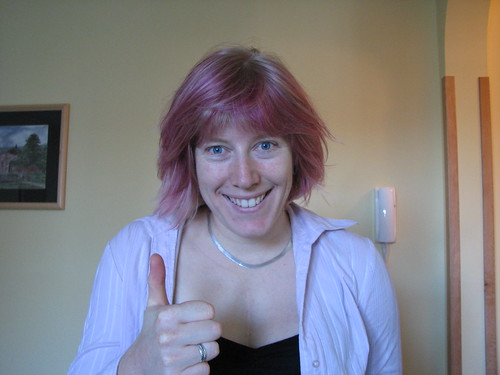
Expressions (Stephanie Booth) 14

note: I took all the rather cheesy “emotion” photos myself the morning before the talk, because I didn’t have the time and resources to go hunting for good “emotional faces” stock photography… I hope you’ll forgive me!

You can find more stuff about consulting in my del.icio.us links.

Thanks to everybody who attended my talk and gave me kind feedback. Many Serbian bloggers also mentioned my talk in their blog posts, but I’m afraid I can’t understand any of it! Here are the links, though:

As far as I can tell, some posts simply mention me. But if there’s anything said worth to be translated or paraphrased, feel free to do so in the comments! (Just tell me what link it’s about…)

Update:

Thanks a lot to darko156 who filmed two short video sequences and uploaded them to YouTube. Here they are. The first video is slides [4]-[7] (what exactly a blogging consultant is, social media, The Cluetrain Manifesto):

The second is slides [7]-[10] (Cluetrain, social media tools and values — dialogue, transparency, authenticity, strategy…):

Curious about what I was waving in my right hand?

Blogopen in Novi Sad, Serbia [en]

[fr] Je suis allée en Serbie donner une conférence sur "être une consultante en blogs" lors du festival "Blogopen" qui a eu lieu samedi à Novi Sad. La conférence s'est extrêmement bien passée, mais n'a malheureusement pas été enregistrée. Les retours ont été assez incroyables, au point que c'était presque pas forcément évident à gérer.

For the last few days I’ve been getting weird digital looks on IM and IRC. You’re in Serbia? What on earth are you doing there?

Simple answer: I came here to give a talk during Blogopen. A few months ago I was contacted by Tatjana Vehovec. Pedja Puselja, a popular Serbian blogger living in Strasbourg, had recommended me as a speaker. Well, past the initial surprise, I happily accepted. That’s how, Saturday just past, I ended up giving a talk on what it is to be a “Blogging Consultant” to a room full of Serbian bloggers and other interested people.

Those of you who give talks regularly know that all “performances” are not equal. I’m happy to say this was a good one. (I was quite happy with the one I gave at Web2Open too, come to think of it.) It was streamed live on Blog.tv by Pedja, but unfortunately (and to my great frustration) it was not recorded. (Had I known it would be broadcast, I would have let you know…) I really need to remember to organise recording for future speaking engagements.

But then… wow, the feedback I got was almost overwhelming. At least three people came up to me saying my talk had really inspired them. A publisher in the room asked me if I would write a guide to being a “blogging consultant”, which would be translated into Serbian. I had put what was left of my Moo cards on the table, thinking a dozen or so people would take one — they all disappeared. I got interviewed on Croatian national TV (the journalist was very nice and promised to send me a copy of the raw interview — I hope he does, because I was very happy with it and would like to be able to show it to you).

Basically, I felt like a superstar or an extraterrestrial which had just descended on planet earth. A very mixed feeling, I have to say — somewhat pleasant, but mainly disturbing to me. I felt like it created a huge distance between me and other people. Hence my use of “overwhelming” to try and describe it. I was very very happy to have my lovely host Sanja by my side during that day. (I’ll write more about that in another post.)

Cory Doctorow: Europe's Copyright Wars – Do We Have to Repeat the American Mistake? (Web 2.0 Expo, Berlin) [en]

My live notes of Cory’s talk. Might be a bit messy because I have trouble wrapping my head around some of these issues, and Cory does indeed talk rather fast. Plus, as you probably know by now, I’m in a frightening state of exhaustion.

Europe and America: harmonization escalation.

Web 2.0 Expo Berlin 26

It’s easy to laugh at US copyright policies from Europe.

Inducing infringing of media copyright: should be held liable. If your technology might be used to infringe copyright… arghl… you’ll be held liable.

So if you develop your technology with the idea of infringing copyright, you will be held liable (thought crime!) for any subsequent copyright infringement.

With this kind of stuff, the VCR would never have seen the light, because one of the main ideas behind it was “time-shifting” and “librarying” (watch something later, or collect your favorite shows). The court ruled that time-shifting was legal, but never ruled on librarying.

FCC.

Guy who gave a talk explaining how Adobe’s DRM was evil, arrested at the end of the talk by the FBI for talking about the wrong type of maths.

DMCA takedown notice. No need for proof. Routinely abused to silence critics, etc.

Viacom abuse, searching YouTube for keywords, thousands of DMCA takedown notices, for things as innocuous as people talking at a part who happened to have the names of their characters, etc.

Viacom says that by allowing private videos, Google and YouTube are inducing infringement.

Lawsuits against music fans in the USA. Suing fans does not convince them to go back to the record store! Hard to believe that the record companies’ best response to file-sharing is suing enough college students hoping the rest get the message.

Europe is by no means inculpable. DMCA started as a proposal shown to Al Gore who said it was bad, then presented to Europe where it got positive response and became the EUCD and back to the US as DMCA. steph-note: maybe the difference in perception, if the laws are similar, has to do with the suing culture?

IPRD 2 : probably the worst. Copyright infringement, historically, has to be dealt with in court. This criminalizes copyright infringement. And turns over dealing with it to the public police. steph-note: I’m afraid I don’t understand all this, a bit over my head.

e.g. Sweden, whole server farm taken down by the police (servers in police van), including legitimate sites of legitimate business, just disappeared into the van.

The sophisticated “cyber criminals”, this kind of thing doesn’t stop them. It just can be the end of it, however, for innocent people who aren’t very tech-savvy. Police cordoning off area for 6 months, 70% of businesses hosted there failed within those six months.

DVD CPCM: Europe-wide thing, all devices reading DVDs required to be compliant. CPCM can individually shut down certain classes of users, based on content producers’ decisions, even if you have the legal right e.g. to show something in school, you wouldn’t be allowed to break the CPCM.

Disturbing CPCM flags: DVD flagged so it can only be used by one household. (What is and what is not a household? huge problem. They have a very “conservative” concept of what a household is, which doesn’t include children and parents scattered through continents, old dads entering retiring homes, kids with divorced parents…)

Restricted playback systems. Goodbye interoperability. We didn’t need permission from Vauxhall to plug in your Nokia phone, or permission from Microsoft for Keynote to open ppts, or film company for playing their DVD on a Toshiba player…

All this is turning interoperability into a crime! You need keys to interoperate, and you’re not allowed to reverse-engineer keys.

steph-note: quite scary, all this.

Some of your sound systems won’t play certain types of audio, etc.

US smart enough to stay away from things like the Database Directive. In Europe, a collection of facts in a DB is protected for 50 years! Economist’s opinion on this: the DB directive is not good for Europe. They also asked the incumbents if the directive if it was good or bad, and of course they said yes. So the commission concluded: “opinions are divided! some people say it’s good, others say it’s bad! let’s leave things how they are!”

What can we do? Get involved in the EFF. steph-note: or ORG

Problem now: hearings for copyright stuff attract copyright holders, not technologists, geeks, economists.

Keith Richards isn’t going to go hungry if he doesn’t get another 40 years of copyright protection for his recordings.

First time in copyright history that the government turned its back on a proposal, and said “no, copyright extension is not a good thing”.

What Cory thinks the BBC should be doing. Streaming with DRM. Excuse: “we don’t have a choice, the right holders dictate the terms.” Why does a corporation funded by the public, for the public, come and tell the public that it has to adapt to the right holders demands, and not the opposite? Here, the BBC is not acting in public interest, but there is a history of the BBC doing so.

At one point, rights holders wanted use-by-use payment for the radio. e.g. each time the DJ want to play something, he has to call and ask permission. They turned that down. Found another solution, other music. Finally rights holders backed out and asked the radios to license their music (instead of the stupid conditions they were putting previously).

So Cory’s advice: look the rights holders in the eye, and go off to find other content, artists, etc which will agree to their terms, and give them a place they have been denied until now.

Problem: nobody is offering collective licensing schemes to the internet. Nobody is offering ISPs a blanket license for music or television shows.

It is not good for society that average people are criminalized for accessing culture.

The EFF is about copyright reform, not copyright abolitionism — not is Cory.

ThePirateBay weren’t abolitionists in Cory’s opinion, at the start.

Useful for copyright reformers that there are copyright abolitionists, because allows to say “if you don’t negotiate with us, you might end up having to deal with them”.

Lars Trieloff: i18n for Web 2.0 (Web 2.0 Expo, Berlin) [en]

steph-note: incomplete notes. I was very disappointed by this session, mainly because I’m exhausted and I was expecting something else, I suppose. I should have read the description of the talk, it’s quite true to what was delivered. Please see my work on multilingualism to get an idea where I come from.

Why internationalize? You have to speak in the language of your user.

e.g. DE rip-offs of popular EN apps like Facebook. CN version of Facebook, and RU, and turkish.

What is different in Web 2.0 internationalization? Much more complicated than normal software i18n, but some things are easier.

More difficult:

  • sites -> apps
  • web as platform
  • JS, Flash, etc…

The i18n challenge is multiplied by the different technologies.

Solution: consolidate i18n technology. Need a common framework for all.

steph-note: OK, this looks like more of a developer track. A little less disappointed.

Keep the i18n data in one place, extract the strings, etc. then pull them back into the application once localized.

Example of how things were done in Mindquarry.

steph-note: oh, this is in the Fundamentals track :-/ — this is way too tech-oriented for a Fundamentals track in my opinion.

steph-note: insert a whole bunch of technical stuff I’m skipping, because I can’t presently wrap my brain around it and it is not what interests me the most, to be honest.

Web 2.0 Expo Berlin 21

Web 2.0 Expo Berlin 22

Ankur Shah & Gi Fernando: (Facebook API) Disrupting the Platform (Web 2.0 Expo, Berlin) [en]

*Here are my notes of this session. Usual disclaimers apply.*

Harnessing social analytics and other musings on the Facebook API

Web 2.0 Expo Berlin 10

Web 2.0 Expo Berlin 17

In the lights of OpenSocial, tough week to be talking about Facebook.

Ankur and Gi are going to talk about a variety of good things that they’ve done with the Facebook platform.

Understanding human relationships.

Facebook is a truly social platform, which allows to create truly social applications. Engage with your friends directly. Ability for a company to respond to the social content inside the platform.

Questions:

– where were they? (Facebook)
– where we are? (developers)
– what’s everyone doing?
– where’s it all going?

Geek + pizza = Facebook.

7000 applications. SuperWall, Slide, Top Friends, iLike, Flixter, Likeness — successful!

*steph-note: Ankur is speaking a little fast for me and I have a headache, so I’m not following this very well, sorry*

Applications kept in a controlled environment. The back-end to all those applications is the same.

Doesn’t depend where your engaging with your users as long as you are.

Standardised facebook functions => very compact code. Homogenous look (avoids the “MySpace effect”)

Web 2.0 Expo Berlin 8

Web 2.0 Expo Berlin 16

Bob Dylan application.

Web 2.0 Expo Berlin 15

PHP. API easy to use. *steph-note: maybe I should build a Facebook app… not sure about what though!*

Standardised component set.

Web 2.0 Expo Berlin 20

Big question: does the platform really break? Facebook’s innovation is so quick that things break.

A short note on viral-ness. A phenomenon, from 50 friends to 50’000 users in a week. It can happen… but. The Dylan application allows you to share something with others. Individuals make applications spread more than other users.

Facebook allows users to spam their friends with applications.

My Questions: 450’000 daily active users.

Socialistics. Information about your friends.

*steph-note: ew, sorry, I’m passing out. Nothing to do with the content of this session, quite interesting.*

Little Facebook API vs. OpenSocial moment.

Jesse James Garrett: Delivering Rich Experiences (Web 2.0 Expo, Berlin) [en]

Here are my notes of the end of Jesse James Garrett’s keynote. There might be bits and pieces missing and I may have misunderstood things. Thanks for bearing with me.

steph-note: missed the beginning, sorry.

MS Word Displaying All Toolbars!

Word Toolbars all turned on sends the following message:

“Word processing is complicated. In fact, it’s so complicated that we, the developers of this tool, haven’t figured it out. So, we’re outsourcing that job (figuring it out) to you, our users.”

Look at video cassette recorders. They’ve come a long way these last 30 years, lots of buttons but… nobody seems to be able to set the clock, still now.

Mentions something Steve Jobs said in 1984.

Beautiful, elegant solution that works.

The product has aesthetic appeal (beautiful), maximises simplicity (elegant), has to address a genuine need/desire (solution) — many startups out there fail because they don’t address a real need — and can be used by its users, not just by us, its creators (that works).

Even MS word has started to get this. They’ve moved beyond toolbars. More simplicity. Not there yet maybe, but real progress. The new interface is much cleaner and simpler.

Last generation of video cassette recorders. Now, we have TiVo. But TiVo was only made possible by really taking a step back. Look at TiVo users: passionate. Users develop an emotional attachment to products which deliver on those four points.

Research seems to show that there is something different happening in our brains when we interact with complex technological tools. steph-note: some variety of pets? Like our interactions with other people, same mechanisms in our brains. We respond to these products as if they were people. We imagine they have personalities, moods… 12-year-old girl who kissed her iPod goodnight before going to bed on the day she got it. Or adults whose iPod breaks, go out and buy a new one, but can’t open the box for two days, because it would mean they have to say good-bye to their old, broken, companion.

iPod case “iGuy”. TiVo logo that has arms and legs.

Products who know who they are, and reflect a consistency in their behaviour.

Experiment: have users try software and evaluate it. One group, user same computer for both tasks. Group 2, different computer. Group 1 were nicer with their feedback, almost as if they didn’t want to hurt the computer’s feelings.

Diamond Rio, first mp3 player commercially available. Looked like a transformative product, so much that the record industries went to court to have it banned in the US. But nobody remembers it! Everybody remembers the iPod as the first mp3 player. Met with a lot of skepticism. (ipod = “idiots price our devices”). Too expensive, not enough features. But actually, it’s a beautiful elegant solution that works.

Developing software applications: we talk about them as data, wrapped in logic, and a user interface. User interface = shell.

But in the minds of our users: there is the user interface, and magic inside.

When we make choices about our products based on things that our users cannot see, we’re going in the wrong direction.

But this is changing. The web (2.0) is leading the way. We make decisions about the user interface first, and allow those decisions to drive technological choices. “Designing from the outside in.” (O’Reilly)

Web 2.0 companies are not being driven by a business or technology strategy, but by an experience strategy.

The experience is the product.

Any technological choices that do not reinforce the experience that we want the users to have of the product are the wrong decision.