FOWA: How to Turn your App into a Business (Ted Rheingold) [en]

[fr] Notes prises à l'occasion de la conférence Future of Web Apps (FOWA) à Londres.

Here are my live notes of Ted Rheingold‘s Future of Web Apps (FOWA) session. They are probably incomplete and may contain mistakes, though I do my best to be accurate. Suw also blogged this session.

Blogged Ted earlier this year at Reboot when he was encouraging us to learn about cats and dogs.

Simple idea: let people make web pages for their dogs and cats. Realised later that this could actually be a business.

FOWA 2007 64

What does it take to be a business? Suddenly all sorts of words like CTO, CEO, Incorporating, Titles… start flying around.

But mainly, being a business is about generating revenue, or at least having a pretty good idea where it’s going to come from. If you don’t have an idea how you’re going to make money, you’re going to run out of money.

Important: don’t think there is a new economy. There’s new technology, but the economy hasn’t really changed.

Dogster and Catster make money from advertising, partnerships, people subscribing… A lot like a magazine. Virtual gifts. You’re maybe disrupting the economy, but not creating a whole new one.

Learn your market. It took Ted a long time to learn these markets. You can’t pretend to know where the advertising goes because you’ve read magazines. Also, get ready to learn other markets. Ted thought at some point they were going to do classifieds, spent a lot of time trying to figure it out, but nobody was interested in their classifieds, so that failed. Don’t get overly attached.

Get advisers. People who understand the industry you’re in. But also people who understand how to run a business.

Learn business finance. Know how much money you need to spend, etc. Forecasting expenses, revenues. Some of these things are actually pretty basic, but you need to be comfortable with them. Don’t spend any money you don’t have to. If you’re cheap with your employees and your contractors, they may leave (steph-note: indeed!), if you’re cheap with your hosting your site might go down, if you don’t trademark your logo/names…

Sell, sell, sell. Ted is a designer, not a salesperson. Nobody is going to sell your business for me. Everything changed for Ted when he brought in a business partner. (Not an employee!) Important to choose well. It will be years of partnering with that person, startups don’t usually get bought. You need somebody who is as passionate as you are.

Make your business a business.

Very hard to make money on AdSense or that kind of advertising unless you’re serving millions and millions of pages. Sponsors and partnerships are more viable. Even a small market is interesting if it’s targeted. Subscription: emotional thing. Be part of the team. To show their support.

steph-note: lost some of the Q&A because of running around with the microphone.

Fail fast. They just removed classifieds three months ago. Important to see if the changes you’re thinking about are really worth it financially.

Q: when did you decide it could be a viable business?

A: thought it would be a kind of passive business where he’d get a check every month from advertising for a bit of maintenance here and there. Month 3, 10’000 people joined the site. A lot! Way more than he thought. Used the wisdom of his crowds to think about it, and then sat on it for a while before making the big decision. Making sure people are using it and spending as little money as possible the whole time.

Hiring is a real pain, specially if you want to be ethical about it (don’t want to hire somebody and lay him off three months later).

Short FOWA Complaint [en]

[fr] FOWA: wifi foireux et peu d'accès aux prises d'alimentation. C'est suffisant pour gâcher une bonne partie de la conférence pour les participants-blogueurs (surtout si on leur a donné un passe pour couvrir la conférence en direct)...

I’m here to live-blog, which must be a recognised activity as I got a “blogger” pass for it. However: the wifi is crap (sorry, I know it’s easy to complain, but it’s making my life difficult — uploading photos is a nightmare), and the power plugs are right at the back of the room. I think that crappy wifi and lack of power supplies are two things which can single-handedly ruin a good part of the conference experience for blogging attendees. Oh, and the rows are so tight that unless you sit in the front row, there isn’t enough space to type comfortably.

Do they really believe that people live-blogging the sessions are going to sit right at the back of the room? I take photos too, so I need to be in front. And the whole “power up then go back to it” idea just doesn’t work: there’s a session going on while I “power up” which I might want to follow!

Then, please let me say a word about the £4 sandwich I bought at the break. I know this is England, but… arghl! There are water fountains at the back of the room, but really (particularly when you’re blogging) bottles are way more practical. Which reminds me… I have an empty bottle with me, so I’ll do something smart and fill it up instead of just complain aimlessly (blame a bad day yesterday, food deprivation, and dehydration).

Oh, and next time, I have to remember that these boots are not good for sitting cross-legged on the floor. The talk in this room (which I’m only half-listening to, unfortunately) is about accessibility and actually sounds very interesting. I saw Suw typing madly a bit further down the row, so hopefully I’ll be able to read about it.

Aside from that, I’m really happy to be here and see everybody!

SET MODE GRUMPY OFF

Update: Suw wasn’t very happy either.

FOWA: We've Got This Community: Now What? (Heather Champ & Derek Powazek) [en]

[fr] Notes prises à l'occasion de la conférence Future of Web Apps (FOWA) à Londres.

Here are my live notes of this Future of Web Apps (FOWA) session with Heather Champ and Derek Powazek. They are probably incomplete and may contain mistakes, though I do my best to be accurate. Chances are I’ll be adding links to extra material later on, so don’t hesitate to come back and check. See Derek’s post about this, and Suw’s notes of this session.
FOWA 2007 7

Telling stories.

Chelm Sweet Chelm

Angels, trying to distribute something (?), and one of the sacks ripped and the contents spread out in the valley, and that valley became the town of Chelm (idiots). steph-note: sorry, very confused, wasn’t concentrated.

So, lots of stories around that. When you run a community site, you sometimes feel like you are living in Chelm. How can you make the most of your life in Chelm?

Heather and Derek are going to tell us some Chelm stories.

Derek will tell the first one, because it’s embarrassing to Heather’s employer.

Yahoo including photos tagged “wii” in a page. But you don’t really tell anybody about it. Users revolt: start tagging all sorts of things “wii”:
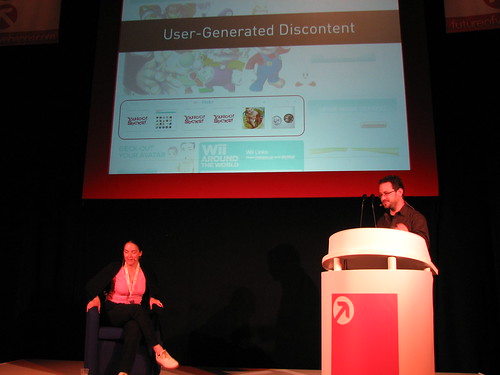
FOWA 2007 15

Heather: being the mothership, you’re always held to higher standards by your community. Do the right thing, beyond the legal requirements. Yahoo had the right to do this, but that didn’t make it “right”.

Derek: provide copious opt-outs.

FOWA 2007 17

Heather: last year, Flickr realised they were going to have to take the DB down (it was bad). So they decided to turn it into a contest instead of just displaying the “massage” message. Something like 2000 different entries. People responded really well. Gave away something like 16 Pro accounts instead of the 1 they had planned.

Derek: when you fucked up, say you fucked up. Confess. You can earn a lot of credibility like that. When you suck, own up.

FOWA 2007 18

Other example: FOWA sending out marketing e-mail to the “wrong list”, the ones who had opted out. “We screwed up!”

Don’t keep score. Here are the top… can be a really excellent way to motivate people when you’re playing a game. But with most web apps, it’s not about playing a game, it’s about sharing your photographs, telling stories… Use these scoreboards when you want to play a game. Otherwise it can actually work against your community.

Heather: Flickr interestingness. This is the only place in the Flickrverse where people are ranked. It was pretty bad when they launched (500 most…). It created aggravation and angst. Now it’s a randomly loaded page.

Derek: the goal of interestingness is to see some interesting photos. The error was showing them in a ranked order. “Hey, look how many photos are more interesting than mine!” Gaming behaviour can lead to a negative experience. (e.g. people trying to get to the front page of digg.)

Use scores where they make sense.

Heather: important to put an editorial layer on the “stuff”. “Contribute a photo of your day”: 20’000 people in the group, 7000 contributed photos, and 122 selected to be in the book. One way of bringing people to the forefront and rewarding them in a more collaborative way than just ranking.

Derek: producing print stuff is often seen as a money-maker. But actually, providing physical real-life things is actually a great motivator to encourage people to participate in your online community. JPEG Mag. Great photographers online, but never seeing anything in print. Getting published in the book was enough to get people motivated to participate in the virtual community.

Rip that band-aid (Heather): the old skool merge thing. Flickr knew at some point they would have to migrate everyone to Yahoo IDs. Waited 18 months, and at some point… it’ll be in 6 weeks. Significant change that’s difficult for the community: don’t wait 18 months. 6 weeks is a good time. Discuss about it, answer people, but then do it, hold firm. Sometimes you have to do things that are unpopular. If Flickr hadn’t waited 18 months… would probably not have been that painful.

Derek: community, manage thyself. Give people the tools they need so that they can be the community manager for you. Build tools to support that. In Flickr: I manage comments for my own photos. It’s my spot, so I’m my own community manager. Heather: it allows people to establish the guidelines for themselves.

Community expectations: Heather loves lawyers. Pages and pages of terms of service. Expectations of what your role is to be in that community. Flickr didn’t have community guidelines when it began. At some point, they understood they needed a way to put those expectations in human-readable format. “Don’t be creepy. You know the guy. Don’t be that guy.” 4-5 bullet points. Doesn’t supercede the TOS, but helps make expectations understood. Understand that nobody reads those legalese TOS.

Derek: don’t create supervillains. We usually have sites with free membership. Anybody can create an account. First community moderation tool: “boot member”. But the booted member can come back, create another free account, but this time he’s pissed. Booting people creates supervillains. Come up with clever ways to minimize their damage, contact them directly, person-to-person. Design community so one person can’t make too much damage. E.g. one site, if you get on their “bad list”, the site just gets slower and slower for you. That’s clever!

Heather: members of your community are passionate. Passionately good, and passionately… passionate.

Derek: know your audience. Eg. Tahoe thing: create your own ad. But actually, all you could do was actually add some text. So they went wild, of course. Be careful how tiny the box is you put people in. Here it was tiny, people rebelled. You couldn’t do much. Constraints are good, but if there are too many, people rebel. Also, their site was available to everybody on the internet, not just Tahoe owners.

Last and most important lesson: embrace the chaos. When you create something where people have a voice, they’ll do something you don’t expect.

Heather: small company which had 4 computers stolen, one of the laptops had PhotoBooth set up to upload automatically to Flickr. Some dude with astounding tattoos unwittingly uploaded PhotoBooth photos to the company’s Flickr stream. “OMG, this could be the guy who got our computer!” To cut a long story short, this guy was “known to the police”, and his lawyer saw a piece about this in the local paper, and told him to turn himself in… which he did.

Ex: person who used geolocating photos to spell “fuck” over Greenland. Lots of hard work there!

Incorporate these things as you go forward.

Derek: pet profiles on Friendster, which they wiped out in a week-end! Created a business opening for Dogster/Catster. When people misuse your site, they’re telling you there’s something to do there. Sometimes the misuse is the most valuable input you can get.

Q: how do you deal with requirements from the mother company regarding the way you manage your community?

A (Heather): not much has “come down”. Often, the answer is education. Talk to people — lots of misguided “requirements” come from the fact they don’t really understand your community.

Derek: design for selfishness.

Q: How do you balance community with commerce?

A (Derek): fable that community and commerce have to be separate, but that’s wrong. We talk about “commerce” a lot with our friends (products, etc). JPEG: been very upfront about “what we’re doing with your work”, “what you get out of it”. Set expectations well in the beginning.

Heather: two kinds of Flickr accounts. Pro, you don’t see ads. Is it worth the money for user X? Running a community costs money. Somebody has to pay for it. “The web is free”: to a certain extent, but when it involves huge amounts of hardware, somebody has to pay for it.

Q: (?)

A (Heather): if you have a global community, you want to ensure that people can express themselves — but when it gets member-on-member, that makes her uncomfortable (abuse). “What’s acceptable in the community?” Have a “report abuse” link in the footer of every page of the site. If you come down too hard saying “you can’t say that”… Trout-slapping. Huge question. Some people join communities just to be trolls.

Derek: if something inappropriate is happening in a global forum, create a place where it’s appropriate, and send people there to discuss it, so the rest can get on with their lives.

FOWA: What is the Future of Web Apps? (Ryan Carson, Om Malik, Michael Arrington) [en]

[fr] Notes prises à l'occasion de la conférence Future of Web Apps (FOWA) à Londres.

Here are my live notes of this Future of Web Apps (FOWA) session with Om Malik, Michael Arrington, and Ryan Carson. They are probably incomplete and may contain mistakes, though I do my best to be accurate. Chances are I’ll be adding links to extra material later on, so don’t hesitate to come back and check.

steph-note: arrived really late to this session (not quite as late as Arrington, though), so vaguely trying to pick up a few snippets here and there as I get organized for the day.

FOWA 2007 3

Gphone. Gphone. Gphone. steph-note: as I was entering the room.

Launching a DRM-free music store would be a good business idea right now. But please, says Om, not another Office clone. We have enough.

Plugins. Facebook. Organizing the buddy-list. Facebook Appls: we haven’t seen that many game-changing apps (besides Scrabble, says Om).

Om: Facebook as directory service. Ryan: critical mass. BBC/Radio4 talk about Facebook.

Arrington thinks there is a chance that Facebook will go the portable social network way. (Ryan seemed skeptical.)

Arrington: more mobile stuff, and more “virtual reality” — using your body to interact with the computer.

Om loves his Crackberry.

BarCamp Lausanne: former des « webmasters 2.0 »? [fr]

[en] Discussing the differences between skills of the old-school webmaster and the "webmaster 2.0" (eeek!) -- basically, a profile for the one to take care of site maintenance once we've done shiny 2.0 things with WordPress and plugins. It's a different skillset, and I'm not certain it's the same kind of person.

Samedi, à l’occasion du premier BarCamp Lausanne, j’ai animé une discussion sur l’avenir du métier de webmaster. Je pense que c’est un rôle qui se voit profondément transformé par l’arrivée du tout l’attirail « 2.0 », et qui est donc effectivement en voie d’extinction tel que nous le connaissons encore aujourd’hui. Je pense cependant qu’il reste une place pour ce que j’appellerai le « webmaster 2.0 », quelque part entre les consultants, développeurs, designeurs, professionnels de la communication ou autres qui se partage le gâteau 2.0.

Cela fait quelques années maintenant que « j’aide les gens à faire des sites » (c’est malheureusement principalement comme ça que je suis perçue — j’ai encore de la marge côté efforts en communication). Je me rends compte que si des outils magnifiques comme WordPress permettent de se libérer du webmaster pour de nombreuses tâches (c’est en effet un « argument de vente » : plus besoin de s’adresser au webmaster pour mettre à jour le contenu de votre site), ils ne sont tout de même pas autosuffisants : ils cessent des fois de fonctionner pour des raisons mystérieuses, il faut les mettre à jour, installer des plug-ins, faire des modifications mineures… Bref, ils requièrent de la maintenance.

Mon point de départ pour cette discussion lors de BarCamp était de mettre en regard les compétences du « webmaster » (j’expliquerai tout soudain les guillemets) avec celles qui seraient à mon avis nécessaires pour la maintenance de sites simples « 2.0 ». Ce rôle (je préfère parler de rôle plutôt que de « métier ») de webmaster disparaît-il, ou bien évolue-t-il ? S’il évolue, les compétences sont-elles assez similaires pour que ce rôle soit repris par la même personne, ou bien ce qu’il requiert un « background » différent ?

Donc, « webmaster » entre guillemets. Inévitablement, je vais parler ici en utilisant des clichés. Les webmasters qui me lisent ne se reconnaîtront probablement pas, et je le sais. Ce que je décris, c’est un des rôles un peu stéréotypés qui intervient dans l’écologie du site Web. Ce rôle (tel qu’il m’intéresse pour cette discussion) se retrouve dans des petites structures (petites entreprises, associations). Il y ait des professionnels qui portent le titre de « webmaster » dans des entreprises plus grandes ou avec plus de moyens, et qui font un travail qui n’a rien à voir avec ce que je décris ici. Le « webmaster » auquel je pense n’est souvent pas un professionnel de la branche, et ne fait probablement pas ça à temps plein. C’est quelqu’un que l’on paye à l’heure ou sous forme de forfait pour l’année, et dont on utilise les services de façon plus ou moins régulière.

Sandrine a eu la gentillesse de spontanément filmer le début de ma présentation, disponible en vidéo chez Google. Il y en a pour treize minutes, je vous laisse regarder si le coeur vous en dit.

Malheureusement, cela s’arrête lorsque la conversation démarre (le morceau le plus intéressant, à mon avis !) — j’imagine que des impératifs techniques sont entrés en ligne de compte…

Pour simplifier, même si je n’aime pas les étiquettes, j’ai proposé que l’on parle de « webmaster 1.0 » et de « webmaster 2.0 ».

Webmaster 1.0

  • FTP
  • mise à jour de contenu
  • HTML/DreamWeaver
  • scripts Perl/PHP
  • images (redimensionner, insérer dans HTML)
  • design (un peu)
  • mailing-lists/newsletter

Webmaster 2.0

  • mises à jour (versions) des « CMS 2.0 »: WordPress, Drupal, MediaWiki, PhpBB…
  • choisir et changer des thèmes/skins
  • compréhension de base du fonctionnement d’un CMS (applications Web PHP/MySQL, quelques notions de base de données, utilisation de PhpMyAdmin…)
  • (X)HTML/CSS, standards Web
  • installer des plug-ins

En fait, le rôle du webmaster 2.0 correspond un peu à celui d’un apprenti sysadmin. Cela reste un rôle technique, la gestion de la communauté étant à mon avis du ressort des personnes qui vont créer le contenu.

Ma motivation principale à tenter de définir ce rôle est en fait économique : bien sûr, un développeur ou un consultant un peu branché technique (comme moi) est tout à fait capable de remplir ce rôle de webmaster 2.0. Mais il n’est pas nécessaire d’avoir toutes les compétences d’un développeur ou d’un consultant pour faire ce genre de travail. Cela signifie qu’il ne devrait pas être nécessaire pour le client de payer du travail de maintenance relativement simple (même s’il requiert des compétences techniques qui dépassent celles de l’utilisateur lambda) à des tarifs de consulting ou de développement. Et personnellement, ce n’est pas (plus !) le genre de tâche que j’ai envie de faire pour gagner ma vie.

Mon expérience est que malheureusement, les personnes en place à jouer le rôle de webmaster 1.0 peinent souvent à acquérir par elles-mêmes les compétences nécessaires pour assurer la maintenance des sites « 2.0 » plus complexes techniquement. Si le webmaster 1.0 est souvent autodidacte, les compétences « 2.0 » sont à mon avis plus difficile à acquérir par soi-même — à moins d’être justement tellement immergé dans ces technologies que l’on est déjà un développeur.

Qui donc pourraient être ces « webmasters 2.0 » qui manquent à mon avis cruellement dans le paysage romand ? Peut-être serait-il intéressant de mettre sur pied une formation continue pour « webmasters 1.0 » ? Le problème avec ça à mon avis, ce que beaucoup de webmasters le sont à titre bénévole ou presque. Est-ce qu’il y a des CFC qui pourraient inclure ce genre de compétences à leur programme ? Pour le moment, la solution qui me paraît le plus immédiatement réaliste est de considérer ce rôle comme une étape de l’évolution professionnelle de quelqu’un. À ce moment-là, cela pourrait être un travail idéal pour des personnes en cours de formation.

Quentin Gouédard, à la tête de l’hébergeur unblog.fr, a suggéré lors de la discussion que ce genre de service pourrait être intégrée à une offre d’hébergement. C’est une idée que je trouve très intéressante.

J’aimerais revenir sur un pont qui a occupé pas mal notre discussion : il y un certain nombre de tâches de maintenance, qui même si elles sont techniques, sont encore relativement simples, et qui ne nécessitent à mon sens pas de faire intervenir des développeurs. Je pense qu’à l’avenir, on va avoir de plus en plus besoin — par intermittence probablement — de personnes ayant cet éventail de compétences, sans pour autant qu’ils aient une spécialisation plus poussée. Je pense aussi que (durant les quelques années à venir en tout cas) ces personnes devront avoir une présence locale. Le contact humain direct reste important, surtout pour des associations ou entreprises dont le métier premier n’est pas le Web.

J’ai conscience que ma réflexion n’est pas encore tout à fait aboutie. J’envisage en ce moment de former deux ou trois étudiants à qui je pourrais confier la maintenance (ou tout du moins une partie de celle-ci) des sites que je mets en place avec mes clients, pour un tarif raisonnable. Je ne peux en effet pas proposer à mes clients des solutions pour leur présence en ligne, si je n’ai rien à leur offrir côté maintenance. La maintenance ne m’intéresse personnellement pas en tant que tel, mais j’avoue ne pas avoir connaissance dans la région d’individus ou d’entreprises dont les compétences sont satisfaisantes et qui ne facturent pas des tarifs de développement (sauf ceux dont on a parlé, Samuel, et c’est justement la solution « étudiante »).

Avec un peu de chance, mes informations sont incomplètes, et quelqu’un va laisser un mot dans les commentaires en proposant ses services 🙂

Y a-t-il un webmaster (2.0) dans la salle ?

Ils parlent de cette discussion sur leur blog: